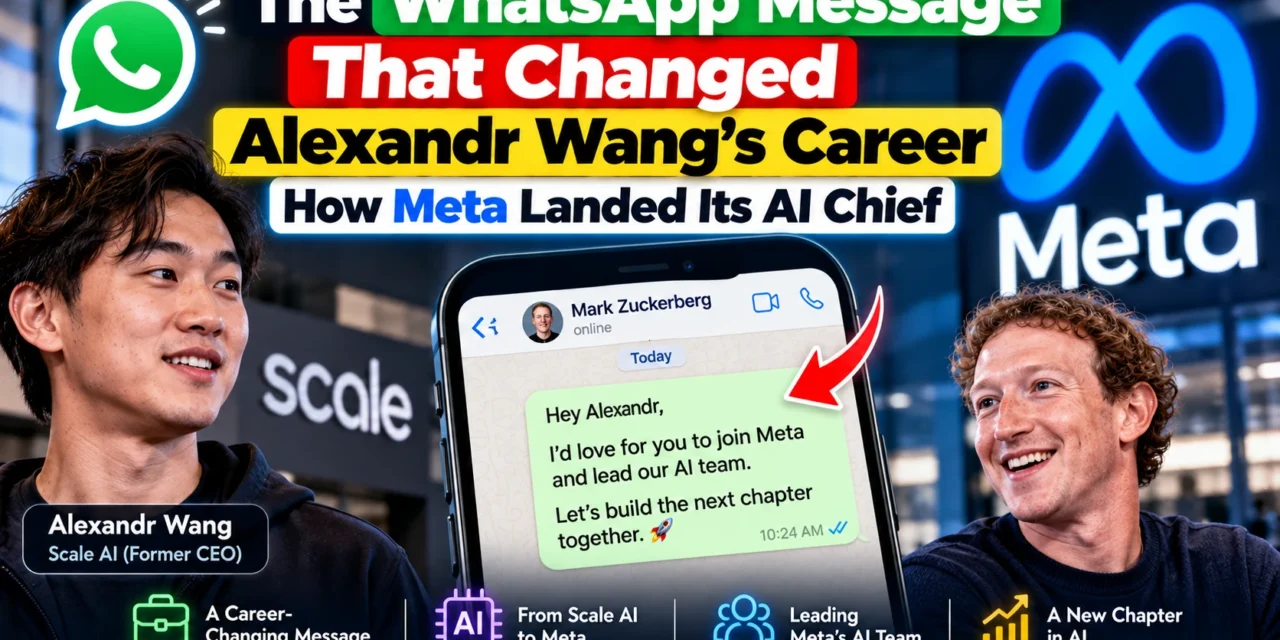
Sometimes a single short message can change a career, and a company’s future. In April 2025, Alexandr Wang, then the head of data-labeling company Scale AI, got a WhatsApp message from Mark Zuckerberg asking if he had time for a call. Within two months, Meta had invested $14.3 billion in Scale AI and put Wang in charge of its AI efforts.
This article retells the story as Wang and Zuckerberg described it on the Cheeky Pint podcast, hosted by Stripe co-founder John Collison. It covers how the hire happened, the advice Wang gave, the nerves around Meta’s giant spending, and where the effort stands now. The details come from a Times of India report dated October 19, 2026.
Quick summary
- The message: A WhatsApp message from Zuckerberg in April 2025 asking if Wang had time for a call.
- The call: It lasted 44 minutes.
- The result: Within two months, Meta invested $14.3 billion in Scale AI for a 49% stake and brought Wang in to run its AI work.
- Wang’s age: 29, an MIT dropout who built Scale AI into a key data supplier for big AI labs.
- Latest results: Muse Spark in April 2026, the Muse personal agent in September, and Muse Wonder on October 12.
How the story began
In April 2025, Wang was in a staff meeting at Scale AI when his phone buzzed. Zuckerberg’s message asked if he had time for a call. Wang says his first thought was simply “huh, interesting.”
The timing mattered. Meta had released its Llama 4 models on April 4, 2025, and the response was lukewarm. Around April 20, Zuckerberg said, he began calling people across the industry for advice on what to do next. Wang was one of them.
Timeline of events
|
When |
What happened |
|---|---|
|
April 4, 2025 |
Meta releases Llama 4 to a lukewarm response |
|
Around April 20, 2025 |
Zuckerberg starts calling industry figures for advice |
|
April 2025 |
Zuckerberg messages Wang; the call lasts 44 minutes |
|
Two days later |
Wang sends Zuckerberg a long memo |
|
Within two months |
Meta invests $14.3 billion in Scale AI for 49% and hires Wang |
|
End of 2025 |
Meta prepares for a giant spending commitment |
|
April 2026 |
Muse Spark is released |
|
September 8, 2026 |
Muse personal agent app launches |
|
October 12, 2026 |
Muse Wonder, Meta’s first frontier-class model, is released |
Wang’s memo: fewer, better people
Two days after the call, Wang sent Zuckerberg a long memo explaining what he would do in Zuckerberg’s position. The first point was about people. According to Zuckerberg, it said that you don’t need a lot of them, and that talent density is what matters.
That idea still shapes Meta Superintelligence Labs:
- Its core research team is under 200 people, closer to 100, according to Wang.
- That sits inside a company of roughly 75,000 employees.
Why the hire raised eyebrows
Wang is 29 and dropped out of MIT. He built Scale AI into a major supplier of data to AI labs, but he had never trained a frontier model. Collison pointed this out during the show.
Zuckerberg said he spoke with research heads at all the major labs before deciding, and came away convinced that Wang was the person for the job.
The recruiting sprint
What followed was a hiring push Zuckerberg called a “supernova.” He cleared his calendar for a month or two just to meet researchers. He said neither of them slept much in the first couple of months.
Wang also recalled an early meeting that left him uneasy. When he said Meta’s first priority should be a strong reasoning model, one of the existing leads asked whether consumers even needed one. Wang called Nat Friedman, now head of Meta’s AI products, right afterward.
The high-stakes spending
By the end of 2025, the numbers had grown huge. Zuckerberg said Meta was preparing to commit something like $100 billion to $200 billion before anyone had seen the new models. He recalled asking Wang whether he was sure it would work.
At an executive gathering in Hawaii, Wang said Chief Financial Officer Susan Li pulled him aside several times to stress the stakes: if the effort worked, everything would be great, but if it failed, the outcome would be very bad. Wang admitted that at the time all he had to show was a “vibe report” on research progress and a few plots.
What the bet has produced
|
Product |
Date |
Notes |
|---|---|---|
|
Muse Spark |
April 2026 |
First model from the new effort |
|
Muse (personal agent app) |
September 8, 2026 |
Climbed to the top of Apple’s App Store within days |
|
Muse Wonder |
October 12, 2026 |
Meta’s first model it calls frontier-class; currently behind paid Muse subscriptions |
Fun details from the podcast:
- Wang named his own Muse agent Oiler. Every week it buys increasingly obscure teas from farms in Taiwan and Japan.
- Zuckerberg uses his to critique his MMA technique during the one-minute breaks between rounds.
What is the culture like?
Zuckerberg said the team was very critical of its own work along the way. Wang describes the lab as a room full of “insecure overachievers.”
Asked what kind of boss Zuckerberg is, Wang called him “very Bayesian.” In plain terms, that means he updates his beliefs when he learns something new and then moves the whole company to match. The WhatsApp message and 44-minute call are an example of that style.
Lessons from the story
- Small teams can be powerful. Meta’s core research group is tiny compared with the whole company.
- Moving quickly matters. From a first call to a multibillion-dollar deal took about two months.
- Big bets come with real fear. Even insiders worried about whether the spending would pay off.
- Setbacks can start new chapters. A lukewarm Llama 4 launch led to a complete reset.
- Reach out directly. A short, simple message started the biggest shift in Meta’s AI strategy.
Things to keep in mind
- It’s a retelling. Wang and Zuckerberg told the story themselves, so details reflect their memories and views.
- Results are still unfolding. Muse Wonder is new, and its real-world performance is still being tested.
- The financial pressure continues. Meta’s spending remains huge, and investors are watching closely.
Frequently asked questions
What was the WhatsApp message? A short note from Zuckerberg asking Wang if he had time for a call.
How much did Meta invest in Scale AI? $14.3 billion for a 49% stake.
How old is Alexandr Wang? 29.
What is Muse Wonder? Meta’s first model it calls frontier-class, released on October 12 and currently behind paid Muse subscriptions.
How big is Meta’s core AI research team? Under 200 people, closer to 100, according to Wang.
Where was the story told? On the Cheeky Pint podcast, hosted by John Collison.
Conclusion
A five-word message started a chain of events that reshaped Meta’s AI strategy: a giant investment, a new lab built on a small group of top talent, and a series of Muse products. Whether the bet pays off in the long run is still an open question, but the story shows how quickly a company can change course when its leaders are willing to act.
Note: This article is based on a Times of India Tech Desk report dated October 19, 2026, rewritten in my own words. Quotes and details reflect the speakers’ own account on the podcast.