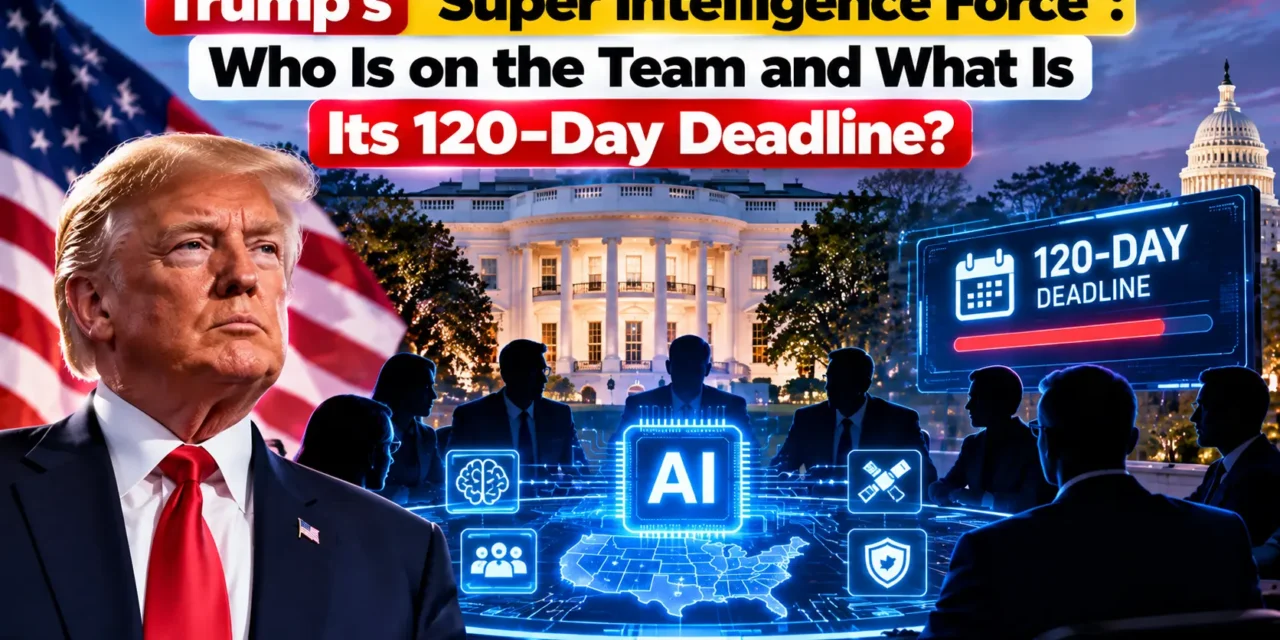
The White House has created a new task force to coordinate how the US government handles artificial intelligence. President Donald Trump calls it the “Super Intelligence Force,” and it has 120 days to report back on the risks and rules around advanced AI.
This article explains what has been reported about who leads it, who is on the team, what it will study, and what critics are saying. The White House has not released detailed information, so much of this comes from media reports of the group’s charter.
Quick summary
- What it is: A federal task force to coordinate US government AI strategy.
- Who leads it: Jay Clayton, named by Trump as his AI czar in early October and identified in reports as the National Intelligence Director.
- Deadline: 120 days to submit a report to the president.
- Background: It follows a September 29 executive order that adopted the term “super intelligence” for AI.
- Criticism: Some Democrats say a task force can’t replace enforceable safeguards.
Why was it created?
The announcement follows Trump’s meeting with leading AI executives in late September. It comes as the US debates how to deal with the risks of advanced AI without slowing down innovation. Trump has described AI as a change that could be bigger than the Industrial Revolution and the internet. Washington also wants to keep its edge in the global technology race.
The task force also connects to the recent wording change. A September 29 executive order adopted “super intelligence” as the government’s term for AI, and the new group carries that name.
Who is on the team?
According to reports on the charter:
|
Role |
Person |
|---|---|
|
Chair |
Jay Clayton, AI czar and National Intelligence Director |
|
Vice chair |
Andrew Ferguson, FTC Chairman |
|
Vice chair |
Emil Michael, Undersecretary of Defense for Research and Engineering |
|
Vice chair |
Scott Kupor, Director of the Office of Personnel Management |
|
Member |
Vice President JD Vance |
|
Member |
Defense Secretary Pete Hegseth |
|
External participant |
David Sacks, former AI czar |
|
External participant |
Condoleezza Rice, former secretary of state |
The group will send its findings to Trump and White House Chief of Staff Susie Wiles.
What will the task force do?
The White House hasn’t shared full details, but reports describe these areas of focus.
Risks it will examine
- Financial services
- Energy infrastructure
- Transportation
- Agriculture
- Emergency services
- Biosecurity threats
- Risks to the water supply
Who it will work with
It will coordinate with federal agencies, including:
- The Pentagon
- The Justice Department
- The Department of Homeland Security
- The Federal Trade Commission
The goal is to develop recommendations for improving the government’s response to new threats.
A possible reporting rule
Media reports say the charter proposes looking at whether AI labs should be legally required to tell the government about:
- Security breaches
- Hacking incidents
- Attempts to bypass the safeguards in their systems
This is only a proposal to study, not a rule.
The 120-day deadline
The task force must give Trump a report within 120 days. The report is expected to cover:
- AI risks
- Cybersecurity
- Civil liberties
- Standards for advanced AI models
- The possible consequences of too much regulation
That last item shows the balance Trump says he wants. He has said regulation should not stifle AI development.
How might AI be governed?
Clayton has said he expects AI governance to develop through dialogue. He pointed to the risk-management models used by the Securities and Exchange Commission and the Federal Reserve as examples. In other words, the approach may lean toward ongoing cooperation between government and industry, not only strict new laws.
What are critics saying?
Some Democrats have questioned the initiative:
- Rep. Lori Trahan told CNN that it lacks a lasting strategy backed by authorization from Congress.
- Rep. Josh Gottheimer asked whether it would produce real protections or be mainly a public-relations effort.
Their main argument is that a task force cannot replace enforceable safeguards. Supporters would likely respond that a study group is a sensible first step before writing detailed rules.
Why this matters
- It shows AI is a national priority. The task force includes defense, justice, trade, and homeland security leaders.
- It sets a timeline. A 120-day deadline means recommendations could arrive early next year.
- It affects AI companies. Possible reporting rules for security incidents could change how labs operate.
- It reflects a balancing act. The government wants to manage risks while staying ahead in the AI race.
Things to keep in mind
- Details are limited. The White House has not published a full description.
- Reports may change. The charter details come from media reports.
- A report is not a law. The task force makes recommendations, and new rules would need further action.
- Views differ. Supporters and critics disagree on how much regulation is needed.
Frequently asked questions
What is the Super Intelligence Force? A federal task force created to coordinate the US government’s AI strategy.
Who leads it? Jay Clayton, whom Trump named his AI czar in early October.
How long does it have? 120 days to submit a report to the president.
What is the “super intelligence” wording about? A September 29 executive order adopted the term for artificial intelligence. It is a naming choice and does not describe a new kind of technology.
Will it create new AI laws? Not directly. It will make recommendations, and any new rules would need further action.
Why are Democrats critical? Some say a task force can’t replace enforceable safeguards and want a strategy backed by Congress.
Conclusion
The Super Intelligence Force is the Trump administration’s attempt to bring AI policy under one roof. With a broad team, a wide list of risks to study, and a 120-day clock, it will shape how the US approaches advanced AI. Whether it leads to real protections or mostly serves as a high-profile review is something the final report, and what follows it, will show.
Note: This article is based on a Hindustan Times report dated October 16, 2026, rewritten in my own words. Details come from media reports of the charter and may change.