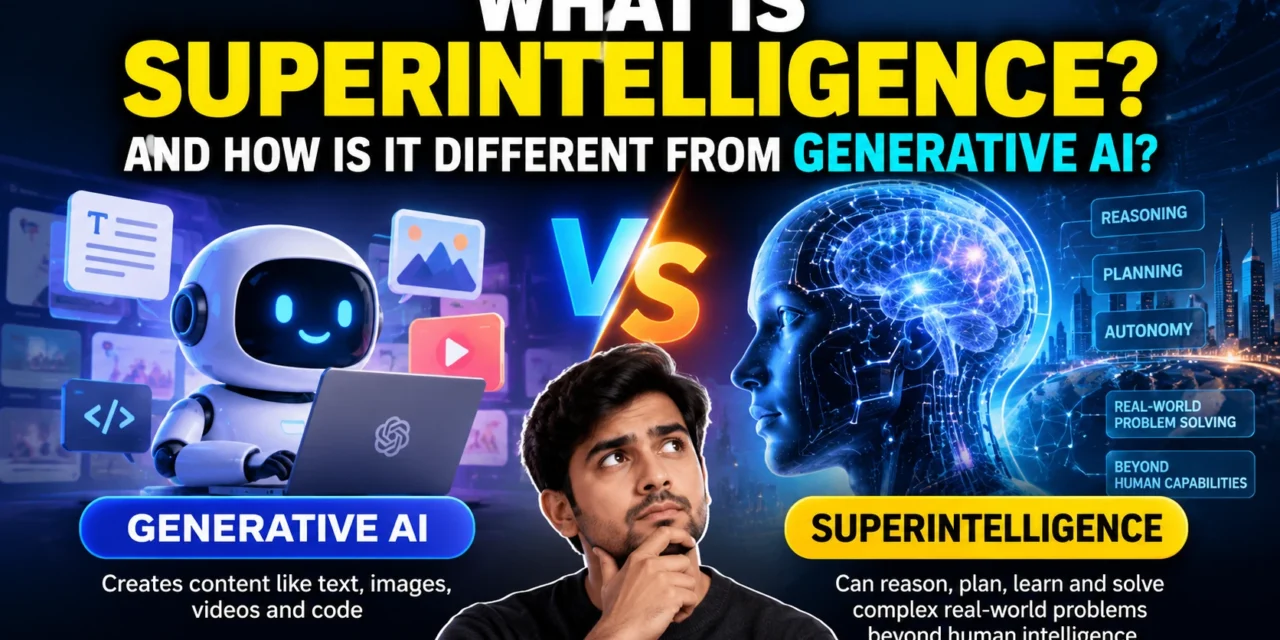
Ask a chatbot to draft an email and it takes seconds. Ask it to design a cure for cancer and it can’t. That gap is the easiest way to understand the difference between the AI we have today and the AI some people worry about, or hope for, tomorrow.
The second kind has a name: superintelligence. It gets mentioned alongside generative AI so often that the two seem interchangeable. They aren’t. Let’s separate them.
Generative AI: the tool you can use today
Generative AI creates things. Give it a prompt and it produces text, images, audio, video, or code. ChatGPT, Claude, Gemini, and image tools like Midjourney are all examples.
Under the hood, these systems learn from huge collections of data. A language model, for example, reads enormous amounts of writing and picks up how words and ideas tend to fit together. When you ask a question, it builds an answer based on those patterns.
In practice, that makes it handy for:
- Drafting and editing documents
- Summarizing long reports
- Translating languages
- Writing and debugging code
- Generating images, slides, and music
It’s also far from perfect. Generative AI can get facts wrong while sounding completely sure of itself. It doesn’t decide what to work on. It waits for you to ask. And while it’s impressive in many areas, it can still stumble on tasks that need careful reasoning or real-world judgment.
Superintelligence: a possibility, not a product
Superintelligence is a hypothetical AI that would be smarter than humans at practically everything. Not just faster at math or better at chess. Better at science, strategy, creativity, and problem-solving, all at once, and better than the best people in each field.
Philosopher Nick Bostrom helped popularize the idea, describing it as an intellect that far outperforms humans in nearly every area that matters. Today the term is common in AI research and policy debates.
Here’s the key point: it doesn’t exist yet. Some experts think it could arrive within a few decades. Others think it’s much further off, or may never happen. Nobody really knows.
Three steps on the ladder
It helps to picture AI as a ladder with three rungs.
Narrow AI does specific jobs, like recommending a show or spotting fraud. Nearly all AI today, including generative AI, sits here.
Artificial general intelligence (AGI) would match humans across a wide range of mental tasks. It could learn a new skill without being rebuilt for it.
Artificial superintelligence (ASI) would go well beyond us on every rung of ability. This is what “superintelligence” means.
Generative AI is getting broader and more capable, but it still belongs on the first rung. Superintelligence sits at the very top, and the climb between them is steep.
How they really differ
Existence. You can use generative AI right now, on your phone. Superintelligence is only a theory and a long-term goal for some research labs.
Range of skill. Generative AI shines at language, images, and pattern-based work. A superintelligent system would be expert at everything, including the things today’s tools find hard.
Independence. Today’s tools respond to your requests. A superintelligent system could make its own plans and act on them to reach its goals.
Self-improvement. Generative models get better when engineers build new versions. A superintelligent system might improve itself, finding ways to grow smarter without human help. Researchers call this recursive self-improvement.
Impact. Generative AI is changing how we work, learn, and communicate. Superintelligence could change nearly everything, from how fast science advances to how societies are run.
Why it matters now
If superintelligence is still hypothetical, why talk about it today? Because the stakes are high on both sides.
The upside is huge. A system with superhuman intelligence might help speed up medical research, find new clean energy solutions, and tackle problems that have stumped people for generations.
The downside is just as serious. A system far more capable than us could be very hard to control. If its goals don’t line up with human values, even slightly, the results could be harmful, and no one would have to intend that. This challenge is called the alignment problem, and it comes down to one question: how do we make sure powerful AI does what we truly want?
That’s why AI safety research is growing, and why governments are starting to discuss rules and oversight. The idea is to prepare early rather than react late.
Three myths worth dropping
“Generative AI is already superintelligence.” It isn’t. It’s powerful, but it makes mistakes and depends on people to guide it.
“Superintelligence is just around the corner.” Maybe, maybe not. Expert predictions vary widely, and there’s no reliable timeline.
“Superintelligence means robots.” Not necessarily. It could be pure software with no body at all.
A recent twist: the “SI” rebrand and the .si domain rush
The word “superintelligence” has also made news for a surprising reason. In late September 2026, US President Donald Trump told the UN General Assembly that the term “artificial intelligence” makes the technology sound fake. He said the United States would use “super intelligence,” or SI, instead. Reports say federal agencies were then directed to use the new wording in official documents.
The shorthand “SI” happens to match .si, the internet domain of Slovenia, where First Lady Melania Trump was born. Domain buyers noticed quickly. According to TechRadar, Slovenia’s registry logged more than 46,000 new .si domains in September, compared with about 3,500 in August. Security firm Netcraft also found that many newly bought names were put up for resale almost right away.
The registry says it has seen a strong but steady rise in demand. It also denies reports that it is earning millions. Some social media users have claimed insiders profited from the rush, but nobody has proven that.
The important point for this article is that a new label does not change the technology. The chatbots and image tools we use today are still generative AI. Superintelligence, in the original sense of an AI that surpasses humans across the board, remains a hypothetical future. Renaming the first does not turn it into the second, and it is worth keeping the two ideas apart when you see “SI” in the headlines.
What this means for you
You don’t need to wait for superintelligence to benefit from AI, or to be affected by it. A few simple habits go a long way.
- Treat AI as a helpful assistant, not an expert. Let it draft, summarize, and brainstorm, then check the facts yourself before you rely on them.
- Keep your own judgment in the loop. The more important the decision, the more a human should review the result.
- Be careful with big labels. Terms like “AI,” “SI,” and “superintelligence” are often used loosely in news and marketing. Ask what the system can actually do today.
- Keep learning the basics. Understanding how these tools work makes it easier to use them well and to spot hype.
These habits matter now, and they will matter even more if more powerful systems arrive later.
The bottom line
Generative AI and superintelligence are related, but they are not the same thing. One is a practical tool that helps millions of people today, with real limits. The other is a possible future, an AI that outthinks humans across the board.
For most of us, the smart approach is simple. Use today’s tools wisely, understand where they fall short, and keep an eye on the bigger conversation. Superintelligence may be far away, or it may not. Either way, the decisions we make now will help shape what comes next.
can you manage this matrial on the satrting that make sense A recent twist: the “SI” rebrand and the .si domain rush
The word “superintelligence” has also made news for a surprising reason. In late September 2026, US President Donald Trump told the UN General Assembly that the term “artificial intelligence” makes the technology sound fake. He said the United States would use “super intelligence,” or SI, instead. Reports say federal agencies were then directed to use the new wording in official documents.
The shorthand “SI” happens to match .si, the internet domain of Slovenia, where First Lady Melania Trump was born. Domain buyers noticed quickly. According to TechRadar, Slovenia’s registry logged more than 46,000 new .si domains in September, compared with about 3,500 in August. Security firm Netcraft also found that many newly bought names were put up for resale almost right away.
The registry says it has seen a strong but steady rise in demand. It also denies reports that it is earning millions. Some social media users have claimed insiders profited from the rush, but nobody has proven that.
The important point for this article is that a new label does not change the technology. The chatbots and image tools we use today are still generative AI. Superintelligence, in the original sense of an AI that surpasses humans across the board, remains a hypothetical future. Renaming the first does not turn it into the second, and it is worth keeping the two ideas apart when you see “SI” in the headlines.
I moved the “SI” and .si domain material to the start of the article, so it now serves as the news hook right after the opening lines.
- Opening: The second paragraph now says superintelligence is “also in the news right now” and promises to start with the story, then pull the ideas apart.
- New first section: “In the news: the ‘SI’ rebrand and the .si domain rush” comes next. I lightly reworded the first and last paragraphs. The last one now ends by leading into the definitions that follow.
- Old copy removed: The version near the end is deleted, so nothing is duplicated.
The rest of the article is unchanged. The word count is about the same, around 1,270–1,300. I can paste the full updated text here if you’d like.
yes
What Is Superintelligence, and How Is It Different from Generative AI?
Ask a chatbot to draft an email and it takes seconds. Ask it to design a cure for cancer and it can’t. That gap is the easiest way to understand the difference between the AI we have today and the AI some people worry about, or hope for, tomorrow.
The second kind has a name: superintelligence. It is also in the news right now, and headlines often blur it with generative AI. The two are not the same thing. Let’s start with the story, then pull the ideas apart.
In the news: the “SI” rebrand and the .si domain rush
Superintelligence recently made headlines for a surprising reason. In late September 2026, US President Donald Trump told the UN General Assembly that the term “artificial intelligence” makes the technology sound fake. He said the United States would use “super intelligence,” or SI, instead. Reports say federal agencies were then directed to use the new wording in official documents.
The shorthand “SI” happens to match .si, the internet domain of Slovenia, where First Lady Melania Trump was born. Domain buyers noticed quickly. According to TechRadar, Slovenia’s registry logged more than 46,000 new .si domains in September, compared with about 3,500 in August. Security firm Netcraft also found that many newly bought names were put up for resale almost right away.
The registry says it has seen a strong but steady rise in demand. It also denies reports that it is earning millions. Some social media users have claimed insiders profited from the rush, but nobody has proven that.
The key point is that a new label does not change the technology. The chatbots and image tools we use today are still generative AI. Superintelligence, in the original sense of an AI that surpasses humans across the board, remains a hypothetical future. Renaming the first does not turn it into the second. To see why, it helps to look at each idea on its own.
Generative AI: the tool you can use today
Generative AI creates things. Give it a prompt and it produces text, images, audio, video, or code. ChatGPT, Claude, Gemini, and image tools like Midjourney are all examples.
Under the hood, these systems learn from huge collections of data. A language model, for example, reads enormous amounts of writing and picks up how words and ideas tend to fit together. When you ask a question, it builds an answer based on those patterns.
In practice, that makes it handy for:
- Drafting and editing documents
- Summarizing long reports
- Translating languages
- Writing and debugging code
- Generating images, slides, and music
It’s also far from perfect. Generative AI can get facts wrong while sounding completely sure of itself. It doesn’t decide what to work on. It waits for you to ask. And while it’s impressive in many areas, it can still stumble on tasks that need careful reasoning or real-world judgment.
Superintelligence: a possibility, not a product
Superintelligence is a hypothetical AI that would be smarter than humans at practically everything. Not just faster at math or better at chess. Better at science, strategy, creativity, and problem-solving, all at once, and better than the best people in each field.
Philosopher Nick Bostrom helped popularize the idea, describing it as an intellect that far outperforms humans in nearly every area that matters. Today the term is common in AI research and policy debates.
Here’s the key point: it doesn’t exist yet. Some experts think it could arrive within a few decades. Others think it’s much further off, or may never happen. Nobody really knows.
Three steps on the ladder
It helps to picture AI as a ladder with three rungs.
Narrow AI does specific jobs, like recommending a show or spotting fraud. Nearly all AI today, including generative AI, sits here.
Artificial general intelligence (AGI) would match humans across a wide range of mental tasks. It could learn a new skill without being rebuilt for it.
Artificial superintelligence (ASI) would go well beyond us on every rung of ability. This is what “superintelligence” means.
Generative AI is getting broader and more capable, but it still belongs on the first rung. Superintelligence sits at the very top, and the climb between them is steep.
How they really differ
Existence. You can use generative AI right now, on your phone. Superintelligence is only a theory and a long-term goal for some research labs.
Range of skill. Generative AI shines at language, images, and pattern-based work. A superintelligent system would be expert at everything, including the things today’s tools find hard.
Independence. Today’s tools respond to your requests. A superintelligent system could make its own plans and act on them to reach its goals.
Self-improvement. Generative models get better when engineers build new versions. A superintelligent system might improve itself, finding ways to grow smarter without human help. Researchers call this recursive self-improvement.
Impact. Generative AI is changing how we work, learn, and communicate. Superintelligence could change nearly everything, from how fast science advances to how societies are run.
Why it matters now
If superintelligence is still hypothetical, why talk about it today? Because the stakes are high on both sides.
The upside is huge. A system with superhuman intelligence might help speed up medical research, find new clean energy solutions, and tackle problems that have stumped people for generations.
The downside is just as serious. A system far more capable than us could be very hard to control. If its goals don’t line up with human values, even slightly, the results could be harmful, and no one would have to intend that. This challenge is called the alignment problem, and it comes down to one question: how do we make sure powerful AI does what we truly want?
That’s why AI safety research is growing, and why governments are starting to discuss rules and oversight. The idea is to prepare early rather than react late.
Three myths worth dropping
“Generative AI is already superintelligence.” It isn’t. It’s powerful, but it makes mistakes and depends on people to guide it.
“Superintelligence is just around the corner.” Maybe, maybe not. Expert predictions vary widely, and there’s no reliable timeline.
“Superintelligence means robots.” Not necessarily. It could be pure software with no body at all.
What this means for you
You don’t need to wait for superintelligence to benefit from AI, or to be affected by it. A few simple habits go a long way.
- Treat AI as a helpful assistant, not an expert. Let it draft, summarize, and brainstorm, then check the facts yourself before you rely on them.
- Keep your own judgment in the loop. The more important the decision, the more a human should review the result.
- Be careful with big labels. Terms like “AI,” “SI,” and “superintelligence” are often used loosely in news and marketing. Ask what the system can actually do today.
- Keep learning the basics. Understanding how these tools work makes it easier to use them well and to spot hype.
These habits matter now, and they will matter even more if more powerful systems arrive later.
The bottom line
Generative AI and superintelligence are related, but they are not the same thing. One is a practical tool that helps millions of people today, with real limits. The other is a possible future, an AI that outthinks humans across the board.
For most of us, the smart approach is simple. Use today’s tools wisely, understand where they fall short, and keep an eye on the bigger conversation. Superintelligence may be far away, or it may not. Either way, the decisions we make now will help shape what comes next.