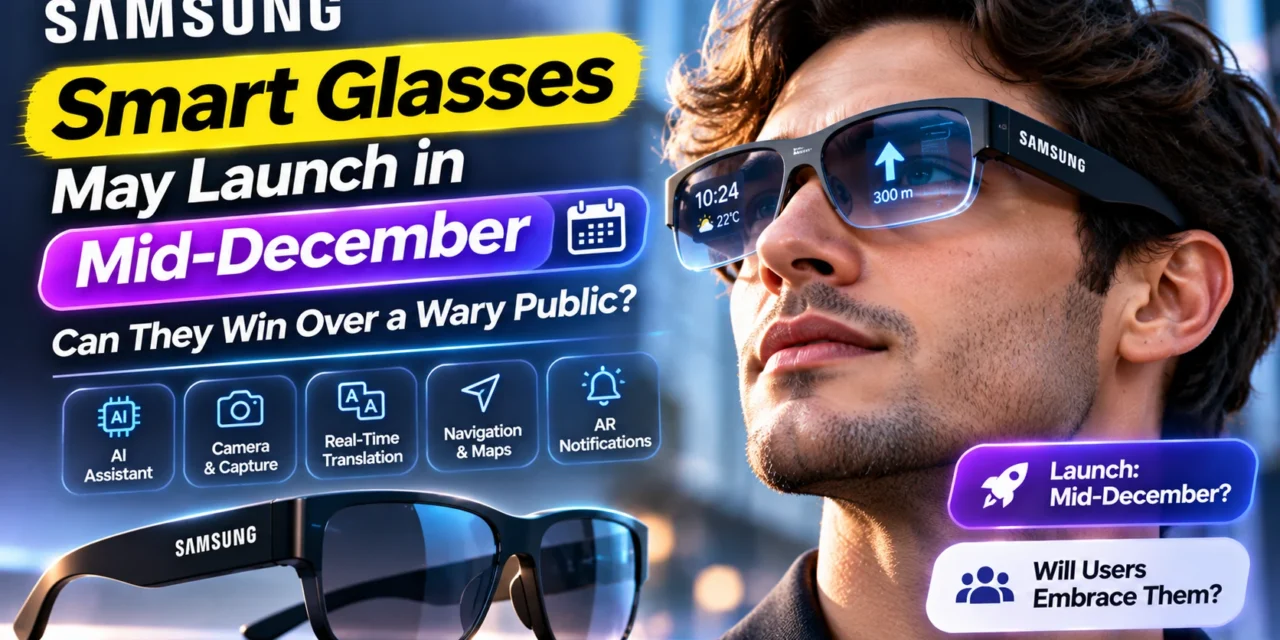
Samsung’s long-teased smart glasses may finally be close to release, but the timing could be tricky. A report says the glasses could go on sale in mid-December, just as public concern and government pressure around smart glasses are growing.
This article explains what has been reported, what is still unknown, and why the climate around smart glasses is changing. The details come from a Gizmodo report dated November 2, 2026, which cites the South Korean newspaper Chosun Ilbo. Samsung has not confirmed the date, so treat it as unofficial.
Quick summary
- The report: Chosun Ilbo, citing electronics industry sources, says Samsung’s smart glasses will go on sale in mid-December.
- Where first: The US and South Korea only, at least at the start.
- Partner: Samsung is making the glasses with Gentle Monster. They were first announced in May.
- Still unknown: Price and other key details.
- The challenge: Rising public pushback and government action against smart glasses.
What has been reported about the launch?
|
Detail |
Status |
|---|---|
|
Release timing |
Mid-December, a bit later than previously expected (unofficial) |
|
Regions |
US and South Korea first |
|
Price |
Not known |
|
Official confirmation |
None yet from Samsung |
Gizmodo says this is the most concrete date seen so far, but it is not a confirmed timeline from Samsung. Price may be the biggest factor in how well Samsung can compete with rivals such as Meta.
Why is the timing difficult?
When Samsung first announced the glasses in May, pushback against smart glasses was noticeable but not overwhelming. Gizmodo says that things have changed since then.
Growing public concern
- Less permissive attitudes. Pushback from celebrities such as Lorde has added to public unease.
- Misuse stories. Accounts of people misusing the devices have appeared around the world.
Regulators are stepping in
The action has been strongest in Europe, according to the report:
|
Place |
Action |
|---|---|
|
Norway |
A national ban is being considered |
|
Hamburg, Germany |
A citywide ban was recently enacted |
These bans apply to public spaces. In the US, restrictions so far have focused on sensitive places such as courtrooms and schools.
US lawmakers are paying attention
- Last week, US senators demanded answers from Meta about its privacy practices for smart glasses.
- The questions include the collection of user data to train AI. The report says this has led some Meta contractors to see video of sensitive moments, such as people being naked or using the bathroom.
- Lawmakers have not called for regulation yet, but at least a couple of senators are beginning to see smart glasses as a privacy risk.
What does this mean for Samsung?
Gizmodo’s view is that Samsung is entering at an interesting, and uncertain, time.
- Competing on technology is not enough. Even if the glasses are a strong competitor to Meta’s lineup, there is no guarantee Samsung will handle restrictions any better if they arrive.
- Price will matter. It may decide how Samsung stacks up against Meta.
- Reputation is a factor. Concerns over privacy and misuse affect every company in the category.
- Samsung looks set to go ahead anyway. The article says the company will soon be testing the waters despite backlash and regulation.
Why are smart glasses so controversial?
- Hidden recording. Cameras and microphones in everyday glasses can capture people without them noticing.
- Data collection. Data from the glasses may be used to train AI.
- Public spaces and sensitive places. Cafes, schools, courtrooms, and changing areas raise special concerns.
- Consent. People nearby usually cannot tell what is being recorded or stored.
What should buyers consider?
If you are thinking about smart glasses from any brand, consider these points.
- Check the privacy policy. See what data is collected, stored, and used to train AI.
- Look for clear recording indicators. A visible light helps people nearby know when recording happens.
- Know the local rules. Restrictions vary by country, city, and place.
- Respect others. Ask permission before recording, and remove the glasses in private or sensitive spaces.
- Compare features and price once Samsung confirms details.
- Consider audio-only options if you want to avoid a camera.
Things to keep in mind
- The date is unofficial. It comes from an anonymous-source report.
- Details could change. Regions, timing, and features may shift.
- Opinion in the article. Gizmodo’s view that the timing is poor is analysis, not fact.
- Rules may tighten. Regulation could affect how and where the glasses can be used.
Frequently asked questions
When will Samsung’s smart glasses launch? A report says mid-December, but Samsung has not confirmed it.
Where will they be sold? The report says the US and South Korea first.
Who makes them? Samsung, in partnership with Gentle Monster.
How much will they cost? Unknown. Price has not been announced.
Why is the timing seen as poor? Because public concern and regulation around smart glasses are growing, including bans in Hamburg and a proposed national ban in Norway.
Are smart glasses banned in the US? Not nationally. US restrictions have mostly focused on places like courtrooms and schools.
Conclusion
Samsung’s smart glasses may arrive just as the public and lawmakers are asking harder questions about wearable cameras. Whether they succeed will depend on price, features, and how well Samsung addresses privacy concerns. For now, the date is unconfirmed, and buyers should wait for official details.
Note: This article is based on a Gizmodo report by James Pero dated November 2, 2026, which cites Chosun Ilbo, rewritten in my own words. The launch date is unconfirmed by Samsung.