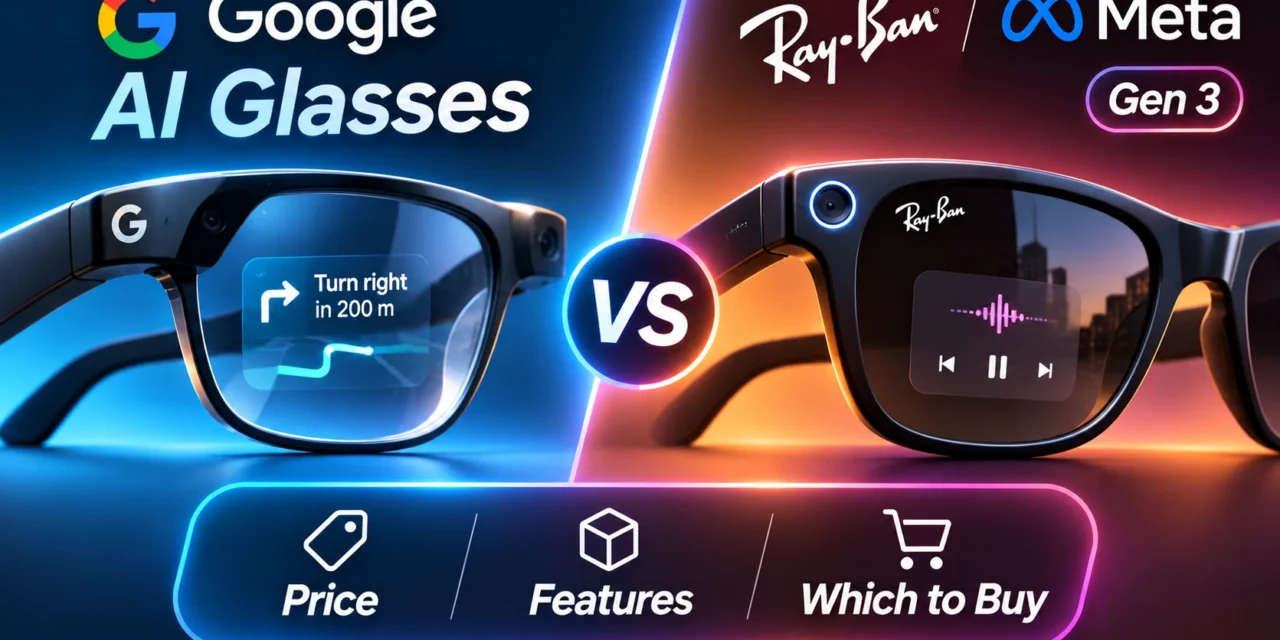
Google and Samsung’s Gemini-powered smart glasses go on sale in December, a few weeks after preorders opened. They aim to take on Ray-Ban Meta Gen 3, which you can already buy. The Google pair starts $54 cheaper, but waiting has a cost, and compatibility rules could rule some buyers out.
This article covers how the two compare on price, AI, hardware, phone support and privacy. The details come from a TechRepublic comparison by Kezia Jungco, dated November 17, 2026, which draws on Google’s, Samsung’s and Meta’s own announcements. Most specs are manufacturer claims, so treat them as unverified until independent reviews arrive.
Quick summary
- What’s new: Google’s Intelligent Eyewear, built by Samsung and Google, with frames from Warby Parker and Gentle Monster.
- Price: Warby Parker models start at $395. Gentle Monster models run from $449 to $489. Ray-Ban Meta Gen 3 costs $449.
- Dates: Preorders opened November 12, and the release is December 10.
- AI assistants: Gemini on Google’s glasses, Meta AI on Ray-Ban Meta.
- Biggest catch: Google’s glasses need an eligible Google account tied to the US or South Korea, and the user must be 18 or older.
Key facts at a glance
| Area | Google AI Glasses | Ray-Ban Meta Gen 3 |
|---|---|---|
| Starting US price | $395 (Warby Parker), $449 (Gentle Monster) | $449 |
| Availability | Preorder, ships Dec. 10 | Available now |
| Assistant | Gemini | Meta AI |
| Camera | 12MP | 12MP |
| Video | Up to 3K at 30 fps | Up to 3K at 30 fps |
| Microphones | Four | Six |
| Battery | Up to nine hours | Up to nine hours |
| Charging case | Up to 72 hours total | Up to 50 extra hours |
| Storage | 64GB | 32GB |
1. Gemini vs. Meta AI
Google’s main pitch is how well the glasses plug into services people already use. You can ask Gemini about what you’re looking at, translate a conversation, or follow Google Maps directions by voice. On supported Galaxy phones, it can read a whiteboard, summarize it and save the notes to Samsung Notes.
Ray-Ban Meta Gen 3 offers similar visual help, voice commands and live translation, but leans on Meta’s own apps like WhatsApp, Messenger and Instagram. Meta also added a customizable action button at its September launch, so you can trigger a function without speaking.
The comparison’s verdict is that neither assistant wins for everyone. It comes down to which ecosystem you already live in.
2. Camera, battery and comfort
The camera specs match on paper. Google adds HDR photos and video stabilization, while Meta offers slow motion and hyperlapse modes. Meta has six microphones to Google’s four, though more microphones don’t guarantee better call quality.
Storage favors Google, with 64GB against 32GB. Battery life per charge is the same at up to nine hours, but the case figures aren’t directly comparable. Google quotes 72 hours in total, while Meta quotes 50 hours of additional charge. Google’s frames weigh about 40 to 44 grams, and Meta’s standard Wayfarer Gen 3 is around 51.5 grams with adjustable temple tips. Both support prescription lenses, with options varying by frame.
3. Compatibility and account rules
This is where Google’s glasses get tricky. They work with selected Pixel and Galaxy phones and compatible iPhones, with minimum software and hardware requirements. Activation needs an eligible Google account linked to the US or South Korea, and the user must be 18 or over.
Some features, including Guided Vision and Aira visual assistance, need a compatible Android phone at launch. An iPhone owner could have a supported device and still miss some advertised features. Ray-Ban Meta also needs a compatible phone, a Meta account and the Meta AI app, and its AI features vary by country.
4. Privacy
Google says its glasses include recording indicators, camera permission controls and automatic blurring of bystanders’ faces during Gemini visual queries. It also says images from those queries aren’t used to train AI models or target ads. Meta’s glasses have an outward-facing recording light to warn people nearby.
TechRepublic’s view is that neither product has shown a clear privacy edge. If you plan to wear camera glasses at work, check whether your office allows them first.
What this says about wearable AI
- Glasses are becoming a mainstream AI device. Two big companies are now competing on price and features.
- The assistant is the real product. The hardware is almost identical, so the ecosystem matters most.
- Price is tightening. A $54 gap at the entry level puts pressure on Meta.
- Regional limits are the new friction. Account and country rules may decide who can buy.
Why this matters
- For Android and Google users: Gemini and Maps integration could make Google’s pair the natural choice.
- For WhatsApp and Instagram users: Meta’s glasses fit existing habits.
- For buyers outside the US and South Korea: Google’s glasses may not work for you yet.
- For workplaces: Camera glasses raise policy and confidentiality questions.
Things to keep in mind
- Specs are manufacturer claims. Battery numbers are estimates and depend on use.
- Case battery figures differ in meaning. Total hours and extra hours aren’t the same measure.
- No independent tests exist yet for Google’s glasses, since they haven’t shipped.
- Feature support varies by phone. Check the full list before ordering.
- Prices and details may change before the December release.
Tips if you want to buy
- Confirm your phone and Google account are eligible before preordering.
- Decide whether waiting until December 10 is worth $54.
- Wait for camera, call and battery reviews if those matter most.
- Review each company’s data policy before wearing them at work.
- Check your prescription lens options for the exact frame you want.
Frequently asked questions
How much do Google’s AI glasses cost? Warby Parker models start at $395, and Gentle Monster models range from $449 to $489.
When can I get them? Preorders opened November 12, and the release date is December 10.
How much is Ray-Ban Meta Gen 3? $449, and it’s available now.
Which has more storage? Google, with 64GB against Meta’s 32GB.
Do the Google glasses work with iPhones? Compatible iPhones are supported, but some features need a compatible Android phone at launch.
Who can activate the Google glasses? Users 18 or older with an eligible Google account associated with the US or South Korea.
Which has the better camera? Unknown for now. The specs are similar and independent tests haven’t happened yet.
Will they work in India? The source mentions only US and South Korea accounts, so availability here is unclear.
Conclusion
Google’s glasses undercut Ray-Ban Meta on price and offer more storage, but they aren’t out yet and come with account and phone restrictions. Meta’s pair is the easy choice if you want glasses today or live in WhatsApp and Instagram. If camera quality or real-world battery life matters most, waiting for independent reviews after December 10 is the safer move.
Note: This article is based on a TechRepublic report by Kezia Jungco, dated November 17, 2026, rewritten in my own words.