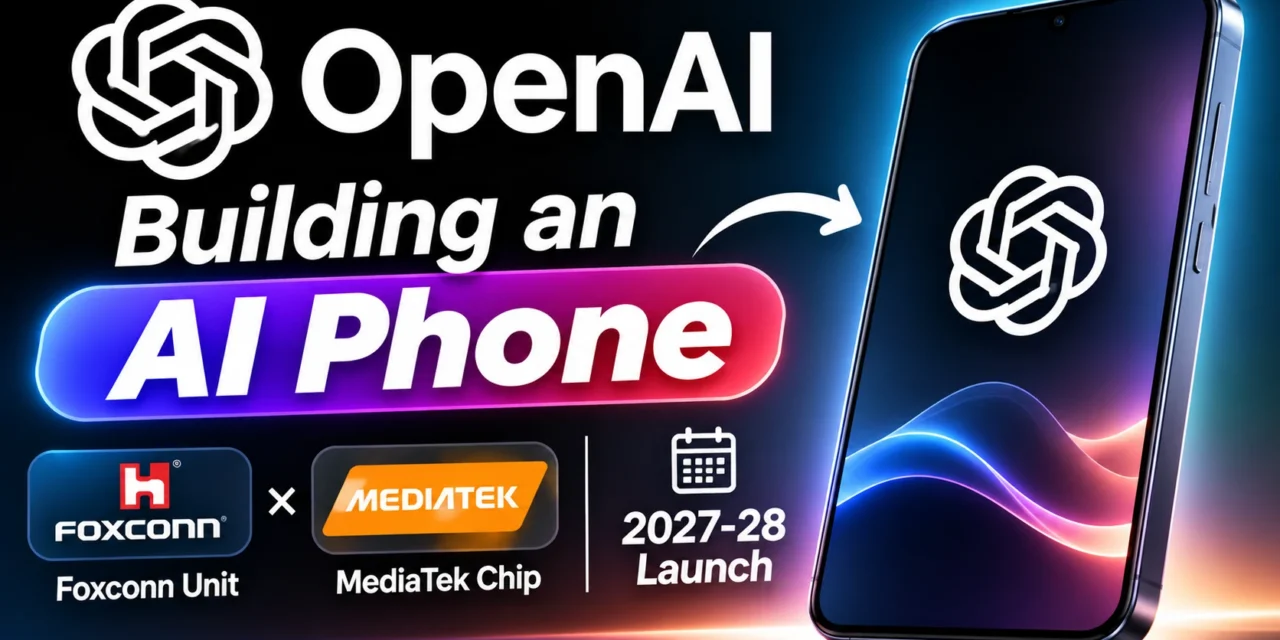
OpenAI is reportedly preparing its first smartphone, with supply-chain sources naming a Foxconn subsidiary as the assembler. The phone is said to put AI agents at the center of the experience. OpenAI has not confirmed anything.
This article covers what the reports say, who is allegedly involved, what is said about the chip and the timeline, and how much of it is still rumor. The details come from an India TV report by Saumya Nigam, dated November 20, 2026, which relies on Chinese media and an analyst’s predictions. Everything here is unconfirmed, so treat it as supply-chain speculation.
Quick summary
- The rumor: OpenAI has reportedly placed an assembly order for its first AI smartphone with FIH Mobile, a Foxconn subsidiary.
- Timeline: Late 2027 or 2028, according to Cailian Press.
- Chip: Possibly a customized MediaTek chipset, per analyst Ming-Chi Kuo.
- Concept: AI agents at the core, handling tasks across services.
- Status: OpenAI hasn’t said anything officially.
Key facts at a glance
| Area | Details |
|---|---|
| Report date | November 20, 2026 |
| Reported assembler | FIH Mobile (Foxconn subsidiary, listed in Hong Kong as 02038.HK) |
| Original sources | China’s Securities Times and Cailian Press |
| Launch window | Late 2027 or 2028 (rumored) |
| Possible chip | Modified MediaTek Dimensity 9600 on TSMC’s 2nm process (Kuo’s view) |
| Other chip names | MediaTek and Qualcomm mentioned in early reports |
| Possible suppliers | Luxshare Precision, Lingyi iTech, AAC Technologies |
| Confirmed by OpenAI | No |
1. The manufacturing report
China’s Securities Times, citing supply-chain sources, says FIH Mobile has already won the assembly contract. That wouldn’t be surprising. FIH Mobile is Foxconn’s arm for designing and building smartphones and other electronics, and Foxconn is best known as an iPhone maker.
Cailian Press adds that OpenAI aims for a late 2027 or 2028 launch. It names Luxshare Precision, Lingyi iTech and AAC Technologies, all known Apple suppliers, as possible component providers.
2. The chip question
Early reports pointed to custom chips from MediaTek and Qualcomm, with Luxshare possibly handling system design and manufacturing. In April, analyst Ming-Chi Kuo predicted mass production of the processors would begin in 2028. By May, he changed his view, saying OpenAI was speeding up and production might start in the first half of 2027.
Kuo thinks the phone could use a modified version of MediaTek’s Dimensity 9600, built on TSMC’s advanced 2nm process. None of this is confirmed.
3. OpenAI and Foxconn’s history
The two companies teamed up last year on AI data center hardware. Foxconn chairman Young Liu said in October that they were discussing more joint projects. Neither company has said those talks cover a phone.
4. What the phone might be
The report says OpenAI wants to break from the usual smartphone formula and make AI agents the heart of the experience, handling tasks and combining actions from many services. Design, specs, price and release date are all unknown.
What this says about the AI race
- AI companies want their own hardware. Owning the device means owning the user relationship.
- Phones are the prize. Several players are trying to rethink the smartphone around agents.
- Supply chains leak plans early. Manufacturing orders often reveal products long before launch.
- Timelines slip. Analysts’ dates for this phone have already moved once.
Why this matters
- For Apple and Samsung: A phone built around an AI agent would challenge their current model.
- For chipmakers: MediaTek and TSMC could gain a high-profile customer.
- For consumers: An agent-first phone could change how apps and services work together.
- For app developers: If agents handle tasks directly, app usage patterns could shift.
Things to keep in mind
- It’s all unconfirmed. OpenAI hasn’t announced a phone.
- Sources are secondhand. The report cites Chinese media and an analyst, not the companies.
- Dates have shifted. Kuo’s own production forecast moved from 2028 to early 2027.
- No design, price or specs are known.
- Details may change, or the project may be dropped.
Tips if you want to follow this story
- Wait for an official OpenAI announcement before drawing conclusions.
- Compare reports from several outlets and analysts.
- Watch Foxconn and MediaTek statements for hints.
- Check how Apple and Google respond with their own agent plans.
- Treat launch rumors as rough guidance, not dates.
Frequently asked questions
Is OpenAI really making a phone? Reports say so, but OpenAI hasn’t confirmed it.
Who would build it? FIH Mobile, a Foxconn subsidiary, according to China’s Securities Times.
When might it launch? Late 2027 or 2028, per Cailian Press.
What chip would it use? Possibly a customized MediaTek chipset, based on Ming-Chi Kuo’s view.
Has OpenAI worked with Foxconn before? Yes, on AI data center hardware last year.
What would make it different? The rumored focus on AI agents carrying out tasks across services.
How much will it cost? Nobody knows yet.
Conclusion
The OpenAI phone is still a rumor, built on supply-chain sources and an analyst’s predictions. If true, it shows how far AI companies want to go in owning the device people use daily. For now, there is no design, no price and no official word. Watch for confirmation from OpenAI, and note how the timeline moves.
Note: This article is based on an India TV report by Saumya Nigam, dated November 20, 2026, rewritten in my own words.