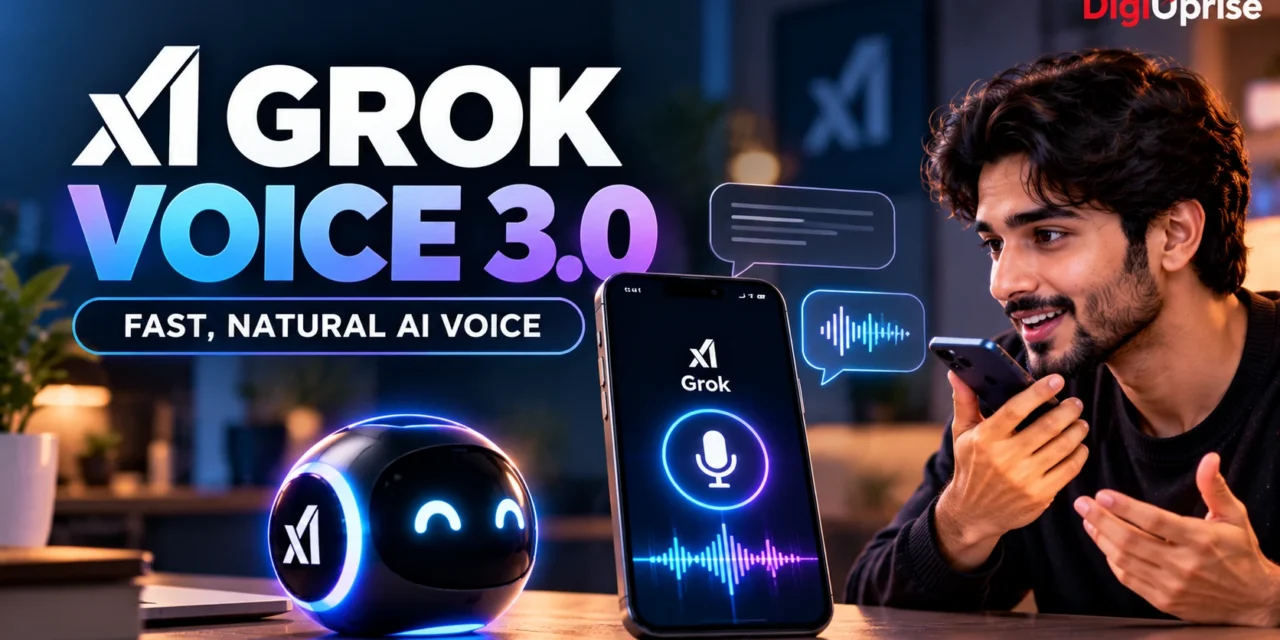
Voice AI is moving fast. Instead of typing to a chatbot, more people now speak to AI and expect a natural, quick reply. On October 13, 2026, xAI announced Grok Voice 3.0, its newest voice model, and described it as the most intelligent speech-to-speech model available.
This article explains what Grok Voice 3.0 is, how it compares with rivals, where it’s already in use, and what it costs. Most figures come from xAI’s announcement and from Artificial Analysis, an independent testing group that xAI cites, so treat the headline claims as the company’s own until you can test the model yourself.
What is Grok Voice 3.0?
Grok Voice 3.0 is a speech-to-speech AI model. That means it listens to a person speaking and answers by voice, without first turning everything into text in a clumsy, slow way. The goal is a conversation that feels natural, with quick replies, smooth turn-taking, and the ability to handle interruptions.
According to xAI, the model:
- Sets a new record for resolving customer support calls
- Responds with class-leading speed, in under one second
- Costs less to run than other frontier voice models
- Powers millions of conversations every day at Tesla and SpaceX
It is available now through xAI’s API.
How does it perform?
xAI points to independent results from Artificial Analysis, dated October 13, 2026.
Overall ranking
Grok Voice 3.0 ranks first on Artificial Analysis’s Speech-to-Speech Index with a score of 86.9. That index blends several things: how well the model reasons about speech, how it handles support-call tests, and results from blind head-to-head conversations.
For comparison, the same table lists Grok Voice 2.0 at 81.3, OpenAI’s GPT-Live-1 (Astra, Medium) at 83.2, and Google’s Gemini 3.8 Live (Extended Thinking, High) at 82.6.
Benchmark comparison at a glance (Source: Artificial Analysis, October 13, 2026, as cited by xAI)
| Benchmark | Grok Voice 3.0 | Grok Voice 2.0 | GPT-Live-1 (Astra, Medium) | Gemini 3.8 Live (Ext. Thinking, High) |
|---|---|---|---|---|
| Speech-to-Speech Index (overall) | 86.9 | 81.3 | 83.2 | 82.6 |
| Big Bench Audio (speech reasoning) | 98.5% | 97.2% | 90.1% | 97.7% |
| Speech Agent Arena (human preference, Elo) | 1070 | 1011 | 1048 | 990 |
| Task success rate | 94.8% | 94.6% | 87.4% | 89.1% |
| Full Duplex Bench (conversation flow) | 97.0% | 95.1% | 94.9% | 91.9% |
Natural conversation
On Full Duplex Bench, which measures how well a model handles pauses, turn-taking, and interruptions, Grok Voice 3.0 scores 97%. That is higher than the other models in the table, which range from about 92% to 95%.
Reasoning and task completion
- Speech reasoning: 98.5% on Big Bench Audio, the top score in the comparison.
- Task success rate: 94.8%, also the highest listed.
- Human preference: An Elo score of 1070 in the Speech Agent Arena, ahead of the rivals shown.
Handling real-world calls
A test called τ-Voice checks how well agents manage support calls with different accents, background noise, and interruptions. Grok Voice 3.0 scores 71.6%, which xAI says is comparable to GPT-Live-1 (Astra), but with about 40% lower latency.
In that same chart, GPT-Live-1 (Astra, Medium) actually scores a bit higher on accuracy at 74.5%, while Grok is faster. So the better choice depends on whether you value speed or a small edge in accuracy.
Enterprise test
On EVA-Bench, an open-source benchmark from ServiceNow that covers more than 200 realistic enterprise scenarios, Grok Voice 3.0 reaches the highest accuracy score, 74%. It is also the best performer when accuracy and customer experience are scored together, according to the announcement.
How much does it cost?
There are two cost points to know.
Price for developers: Grok Voice 3.0 is available in the Voice Agent API at $0.08 per minute, or $4.80 per hour. That is the same price as Grok Voice 2.0. Agents that use the grok-voice-latest setting have already been switched to the new version automatically, with no changes needed.
Cost per task: Artificial Analysis measured the average cost of completing a task in its Big Bench Audio test. Grok Voice 3.0 came in at about $0.025, compared with about $0.030 for GPT-Live-1 (Astra, Medium) and about $0.055 for GPT-Realtime-2.1 (High).
Cost per task at a glance (average cost on Artificial Analysis’s Big Bench Audio run; lower is better)
| Model | Cost per task (USD) |
|---|---|
| Grok Voice 3.0 | $0.025 |
| GPT-Live-1 (Astra, Medium) | $0.030 |
| GPT-Realtime-2.1 (High) | $0.055 |
How to use Grok Voice 3.0
The way you use it depends on who you are.
For developers and businesses
- Go to xAI’s website. Open the Grok Voice 3.0 announcement page and choose Try It Free or View Docs.
- Create or sign in to your xAI account and get API access.
- Open the Voice Agent API documentation. It explains how to connect and send audio.
- Choose the model. Use grok-voice-latest to always get the newest version. If you already use it, your agents have been switched to 3.0 automatically.
- Build your agent. Connect it to your own tools, such as customer records, order systems, or booking calendars, so it can verify callers and complete tasks.
- Test with real calls. Try different accents, background noise, and interruptions before going live.
- Monitor cost and results. Voice Agent API pricing is $0.08 per minute ($4.80 per hour). Track how many calls are resolved without a human.
For everyday users
- In Tesla vehicles: Use hands-free voice features for simple requests like checking your calendar or answering an email, and Grok Bot for bigger tasks like ordering coffee or booking dinner.
- In Grok Bot’s voice mode: According to xAI, Grok Voice 3.0 powers its voice conversations.
Exact steps and menu names may change, so follow xAI’s official documentation.
Tips for better results
- Write clear agent instructions. Tell the agent what it can and can’t do.
- Start with one use case, such as order status or appointment booking.
- Always offer a human handoff for complex or sensitive calls.
- Review call recordings (where legally allowed) to find gaps.
Where is it already used?
In Tesla vehicles
xAI says Grok Voice 3.0 handles millions of conversations a day in Tesla cars. Drivers can use it hands-free for simple requests, such as checking their calendar or answering an email. For bigger tasks, such as ordering a coffee or booking dinner, they can use Grok Bot. It also powers the voice mode of Grok Bot.
In Starlink call centers
Starlink’s call centers use Grok Voice to answer about 20,000 customer calls a day in multiple languages. According to xAI:
- Roughly 70% of calls are resolved without a human
- One in four sales calls ends in a purchase before the caller hangs up
- A single agent can verify customers, troubleshoot hardware, issue credits, and ship replacement equipment
Why this matters
- Customer service: Faster, more natural voice agents could cut wait times and handle simple calls without staff.
- Hands-free use: Better voice AI makes it easier to use technology while driving or working.
- Competition: Big tech companies are racing to improve voice AI, which tends to push quality up and prices down.
- Business adoption: Fast responses and low cost per task make voice agents more practical for companies.
Key advantages of Grok Voice 3.0
- Fast responses. xAI says replies arrive in under one second, which keeps conversations natural.
- Natural conversation. It scores 97% on Full Duplex Bench, so it handles pauses, turn-taking, and interruptions well.
- Strong accuracy. It ranks first on the Speech-to-Speech Index and leads several other benchmarks.
- Lower cost per task. In Artificial Analysis’s test, it cost less than the other models compared.
- Stable pricing. The price stays at $0.08 per minute, the same as Grok Voice 2.0.
- Easy upgrade. Agents using grok-voice-latest switched over automatically.
- Proven at scale. It already handles millions of conversations a day at Tesla and SpaceX.
- Works across languages. Starlink uses it for calls in multiple languages.
- Can complete real tasks. One agent can verify customers, troubleshoot, issue credits, and ship replacements.
Things to keep in mind
- Many numbers come from xAI. The benchmarks are run by Artificial Analysis and ServiceNow, but the announcement is still marketing from the model’s maker.
- Results vary. Your own accents, background noise, and use case may produce different results.
- It’s not the top on every test. On accuracy in τ-Voice, a rival scored slightly higher.
- Check privacy and compliance. Companies using voice agents for calls should review data handling and legal requirements.
- Prices can change. Check xAI’s documentation for current rates.
Frequently asked questions
What is a speech-to-speech model?
It’s an AI model that takes spoken audio as input and replies in spoken audio, aiming for faster, more natural conversation than systems that rely only on text.
Is Grok Voice 3.0 free?
xAI offers a free way to try it, but developers using the Voice Agent API pay $0.08 per minute.
Do I need to change anything if I already use Grok Voice 2.0?
If your agent uses grok-voice-latest, it has already been switched over automatically.
How fast is it?
xAI says its response time is under one second.
Who is it for?
Businesses building voice agents, such as customer support, sales, and in-car assistants, as well as developers who want voice features in their apps.
Conclusion
Grok Voice 3.0 is a notable step for voice AI. xAI says it leads independent rankings, responds quickly, and keeps prices steady, and it’s already handling large call volumes at Tesla and Starlink. The best way to judge it is to test it on your own use case and compare it with alternatives.
Note: This article is based on xAI’s October 13, 2026 announcement and the benchmark figures it cites. Please confirm current details on xAI’s website.