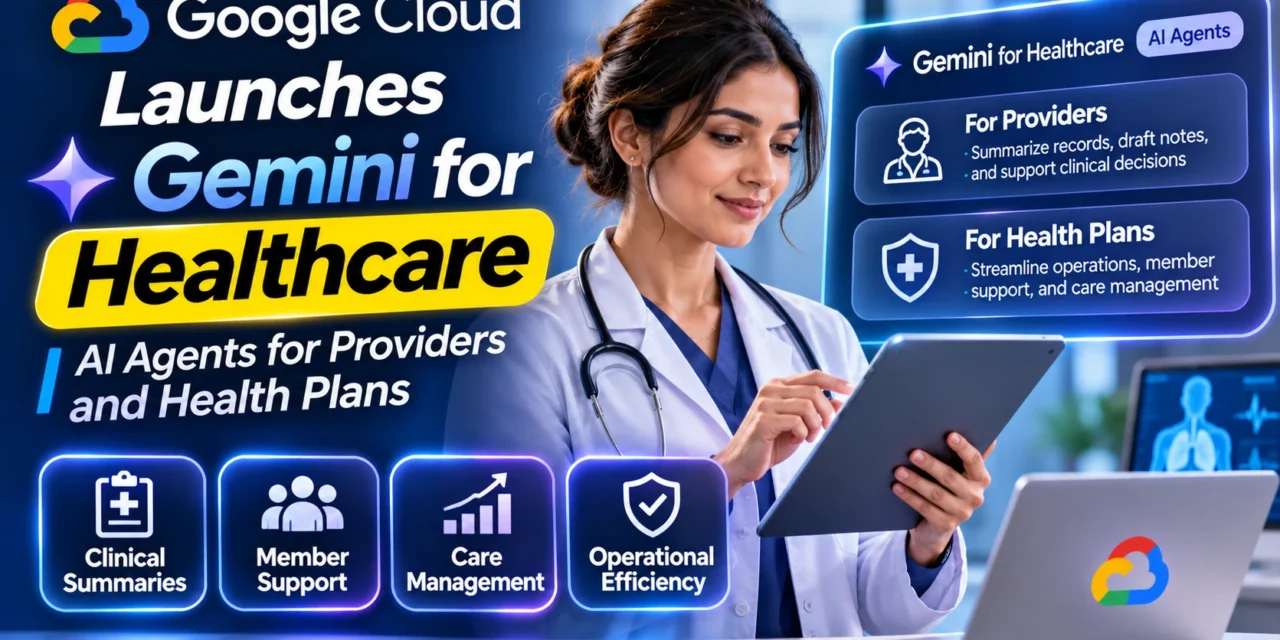
Google Cloud has introduced Gemini for healthcare, an industry version of its Gemini agent built to help hospitals, clinics, and health insurers handle the paperwork and data-gathering that slows down care and coverage decisions. It is available in preview in the US.
This article explains what it is, its four main components, the workflows it targets, the systems it connects to, and its privacy and governance claims. All details come from Google Cloud’s own announcement, written by Thomas Kurian and dated November 11, 2026, so the benefits are Google’s claims, not independent findings.
Quick summary
- What it is: Gemini for healthcare, a purpose-built solution based on the Gemini agent introduced last month at “Gemini at Work.”
- Who it’s for: Healthcare providers and health plans (payers).
- Availability: Preview in the US, starting November 11, 2026.
- Key idea: A single governed layer that coordinates work across the systems organizations already use, with human oversight.
- Compliance: Built to support HIPAA compliance, according to Google.
The problem Google says it addresses
Google describes healthcare as running on fragmented data. Patient records, coverage policies, and clinical evidence are spread across disconnected records, claims systems, and administrative tools.
- Clinicians spend nearly 28 hours a week reconciling information by hand, according to the post.
- Patients wait for answers about their care and their coverage.
Google’s argument is that a general AI model is not enough. Healthcare needs a secure, governed layer that coordinates work across existing systems, assembles verifiable evidence, and carries multi-step workflows through to completion under human oversight.
What is the Gemini agent?
The Gemini agent is described as a single, always-on work agent. An employee gives it an objective, and it plans the steps, keeps organizational context, and routes across the best models to deliver finished outcomes inside the tools teams already use.
Google says it has built-in:
- Enterprise-grade identity administration
- Fine-grained access control
- Centralized policy management
Each agent has its own identity, inherits each user’s role-based permissions, and enforces strict need-to-know boundaries across users, sub-agents, and workflows.
Four core components
|
Component |
What it provides |
|---|---|
|
Skills for healthcare work |
Reusable, expert-written instructions for tasks like medical records synthesis, pre-appointment preparation, coverage and policy review, and payer benefit determination. Organizations can build custom skills. |
|
Connectors |
A library that links Gemini to electronic health record (EHR), claims, care management, and administrative systems while preserving existing identity and role-based access, so data does not need to be migrated. |
|
Open partner ecosystem |
Systems integrators and digital health partners that help organizations extend, connect, and scale Gemini without lock-in. |
|
Governed platform with model choice |
One place to set and enforce policies, with access controls, end-to-end audit logging, and verifiable citations. Organizations can pair frontier models for complex clinical reasoning with fast, low-cost models for routine tasks. |
What can it do?
At the point of care (for providers)
- Build a patient timeline from scattered sources. It synthesizes EHR and outside records, separates active from resolved problems, lists allergies, and flags medication discrepancies.
- Prepare charts before visits. It flags events since the last visit, current medications, and outstanding clearances, labs, or consents.
- Streamline prior authorizations and appeals. It pulls relevant chart evidence into an audit-ready packet aligned with payer policy, flags documentation gaps before submission, and, if a denial occurs and the record supports it, drafts an appeal based on the clinical record and the plan’s policy.
At the point of coverage (for health plans)
- Speed up payer review. It checks requests against medical policy and organizes findings for clinical reviewers, with findings traceable to the submitted documents and policy.
- Explain benefits and costs. It reads plan benefit booklets to estimate out-of-pocket costs, track deductibles, and verify in-network status. For Medicare Advantage members, it applies Medicare’s coverage criteria where a plan’s internal rule is stricter.
Systems it connects to
The connectors inherit each source system’s role-based access controls and data permissions. Google lists these among them:
|
Category |
Examples named |
|---|---|
|
EHRs and clinical data |
Epic (read-only), Oracle Health (read-only, no write-back), InterSystems FHIR Server, Verato, Keragon |
|
Eligibility, claims, and pricing |
Optum Coordination of Benefits and Network Eligibility (limited release), TriZetto Provider Solutions, GoodRx, Infinitus Relay |
|
Terminology and coding |
IMO Health, ICD-10 Codes, RxNorm Drug Vocabulary |
|
Coverage and provider reference |
CMS Coverage, NPPES NPI Registry |
|
Evidence and guidelines |
Optum EvidenceVue, BMJ Digital Health |
|
Clinical and operational workflows |
Salesforce Health Cloud, Suki, UiPath, Synthpop Careflow, Alteryx |
|
Productivity and collaboration |
Sana from Workday, ServiceNow, Microsoft 365, Google Workspace |
|
Security and compliance |
Cyera Dataport |
The Epic and Oracle Health connectors are read-only, with no write-back to the patient chart, which Google says keeps clinical data integrity intact.
Implementation partners
Google names global integrators that can customize and scale the solution, including 66degrees, Accenture, Altimetrik, AuxoAI, Cognizant, Deloitte, Egen, HCLTech, KPMG, NTT DATA, PwC, Quantiphi, Slalom, Tata Consultancy Services, TEKsystems Global Services, and Wipro. It also mentions specialized partner agents such as the ASCO Oncology Guideline Assistant.
What do early partners say?
The post includes statements from several organizations that say they are working with Google Cloud. These are promotional quotes, and most describe exploration, not completed results.
- HCA Healthcare is exploring how Gemini could synthesize patient information from multiple EHR systems.
- Highmark Health wants to connect information across the healthcare experience.
- Northwell Health expects to ease administrative burden on clinical teams.
- Optum Insight says AI should help payers and providers connect data and workflows.
- Blue Cross Blue Shield of Massachusetts says Gemini for healthcare is a foundation for a unified architecture of reusable AI agents.
- American Society of Clinical Oncology is excited about help finding current, relevant information quickly.
Privacy and governance claims
According to Google:
- Gemini for healthcare runs on Google Cloud’s secure infrastructure and is built to support HIPAA compliance.
- Clinical data, prompts, and generated outputs stay within the customer’s governed environment and are never used to train or fine-tune Google’s foundation models.
- Outputs are grounded in clinical records, plan policies, and approved guidelines, with traceable citations and audit logging.
- High-volume administrative tasks can be routed to fast, low-cost models, and complex clinical analysis to high-reasoning models, so organizations can scale without costs rising at the same pace.
Why this matters
- Administrative load is huge. Time spent reconciling records and chasing authorizations is time away from patients.
- Agents are moving into regulated fields. Google says it is also offering purpose-built solutions for legal, financial services, and government.
- Human oversight and audit trails are central. For healthcare, being able to check where an answer came from is essential.
- Integration is the real challenge. Value depends on how well AI connects to existing records and rules.
Things to keep in mind
- It’s a preview. Features, availability, and pricing may change.
- Claims are Google’s. Performance and compliance statements have not been independently verified here.
- “Built to support HIPAA compliance” is not a guarantee. Organizations remain responsible for their own compliance.
- Some connectors are in limited release. The Optum tools are in limited testing.
- Clinical judgment stays with people. The post describes human oversight, and any AI-drafted packet, summary, or appeal should be reviewed.
- Pricing and rollout details were not provided.
Frequently asked questions
What is Gemini for healthcare? A purpose-built version of Google’s Gemini agent for providers and health plans, with healthcare skills, connectors, and governance tools.
Who can use it? Health systems, medical groups, health plans, and payers in the US, in preview.
Does it change patient records? The Epic and Oracle Health connectors are described as read-only, with no write-back to the chart.
Is patient data used to train Google’s models? Google says clinical data, prompts, and outputs are never used to train or fine-tune its foundation models.
Is it HIPAA compliant? Google says it is built to support HIPAA compliance. Organizations should confirm their own requirements.
Does it make clinical decisions? The post describes it as assembling evidence and drafting work for human review, with oversight.
Conclusion
Gemini for healthcare is Google’s attempt to bring an agent into one of the most complex, data-heavy industries. Its pitch is less about replacing clinicians and more about taking over the assembly work around charts, authorizations, and benefits. Whether it delivers will depend on how well it connects to real systems, how accurate its drafts are, and how organizations govern it. For now, it is a preview with promising claims that need real-world testing.
Note: This article is based on a Google Cloud blog post by Thomas Kurian dated November 11, 2026, rewritten in my own words. All claims are Google’s. This is not medical, legal, or compliance advice.