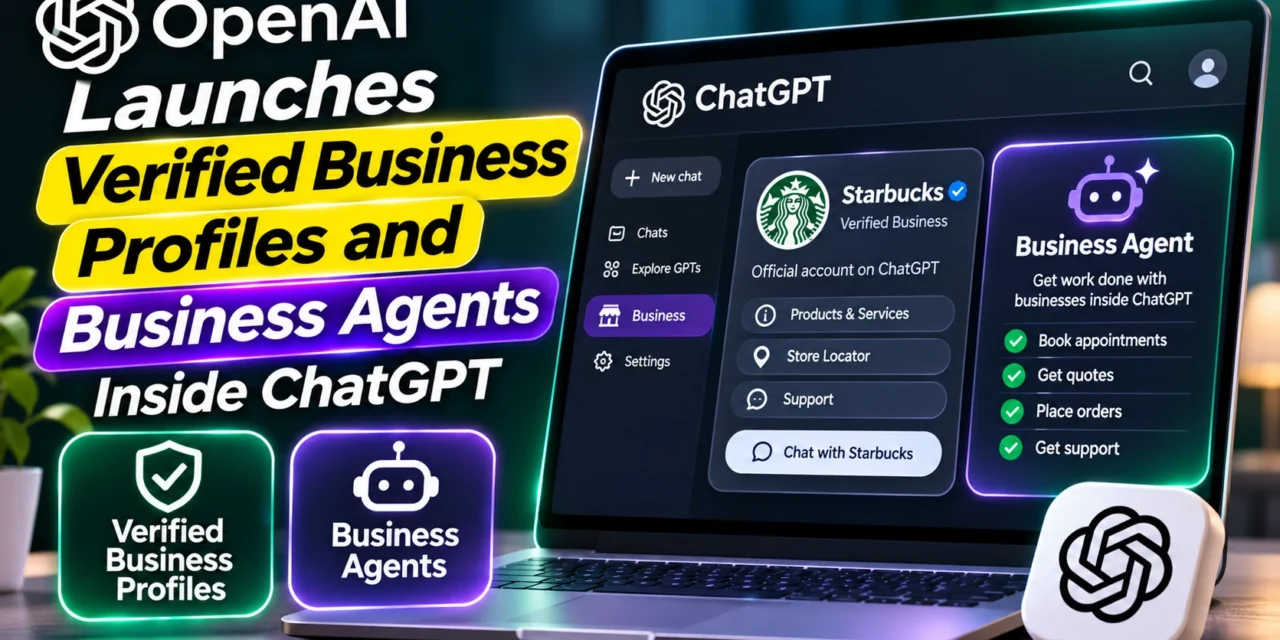
OpenAI is turning ChatGPT into a place where businesses can show up, share their details, and talk to customers. On November 10, 2026, it introduced “Businesses in ChatGPT” in beta, letting companies claim verified profiles and, if eligible, launch AI agents that answer questions from ChatGPT users.
This article explains what is new, how Business Hub and Business Agents work, what businesses can and cannot see, how ads fit in, and what is still unclear. The details come from a Quartz report updated November 11, 2026, which cites OpenAI and TechCrunch. The feature is a beta, and OpenAI has not published all details.
Quick summary
- What launched: Businesses in ChatGPT, in beta, including Business Hub and Business Agents.
- Business Hub: Lets companies claim their profile, manage information, and view insights.
- Business Agents: AI agents that answer customer questions inside ChatGPT. Available to eligible e-commerce and online service businesses in the US.
- Reach: OpenAI says 1.2 billion people use ChatGPT each week.
- Still unclear: The details of how verification works.
What is Business Hub?
Business Hub is a tool where companies claim their organization in ChatGPT and manage how it appears. After verification, a business can:
- Update key details about the company
- Add product feeds with pricing and availability
- View insights about how people engage with it
What do the insights show?
|
Insight |
Meaning |
|---|---|
|
Mentions |
How often the business appears |
|
Website clicks |
Clicks to the business’s website from ChatGPT |
|
Discovery topics |
Common themes in conversations where the business’s website is cited |
OpenAI says the insights are aggregated and appear only when conversations or interactions meet certain thresholds. It also says it withholds users’ conversations and agent chats from businesses.
What are Business Agents?
Business Agents are AI agents a company can build, test, and launch after claiming its profile. They are available to eligible e-commerce and online service businesses in the US.
How would a customer use one?
- A business appears in a ChatGPT response.
- The user opens that business’s ChatGPT profile.
- If the business has an agent, the user can start a conversation with it.
- They can ask follow-up questions about the business’s offerings.
How is it separated from ChatGPT itself?
OpenAI says the agent conversation is:
- Labeled as a business agent
- Separate from the user’s original ChatGPT conversation
- Distinct from ChatGPT’s own, independent answers
How do ads fit in?
Businesses can sponsor their agent and use it as the destination for ChatGPT Ads. OpenAI says sponsored placements are labeled and separate from ChatGPT’s responses.
Who can use it?
|
Group |
Details |
|---|---|
|
Claiming a profile |
Any eligible business located where ChatGPT is available |
|
Business Agents |
Eligible e-commerce and online service businesses in the US |
|
Enterprise customers and advertisers |
Can work with their OpenAI representative |
|
Shopify merchants |
Can connect their store from Business Hub or the Shopify admin |
OpenAI plans to expand to more markets and business categories and to build tools for organizations with more complex needs.
What about verification?
The Quartz report says OpenAI has given no details on the verification process, according to TechCrunch. Benji Shomair, OpenAI’s vice president of monetization, told journalists that the company uses multiple verification methods that differ by type of business and market. Businesses should expect checks, but the specifics are not public.
How does this build on earlier moves?
|
When |
What happened |
|---|---|
|
March 2026 |
OpenAI retired an earlier ChatGPT shopping effort that used commission fees and a checkout cart, according to TechCrunch |
|
September 2026 |
It announced a test of Sponsored Agents, where tapping an ad opens a chat with an advertiser’s AI agent, with select US advertisers |
|
October 2026 |
It expanded ChatGPT ads to 89 countries and said more than 100,000 advertisers had launched campaigns |
|
November 2026 |
It introduced Businesses in ChatGPT in beta |
TechCrunch’s headline frames the profiles as making ChatGPT a little more like Google, since businesses can now have listings people can look up.
What could this mean for businesses?
- A new way to be found. Customers may discover businesses through ChatGPT answers.
- Control over information. Claiming a profile lets a company correct and update details.
- Customer conversations. An agent can answer questions around the clock.
- Insights. Aggregated data can show how people find and engage with a company.
- Paid options. Sponsored agents and ads offer ways to buy visibility.
What could this mean for users?
- More business information in ChatGPT. You may see profiles and be able to chat with a business’s agent.
- Labels matter. Agent chats and sponsored placements are labeled, so check what you’re seeing.
- Know who you are talking to. A business agent speaks for the business, not for ChatGPT.
- Be careful with personal data. Think before sharing sensitive details in a conversation with any business agent.
Things to keep in mind
- It’s a beta. Features and rules may change.
- Verification details are unclear. OpenAI has not published specifics.
- Limited eligibility. Business Agents are for eligible US e-commerce and online service businesses.
- Ads and agents are linked. Sponsored agents may blur lines unless labels are clear.
- Data rules matter. OpenAI says it withholds user conversations from businesses, but businesses should still handle any information shared directly with their agents responsibly.
Tips for businesses
- Claim your profile and complete the verification steps.
- Keep details accurate, including prices, availability, and policies.
- Test your agent before launching it widely.
- Be transparent about what the agent can and cannot do.
- Watch the insights to learn what customers ask about.
- Review ad rules before sponsoring an agent.
Frequently asked questions
What are Businesses in ChatGPT? A beta feature that lets companies claim verified profiles in ChatGPT and, if eligible, launch AI agents to answer customer questions.
Who can build a Business Agent? Eligible e-commerce and online service businesses in the US.
Can any business claim a profile? Any eligible business located where ChatGPT is available.
Will businesses see my ChatGPT conversations? OpenAI says it withholds users’ conversations and agent chats from businesses and shows only aggregated insights.
Are agent chats and ads labeled? Yes. OpenAI says agent conversations and sponsored placements are labeled and separate from ChatGPT’s own answers.
How does verification work? OpenAI has given no details beyond saying it uses multiple methods that vary by business type and market.
Conclusion
With Business Hub and Business Agents, OpenAI is adding a business directory and a customer-service layer to ChatGPT, backed by ads and sponsored agents. For companies, it is a new place to be found. For users, it means more commercial content inside ChatGPT, so labels and personal-data care matter. The details of verification and how it develops are worth watching.
Note: This article is based on a Quartz report by Cris Tolomia updated November 11, 2026, which cites OpenAI and TechCrunch, rewritten in my own words. This is a beta, and details may change.