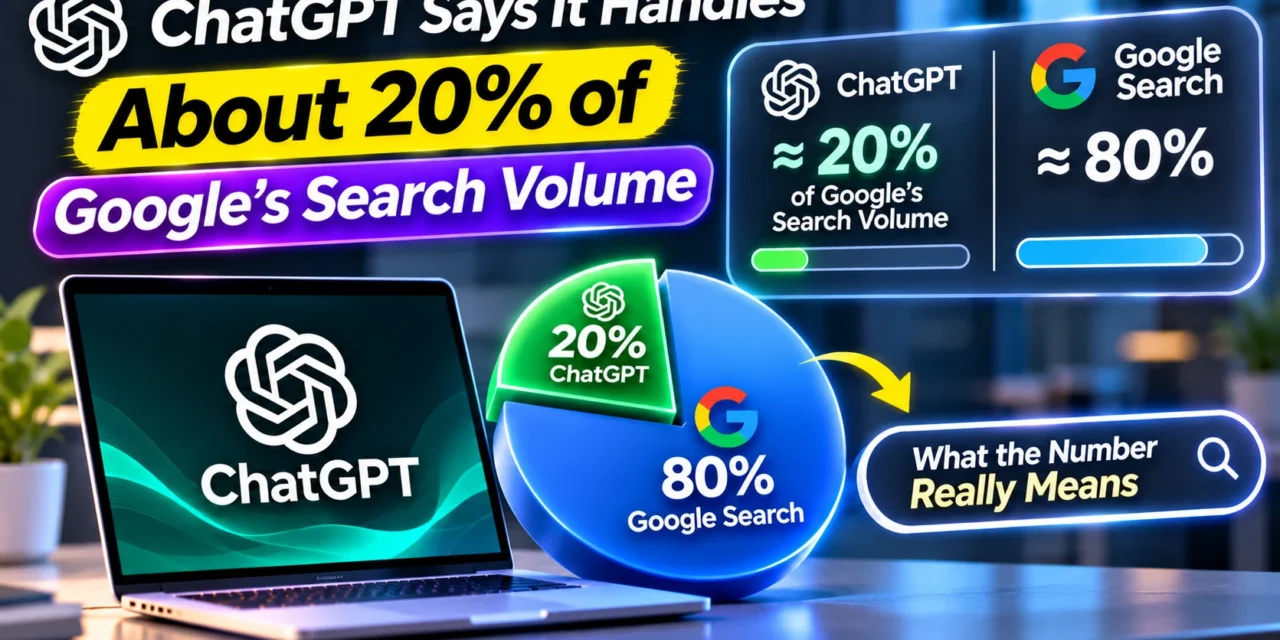
OpenAI’s ChatGPT may now be one of the largest search tools in the world, at least by its own count. A ChatGPT executive says the chatbot handles roughly one fifth as many “search-like” queries as Google. But how that figure is measured matters a lot.
This article explains the claim, how it is defined, the other usage numbers OpenAI shared, and the numbers it did not share. The details come from a Gizmodo report dated November 3, 2026, based on an interview with Big Technology. The figures are OpenAI’s own and are not independently verified.
Quick summary
- The claim: ChatGPT has about 20% of the search volume Google does.
- Who said it: Adam Fry, ChatGPT’s consumer product lead, in an interview with Big Technology.
- The estimate: If Google handles about 16 billion searches a day, 20% would be roughly 3.2 billion search-like interactions daily.
- Weekly users: 1.2 billion, up about 200 million in two months.
- What was missing: An update on how many people pay for ChatGPT.
What is a “search-like query”?
Fry defined it as basically anything a person would traditionally have gone to a search engine for, but now takes to ChatGPT. In his words, every time you ask a question and go search the web, that counts as a search.
That definition is broad, and Gizmodo points out why:
- ChatGPT now looks up information on the web in most conversations, unlike earlier versions that relied only on training data up to a certain date.
- That means a large share of interactions could count as “search-like,” even if the user did not think of it as searching.
- Image and video generation may not count, but most other prompts could.
Fry did not give a specific number of prompts that qualify.
The math behind the claim
|
Item |
Figure |
|---|---|
|
Google searches per day (reported) |
About 16 billion |
|
ChatGPT’s claimed share |
About 20% |
|
Implied ChatGPT search-like interactions |
About 3.2 billion per day |
Gizmodo says that is believable enough, though it depends entirely on how generously “search-like” is defined.
Google’s lead is still huge
Google has more than 90% of the global search engine market share, if AI tools are not counted. Claiming 20% of Google’s volume would, by some measures, make ChatGPT the second-largest search engine in the world. But comparing a chatbot conversation with a traditional search query is not a clean, like-for-like comparison.
OpenAI’s own search products have struggled
The article notes that OpenAI’s attempts to build Google-like products have not gone well:
- SearchGPT: Planned as a standalone search engine, it was folded into ChatGPT.
- ChatGPT Atlas: A Chrome-like browser that reportedly was put out to pasture earlier this year after generating very little interest.
So while people may be using ChatGPT for search, they are doing it inside the chatbot, not through separate search products.
Other numbers Fry shared
|
Metric |
Figure |
|---|---|
|
Weekly active users |
1.2 billion, including about 200 million added in the last two months |
|
Images generated per week |
About 1.5 billion |
|
People using ChatGPT Voice |
About 250 million |
These are bigger, more specific numbers, and Gizmodo calls them pretty big and noteworthy.
The number that was missing
Fry did not give a new figure for how many people pay for ChatGPT. He gave the most recent public number, 50 million paying subscribers, and said it has grown but not by how much.
Gizmodo does a quick check:
- Even if the company had added 10 million subscribers, that would be about 60 million out of 1.2 billion weekly users.
- That is a conversion rate of about 5%.
- Most paying users are on monthly plans, so they could cancel or switch services at any time.
Why is OpenAI sharing this now?
Gizmodo notes that this is the kind of claim a company would want to make publicly ahead of a planned initial public offering (IPO). Big numbers about reach and growth can help tell a story to investors, which is one reason to read them carefully.
How to read company numbers
Gizmodo’s closing advice is simple: pay attention to the numbers companies share and to the ones they do not. A few practical questions can help:
- How is it defined? “Search-like” is broad and flexible.
- What is it compared with? A chat interaction is not the same as a search query.
- Which numbers are missing? Paying subscribers, revenue, and retention matter as much as usage.
- Who is the audience? Claims made before an IPO may be framed for investors.
- Is there independent data? Outside measurements help check company claims.
Why this matters
- Search is changing. More people use chatbots for questions they once typed into a search engine.
- Pressure on Google. Google’s own AI Mode is already affecting its ad revenue, as covered in earlier reports.
- Monetization is the question. Usage is large, but turning it into profit is harder, especially with only a small share of users paying.
- Advertising is coming. OpenAI has been expanding ads in ChatGPT’s free tiers, which is one way to make money from search-like use.
Things to keep in mind
- The 20% figure is OpenAI’s estimate. It uses a broad definition and no hard query count.
- Comparisons are imperfect. Search engines and chatbots work differently.
- Usage is not revenue. Free users generate costs, not income.
- Subscriber data is old. The latest public figure is 50 million.
- This is not investment advice.
Frequently asked questions
Does ChatGPT really have 20% of Google’s search volume? That is OpenAI’s own estimate, based on a broad definition of “search-like” queries.
How many people use ChatGPT weekly? 1.2 billion, according to OpenAI’s Adam Fry.
How many pay for ChatGPT? The latest public figure is 50 million, and OpenAI says it has grown but did not give a new number.
What happened to SearchGPT and Atlas? SearchGPT was folded into ChatGPT, and the Atlas browser reportedly faded out earlier this year after little interest.
Is ChatGPT now the second-largest search engine? By OpenAI’s own count it could be, but the comparison depends on how queries are defined.
Conclusion
ChatGPT’s claim shows how quickly people are shifting some of their questions from search engines to chatbots. But the number rests on a broad definition, and the missing details about paying customers show why it helps to read company statistics carefully. The big question is not how many people ask ChatGPT questions, but whether OpenAI can turn that attention into a lasting business.
Note: This article is based on a Gizmodo report by AJ Dellinger dated November 3, 2026, which cites an interview with Big Technology, rewritten in my own words. The figures are OpenAI’s and not independently verified. It is not financial advice.