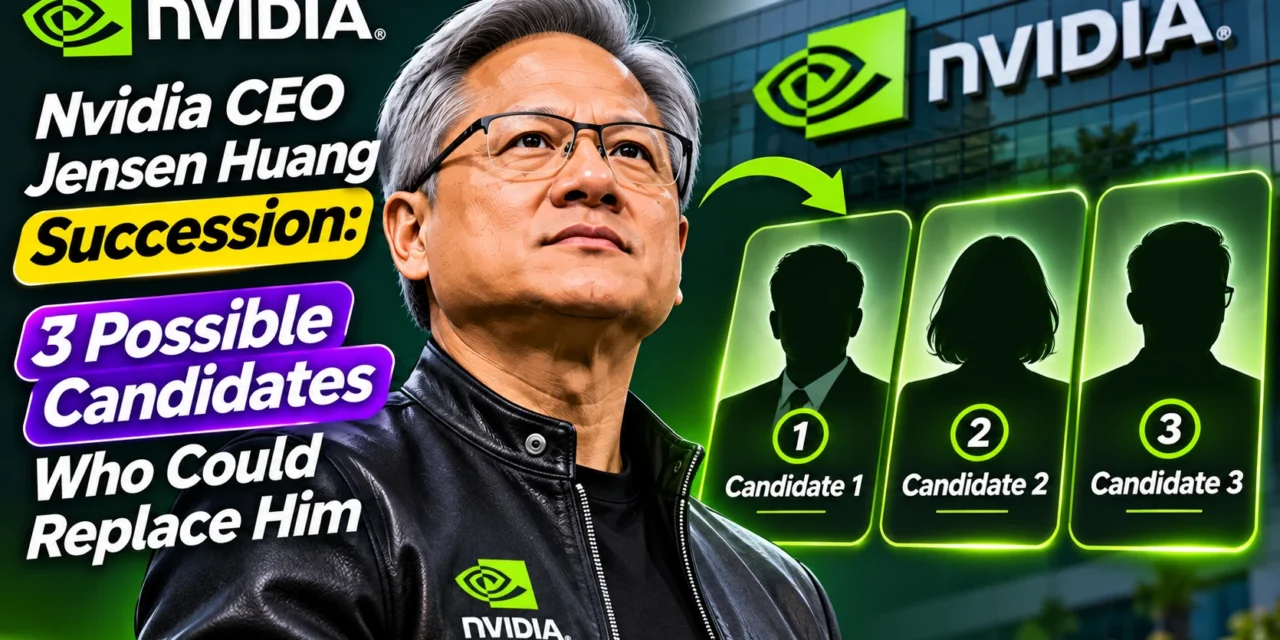
Nvidia has become one of the most influential technology companies in the world, largely driven by the growing demand for artificial intelligence chips and computing infrastructure. However, recent reports surrounding CEO Jensen Huang have raised questions about the company’s future leadership.
According to reports published by The Wall Street Journal and The New York Times, Nvidia’s board is reportedly considering Huang’s position following allegations involving his personal relationships and a possible foreign intelligence connection. The developments have brought attention to an important question: who could lead Nvidia if its co-founder steps down?
Several senior executives within Nvidia, along with leaders from other major technology companies, are being discussed as potential successors.
In this article, we explore three possible internal candidates, other external leadership options, and why replacing Jensen Huang could be one of Nvidia’s biggest challenges.
Why Is Nvidia’s CEO Position Under Discussion?
Jensen Huang co-founded Nvidia in 1993 and has led the company through its transformation from a graphics processor manufacturer into a major supplier of AI computing technology.
Recent reports have placed his leadership under scrutiny following allegations involving two extramarital relationships, including one involving a woman suspected by US intelligence agencies of having links to Chinese intelligence.
The company’s board had initially expressed confidence in Huang while investigating whether he had been targeted by a foreign intelligence operation.
However, subsequent reports have intensified the situation, with discussions reportedly taking place about his future as CEO.
Huang has acknowledged being unfaithful to his wife and apologised to his family and employees.
Despite the controversy, replacing him would not be a straightforward decision because of his influence over Nvidia’s business, technology strategy, and industry relationships.
Who Could Replace Jensen Huang as Nvidia CEO?
According to the reports cited by Business Insider, three Nvidia executives could emerge as potential candidates for the company’s top leadership position.
1. Ian Buck: The Engineering and AI Infrastructure Expert
<text>Ian Buck</text> could be one of the strongest internal candidates to succeed Jensen Huang.
He has spent 22 years at Nvidia and played an important role in developing CUDA, the software platform that helped establish Nvidia’s GPUs as essential computing tools for artificial intelligence.
Buck currently leads Nvidia’s data centre and computing businesses, which are particularly important to the company’s overall revenue.
His experience makes him a potential candidate for several reasons:
-
More than two decades of experience at Nvidia.
-
Important contributions to the development of CUDA.
-
Leadership experience across data centre and computing operations.
-
Strong understanding of Nvidia’s engineering culture.
-
Direct involvement in the company’s major AI infrastructure business.
His technical background and knowledge of Nvidia’s operations could make him a natural choice for the leadership role.
2. Colette Kress: A Potential Interim CEO
Colette Kress, Nvidia’s Chief Financial Officer (CFO), is another executive who could be considered for the position.
She has been with the company for 13 years and previously held finance-related positions at Cisco and Microsoft.
Kress is one of Nvidia’s most visible senior executives and could potentially take over as interim CEO if Huang steps aside.
Her experience includes:
-
Managing Nvidia’s financial operations.
-
Experience working with major technology companies.
-
Understanding the company’s business strategy.
-
Long-term involvement in Nvidia’s growth.
However, her background is primarily in finance rather than engineering. This could become an important consideration because Nvidia’s success has been closely connected to Huang’s technical knowledge and understanding of emerging technologies.
3. Madison Huang: Could Jensen Huang’s Daughter Take Over?
Madison Huang, Jensen Huang’s daughter, is another name being discussed as a possible future leader.
She works at Nvidia as a senior director of product marketing for physical AI, a field focused on applying artificial intelligence to machines and real-world environments.
According to a former employee cited by Business Insider, Madison has been taking on greater responsibilities across different parts of Nvidia’s business.
This has led to speculation about whether she could eventually move into a larger leadership position.
However, Nvidia has not publicly confirmed any succession plan involving Madison.
A potential family succession could also raise questions about corporate governance and leadership independence, particularly given Nvidia’s position as one of the world’s most important technology companies.
Her brother Spencer also works at Nvidia.
Could Nvidia Appoint a CEO From Outside the Company?
Apart from its internal executives, Nvidia could also consider candidates from other major technology companies.
Two names mentioned in the reports are:
| Candidate | Current Position | Relevant Experience |
|---|---|---|
| Thomas Kurian | CEO, Google Cloud | Cloud computing and enterprise technology |
| Matt Garman | CEO, Amazon Web Services | Cloud infrastructure and large-scale technology operations |
Both leaders have experience managing major cloud computing businesses that invest heavily in AI infrastructure.
Their understanding of enterprise technology, cloud services, and AI development could be valuable to Nvidia.
However, hiring an external CEO would come with its own challenges. The new leader would need to understand Nvidia’s engineering culture, customer relationships, product strategy, and position within the global AI industry.
Why Replacing Jensen Huang Could Be Nvidia’s Biggest Challenge
Finding a qualified CEO may not be Nvidia’s biggest problem. The real challenge could be replacing the influence and leadership style that Huang has built over more than three decades.
Since founding Nvidia in 1993, Huang has played a central role in transforming the company into a major force in graphics processing, data centres, and artificial intelligence.
His leadership has also been highly centralised. Reports suggest that Nvidia does not have a clearly established successor who has been publicly positioned as the company’s second-in-command.
Huang has previously indicated that he has as many as 60 direct reports.
This leadership structure has supported Nvidia’s growth, but it could make a transition more complicated.
What Makes Jensen Huang Difficult to Replace?
Some important factors include:
-
Technical expertise: Huang has a deep understanding of graphics processors, AI chips, and computing technology.
-
Business strategy: He played a major role in positioning Nvidia for the rapid growth of artificial intelligence.
-
Industry relationships: His connections with technology companies and industry leaders are an important part of Nvidia’s influence.
-
Company culture: His leadership style has shaped the organisation over several decades.
-
Shareholding influence: Huang owns approximately 3.6% of Nvidia, giving him a significant financial stake in the company’s future.
The board will therefore need to consider more than the leadership controversy. It must also evaluate how a potential CEO transition could affect innovation, business performance, and investor confidence.
Quick Comparison: Possible Nvidia CEO Successors
| Candidate | Main Strength | Potential Challenge |
|---|---|---|
| Ian Buck | Engineering and AI infrastructure experience | Taking responsibility for the entire company |
| Colette Kress | Financial and business leadership | Less direct engineering experience |
| Madison Huang | Product marketing and physical AI experience | Limited publicly established CEO experience |
| Thomas Kurian | Cloud and enterprise technology | Understanding Nvidia’s internal culture |
| Matt Garman | Large-scale cloud infrastructure leadership | Transitioning from AWS to Nvidia |
Frequently Asked Questions
1. Who is Jensen Huang?
Jensen Huang is the co-founder and CEO of Nvidia. He established the company in 1993 and helped transform it into a major supplier of graphics processors and AI computing technology.
2. Why is Jensen Huang’s CEO position under scrutiny?
Recent media reports have raised questions about his personal relationships and a possible foreign intelligence connection. Nvidia’s board is reportedly considering his future leadership.
3. Who are the possible internal candidates to replace Jensen Huang?
The three internal candidates discussed in the reports are Ian Buck, Colette Kress, and Madison Huang.
4. Could Nvidia hire a CEO from another company?
Yes. Thomas Kurian of Google Cloud and Matt Garman of Amazon Web Services have been mentioned as possible external candidates.
5. Who is Ian Buck at Nvidia?
Ian Buck is a senior Nvidia executive who leads its data centre and computing businesses. He also contributed to the development of CUDA, Nvidia’s important software platform.
6. Why would replacing Jensen Huang be difficult for Nvidia?
Huang has led Nvidia since its founding and has played a major role in its technical direction, business strategy, and industry relationships. Finding someone with similar experience and influence could be challenging.
Conclusion
Nvidia’s leadership situation has brought attention to a succession question that the company has rarely needed to address publicly.
Ian Buck, Colette Kress, and Madison Huang are among the internal names being discussed, while Thomas Kurian and Matt Garman represent possible external options.
However, choosing a new CEO would involve more than selecting an experienced executive. Nvidia needs someone who can maintain its engineering strength, continue its AI expansion, and manage relationships across the global technology industry.
For now, the company’s leadership future remains uncertain, and the next decisions from its board could become an important moment in Nvidia’s history.
Source: Based on the supplied NDTV report dated November 12, 2026, citing reporting from The Wall Street Journal, The New York Times, and Business Insider. Leadership changes and succession candidates discussed above are reported possibilities, not confirmed appointments.