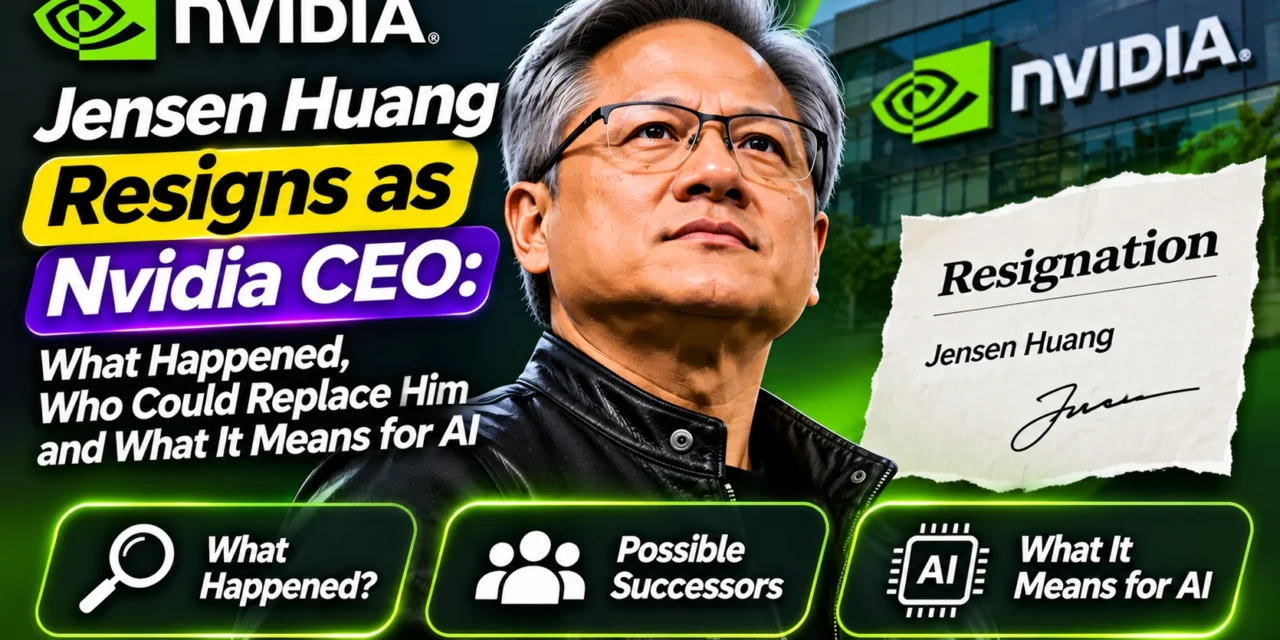
Nvidia co-founder Jensen Huang has resigned as chief executive after weeks of reports about his personal conduct and a relationship with a business contact that US officials are reported to be scrutinizing. The news hit the company’s stock and raised big questions about who will lead the world’s most important AI chip maker.
This article summarizes the business and governance side of the story. The details come from a Guardian report dated November 12, 2026. Many of the claims are allegations from news reports, not findings by a court or an investigation, and some people named in coverage have not commented. For that reason, this summary avoids naming individuals who are not corporate officers.
Quick summary
- What happened: Huang resigned as Nvidia’s chief executive, president, and board member, effective immediately.
- Interim leader: Chief financial officer Colette Kress, until a permanent successor is named.
- Stock reaction: Shares fell about 13% at the open, then closed down 4.3% on Thursday. That wiped more than $180 billion off the company’s value on the day and about $490 billion over the week, leaving it valued at around $4 trillion.
- New role: Harvey Jones, a tech investor and entrepreneur, was named Nvidia’s first-ever chair.
- Investigation: The board hired the law firm Wachtell, Lipton, Rosen & Katz for an independent review.
Why did he resign?
According to the Guardian, Huang stepped down after reports of extramarital affairs, including with a person alleged to be connected to Chinese intelligence, and with company employees. These are allegations carried in news reports.
The key points reported:
- A customer relationship under scrutiny. The board launched an investigation into Huang’s relationship with a businesswoman who is a Nvidia customer, a Chinese citizen, and head of a Singapore-based data center company. She is not related to him. US intelligence services are reported to suspect that she is a Chinese asset. Huang has denied any knowledge that she allegedly worked for the Chinese government.
- A change in Nvidia’s position. Nvidia had previously denied anything unusual about the relationship. That changed on Sunday, when Huang admitted he had been unfaithful to his wife, without referring directly to the businesswoman.
- More reports. The New York Times and Reuters later reported separate relationships with company employees. Those reports have not been confirmed by Nvidia in the coverage cited.
- Board pressure. The board called a meeting late on Wednesday to discuss the chief executive’s future, and Huang resigned on Thursday.
Nvidia’s statement did not mention the scandal. It paid tribute to Huang’s “profound” contributions to the company he co-founded in 1993.
What happens next at Nvidia?
|
Item |
Status |
|---|---|
|
Interim CEO |
Colette Kress, the chief financial officer |
|
Permanent CEO search |
The board says it will consider internal and external candidates |
|
New chair |
Harvey Jones, the first-ever chair |
|
Investigation |
Independent review by Wachtell, Lipton, Rosen & Katz |
|
Congress |
Huang has agreed to testify before US Congress |
Who has been mentioned as a possible successor?
The Guardian lists names that have been floated. None of these has been confirmed by Nvidia.
- Internal: Colette Kress and Ian Buck, who manages the company’s AI hardware and software products.
- External: Tim Cook, Apple’s former CEO and current executive chair; Rene Haas, CEO of Arm Holdings; and Lisa Su, CEO of AMD.
- Political comment: President Donald Trump posted that Cook should take the job. That is a political opinion, not a board decision.
Huang’s two adult children also work at Nvidia, but the report describes them as relatively inexperienced.
Why is Nvidia’s leadership so important?
- The AI industry depends on Nvidia. It makes the advanced chips used to train AI models and run companies such as OpenAI and Anthropic.
- It is one of the most valuable companies in the world. Its market value reached $5 trillion at one point last year.
- Huang ran it tightly. He managed about 60 direct reports, an unusually large number, which emphasized his control.
- He is a major shareholder. He owns more than 870 million shares, about 3.6% of the company, and was worth about $145 billion on Thursday morning, according to Bloomberg.
- Geopolitics. The exit comes while the US and China compete intensely in AI, and calls are growing in Congress for stricter controls on chip exports to China.
What are analysts saying?
- Dan Ives, a senior US tech analyst, said the board did what it needed to do by “ripping off the Band-Aid” and moving Nvidia into its next chapter without Huang, and that the company remains ahead of competitors.
- Neil Wilson, an analyst at Saxo UK, said Nvidia needs a “great CEO” because Huang’s technical knowledge of every product was unique and impossible to replicate. He added that Nvidia is well placed in terms of upcoming products and orders.
What could this mean for the AI industry?
- Chip supply and strategy. A leadership change could affect product plans, partnerships, and relations with governments.
- Customers will watch closely. Big AI companies depend on Nvidia’s supply and roadmap.
- Competitors may see an opening. AMD, custom chips from large cloud companies, and others could try to gain ground.
- Governance questions. The case has reignited debate about how much power individual tech founders hold, and about boards’ roles in oversight.
- Policy attention. Lawmakers are already calling for tighter scrutiny of chip exports to China.
Things to keep in mind
- Allegations are not findings. The investigation is ongoing, and key claims come from news reports and unnamed sources.
- Privacy and fairness. Reports about personal relationships involve people who may not have commented.
- Stock moves can reverse. Market reaction in one day or week is not a prediction.
- Succession is open. The names above are speculation until the board announces a choice.
- Check updates. This is a fast-moving story, and details may change.
- This is not investment advice.
An update to earlier coverage
If you saw an earlier overview of leading AI companies that listed Jensen Huang as Nvidia’s CEO, that information is now out of date. Colette Kress is the interim chief executive as of November 12, 2026.
Frequently asked questions
Who is leading Nvidia now? Colette Kress, the chief financial officer, on an interim basis.
Why did Huang resign? After reports of affairs and scrutiny of a relationship with a business contact. The board’s statement did not mention the scandal.
How did the stock react? It fell about 13% at the open, closed down 4.3% on Thursday, and lost about $490 billion in value over the week.
Who will be the next CEO? Not decided. The board will consider internal and external candidates.
Is there an investigation? Yes. The board hired the law firm Wachtell, Lipton, Rosen & Katz for an independent investigation.
Will Huang testify before Congress? He has agreed to, according to the Guardian.
Conclusion
Huang’s resignation removes one of the most recognizable leaders in technology at a critical moment for AI. The story combines corporate governance, personal allegations, and national security concerns, and many facts remain unconfirmed. The next steps to watch are the board’s investigation, the choice of a permanent CEO, and any decisions in Washington about chip exports.
Note: This article is based on a Guardian report by Dan Milmo and Dara Kerr dated November 12, 2026, rewritten in my own words. Many claims are allegations from news reports, not proven facts. It is not investment advice.