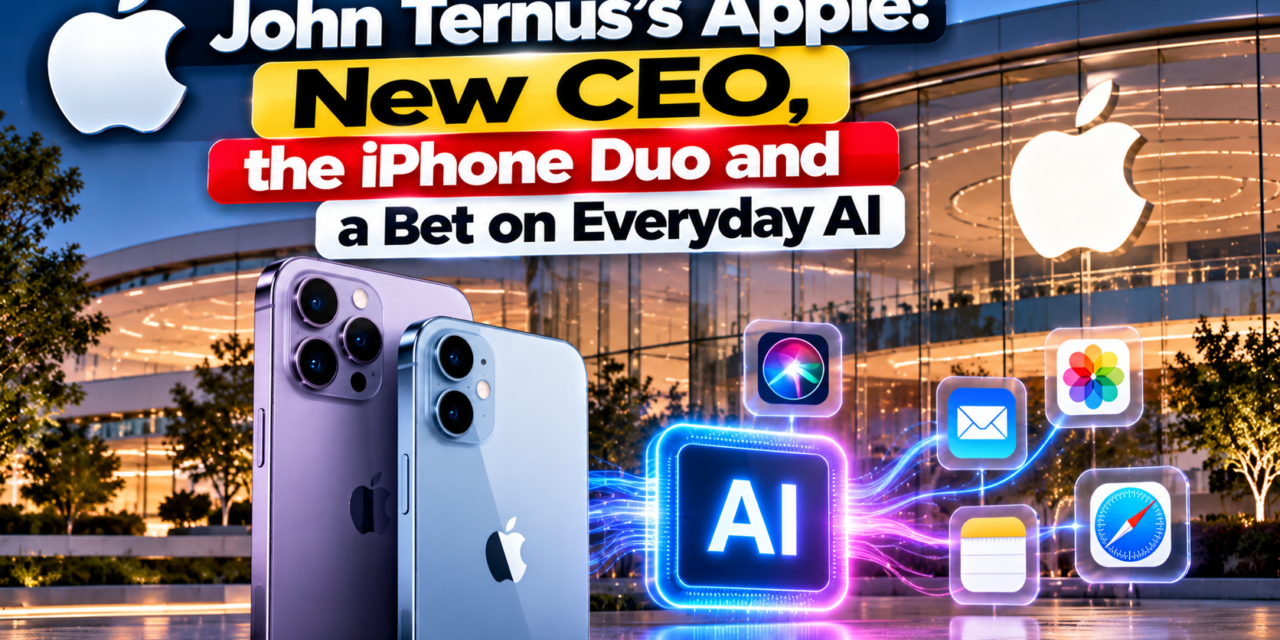
Apple has a new leader, a new foldable phone, and a different plan for artificial intelligence than almost every other big tech company. In a profile published by TIME on October 15, 2026, new CEO John Ternus explains how he wants to guide Apple while rivals race to build ever smarter AI.
This article summarizes the key points in simple terms: who Ternus is, what the iPhone Duo is, how Apple approaches AI, and the challenges ahead.
Quick summary
- New CEO: John Ternus took over as Apple’s CEO on September 1, 2026. Tim Cook stays on as executive chairman.
- New product: The iPhone Duo, Apple’s first foldable phone, starts at $1,999.
- AI strategy: Apple is building a modest, personal, privacy-focused kind of AI instead of chasing the most powerful models.
- Big challenges: A global memory chip shortage, political pressure, child safety, and new rivals.
Who is John Ternus?
Ternus is a hardware engineer who has spent 25 years at Apple. Here are the highlights:
|
Fact |
Detail |
|---|---|
|
Born |
1975, Orange County, California |
|
Education |
Mechanical engineering, University of Pennsylvania |
|
Joined Apple |
2001, at age 26, after working at a virtual reality company |
|
Known for |
Shaping products such as the Mac, iPad, AirPods, and iPhone |
|
Became CEO |
September 1, 2026 |
He fell in love with Apple as a child when his father bought an Apple II. Colleagues describe him as pragmatic, careful, and good at bringing teams together. Unlike Steve Jobs, who was a visionary showman, or Tim Cook, who was a skilled negotiator, Ternus is a private, detail-focused engineer. Rather than copy them, he is playing to his own strengths, which are also Apple’s: building beautiful products people enjoy using.
The iPhone Duo: Apple’s first foldable
The Duo is Apple’s biggest design change to the iPhone since 2007. It folds like a passport-sized phone that opens into a tablet.
What makes it notable:
- Almost no visible crease. Apple developed a special surface material and a hinge with more than 100 tiny precision parts. Early users say they can barely detect a crease.
- New display engine. It helps the phone move smoothly between its inner and outer screens.
- Redesigned iOS. Main controls moved to the right side for easier thumb use.
- Useful features. Compare websites side by side, watch movies, play games, and use a dual-camera setup on FaceTime.
Apple has explored foldables for years. Ternus and five other engineers filed a patent application in 2011. Other companies reached the market first, but Ternus pushed his team to keep improving instead of settling for “good enough.”
The risks: The price will put off many buyers, and Apple has had flops before, such as the Vision Pro, which reportedly sold very poorly in the past year. Still, early feedback has been positive, and demand for rival foldables like Samsung’s Galaxy Z Fold8 has been strong.
Apple’s different approach to AI
Most big tech companies are spending hundreds of billions of dollars to build the most powerful AI. Apple trains its own models but is not at the cutting edge. Critics worry it could be left behind. Apple’s leaders disagree and say they are focusing on AI that helps ordinary people.
The new Siri
The new Siri launched in the US in September. It is powered by an Apple AI model that uses Google’s Gemini technology. That means Apple relies on a rival for an important part of its product, something Steve Jobs disliked. Ternus says Apple has always relied on suppliers for parts such as screens and memory, and that Apple focuses on what it can do differently.
With your permission, Siri can connect information across your messages, emails, calendars, documents, and other data on your Apple devices. It can help you prepare for a meeting, find a flight confirmation buried in your inbox, or interpret health data from your Apple Watch.
The tradeoff is that Siri can’t code like OpenAI’s Codex or write like Anthropic’s Claude. Apple executives say this is partly by design. They did not want it to act like a companion or replace human connection.
Privacy as a selling point
- Siri processes requests on the device when possible.
- Harder requests go to Apple’s Private Cloud Compute, which is designed so that queries are not stored or accessible to the company.
- Apple has made parts of this system open for independent researchers to inspect. Some have praised the approach while noting limits to its transparency.
Why Apple thinks it can win
Ternus argues that even if others build super-smart AI, people will still want to use it on devices like the iPhone. His view is that people want physical things to talk to, take pictures with, and look at loved ones on. Analysts add that Apple’s strength is its ecosystem. The device, the operating system, and your personal information are what make AI truly useful.
There’s some evidence for this. Earlier this year, many AI fans bought $600 Mac Minis to run personal AI agents at home with an open-source project called OpenClaw. Demand was strong enough that some Mac Mini models were unavailable for months.
Challenges ahead
Memory chip shortage
Ternus calls the global shortage of memory chips a crisis. It has raised costs and delayed production. The Financial Times reported in July that Apple had begun testing memory chips from a Chinese company, which drew criticism from a bipartisan group of US senators who said it could threaten national security. Ternus says all options should be on the table.
Politics and government
Tim Cook was skilled at dealing with governments. He still represents Apple at major world events. Ternus says he has met with members of the Trump administration and is keeping details of his own approach private.
Child safety
Governments are restricting children’s use of social media, AI, and phones in schools, and pressing Apple and Google to add stronger protections. Apple rolled out a redesigned Screen Time experience in September with more parental controls. Ternus says child safety will be central to Apple’s approach.
New competition
- OpenAI acquired the startup of Jony Ive, Apple’s former chief design officer, and is building AI-first devices with former Apple veterans.
- Apple sued OpenAI in July, alleging theft of hardware trade secrets. OpenAI calls the lawsuit baseless.
- New Apple hardware: Apple announced a smart-home hub called HomeView on October 13. Bloomberg has reported that Apple is preparing smart glasses for 2027, though Apple declined to comment.
Apple by the numbers
- 2.5 billion active Apple devices
- Nearly half a trillion dollars in yearly revenue
- $1,999 and up for the iPhone Duo
- September 18: Date of the latest iPhone launch, with lines of customers from Hangzhou to London to Mumbai
Why this matters
- A change of style. Apple is returning to its hardware and design roots under an engineer CEO.
- A different AI bet. Instead of racing for the smartest AI, Apple is betting on helpful, private, and personal AI.
- High stakes. If powerful AI changes the world, Apple’s modest approach could look smart or too cautious.
- Lots of pressure. Supply chains, politics, child safety, and new rivals all need attention at once.
Frequently asked questions
Who is Apple’s CEO? John Ternus, since September 1, 2026. Tim Cook is executive chairman.
What is the iPhone Duo? Apple’s first foldable iPhone, starting at $1,999, that opens from a phone into a tablet.
Does the new Siri use Google’s technology? According to TIME, it is powered by an Apple AI model that uses Google’s Gemini technology.
Is Apple behind in AI? Apple trains its own models but is not at the frontier. Its leaders say they are focusing on personal, private AI for everyday people.
What is HomeView? A smart-home hub announced on October 13 and powered by Apple Intelligence.
Conclusion
John Ternus is leading Apple at an important moment. The iPhone Duo shows the company’s strength in hardware and design, while its AI plan shows a different path from the rest of Big Tech. Whether that approach works will depend on how well Apple handles chip shortages, government pressure, child safety, and new competition. For now, Apple is betting that most people care less about the most powerful AI and more about technology that is useful and private in everyday life.
Note: This article is based on a TIME profile published on October 15, 2026, rewritten in my own words. Please check the original article and Apple’s official announcements for full details.