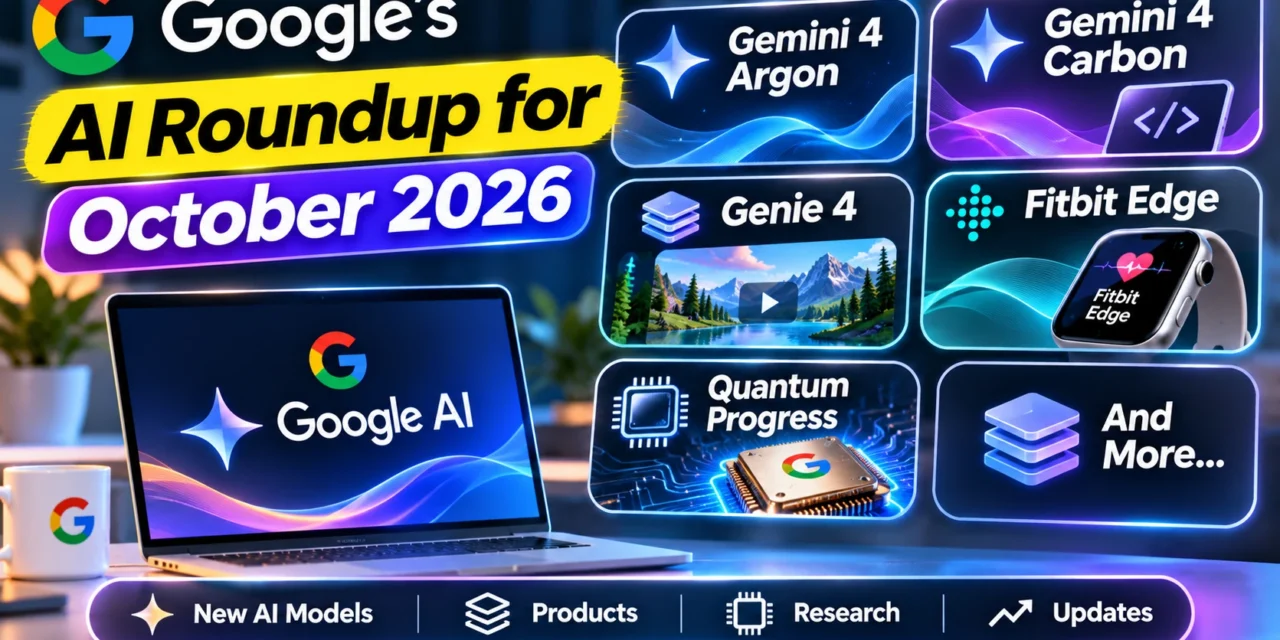
Google packed a lot into October. It rolled out one frontier AI model worldwide, announced a stronger one two weeks later, and shared news about world simulation, health, scam protection, education, space-based computing, and quantum computing.
This article summarizes Google’s own monthly recap, published on November 2, 2026. Everything below comes from Google’s blog, so the performance and safety claims are the company’s own and have not been independently verified here.
Quick summary
- Gemini 4 Argon: A frontier reasoning model, now rolled out globally.
- Gemini 4 Carbon: Google’s strongest model yet for long-horizon engineering and cybersecurity defense, in limited pre-release testing.
- Genie 4: A new world model for real-time interactive simulation with native audio.
- Google Fitbit Edge: A new fitness tracker with a Gemini-powered coach.
- Quantum computing: A technique that reportedly cuts errors roughly 40-fold.
- Space: The first AI response generated by a data center-class chip in orbit.
The big picture: two models in two weeks
Google says it released one frontier model globally and announced its next one just two weeks later, while strengthening safety guardrails at the same time.
|
Model |
What it is |
Availability |
|---|---|---|
|
Gemini 4 Argon |
Frontier reasoning model for complex coding, financial analysis, and legal workflows |
Rolled out globally across Google AI Studio, the Gemini API, Google Cloud, Search, and the Gemini app |
|
Gemini 4 Argon for Robotics |
Physical-world reasoning |
Powered by Argon |
|
Gemini 4 Carbon |
Strongest model yet for long-horizon engineering and cybersecurity |
Pre-release testing with the US government and a subset of trusted cyber defenders through the Fairwind Program |
Google says Carbon will have a broader launch to developers, businesses, and consumers after it refines safety guardrails and expands partner testing. No date was given.
Genie 4: interactive worlds
Genie 4 is a world model that creates real-time interactive simulations. According to Google, it adds:
- More realism and advanced physics
- Lifelike human movement
- Native audio
- Steering of scenes with natural language as they unfold
Google says it advances the creation of safe training environments for robots and AI agents, which it calls an important step toward AGI. Demos are available on the Google DeepMind blog.
Safety tools: verifying AI content and stopping scams
SynthID Detector goes global
Google says it has watermarked more than 180 billion images and videos and 240,000 years of audio with SynthID. It is expanding SynthID Detector globally in English so anyone can check whether an image, video, or audio clip was generated with AI.
- Built-in verification tools in Search, Chrome, and the Gemini app regularly handle over a million requests each day.
- The detector also identifies AI content from industry partners such as OpenAI, NVIDIA, Kakao, and Apple.
New Android scam protection
- Scam Detection in Phone by Google and Google Messages already flags more than 5 million suspected scam calls and texts a month.
- A new opt-in Enhanced protection mode in Google Messages uses Private AI Compute and the latest cloud Gemini models to catch sophisticated conversational scams.
- Expanded chat alerts and stronger defenses against call forwarding and screen sharing scams are included.
Health and clinical AI
Google Fitbit Edge
Google calls it its smartest fitness tracker. Features include:
- Slim, comfortable design with up to seven days of battery life
- Precision GPS
- Automatic workout recognition across more than 50 activities
- Personalized guidance from the Gemini-powered Google Health Coach
Google also rolled out more than 55 updates across Google Health and Fitbit Air, including photo meal logging, new Metal Mesh bands, and Health Guardian features that track long-term blood pressure and insulin resistance trends.
AMIE in real clinics
In Google’s first publication in the main journal of The Lancet, researchers from Google and Beth Israel Deaconess Medical Center tested the AMIE conversational medical AI in real primary care visits. AMIE gathered patient histories and produced clinical summaries before urgent care appointments.
|
Result |
Figure |
|---|---|
|
Helped clinicians prepare |
75% of cases |
|
Matched doctors’ final differential diagnoses |
90% of the time |
Creativity, games, and education
- Playground: A new experimental platform where anyone can build, remix, and share custom single- and multiplayer games from simple text prompts, with no coding.
- Personal AI apps on Android: Users can build apps with Google AI Studio and install them from Google Play.
- Google Flow Music: Music producers can vibe code custom instruments and audio plugins.
- For teachers: For World Teachers’ Day, Google shared how teachers use Gemini, with a global idea search in partnership with TED.
- Gemini Notebook: Study tools such as interactive learning overviews and custom quizzes, plus co-creation controls for Slide Decks and Video Overviews.
Scaling AI from devices to orbit to science
EmbeddingGemma 2
An open embedding model built on the Gemma 4 architecture with 740 million parameters. It maps code, images, video, and audio into one shared space on everyday devices. Google says its modular design cuts local vector storage by up to 6 times, helping developers build private, offline apps, such as finding a video clip from a voice memo.
Project Suncatcher
Google’s prototype satellite returned the first AI response generated by a data center-class Google TPU in space: a haiku composed onboard by Gemma 4. This shows the hardware survived launch and can run AI in orbit. The team will keep testing how the chips handle radiation and extreme temperatures, as part of a long-term goal of orbital AI infrastructure powered by solar energy.
Research@ 2026
- An experimental Geospatial Reasoning agent
- Public access to the Deep Review tool for technical papers
- Top-ranked flu hospitalization forecasting
- Mapping of the world’s forest types
- $36 million from Google.org to 17 organizations for AI-driven science
Quantum computing breakthrough
In a study published in Science, Google Quantum AI showed that a technique called “magic state cultivation” works in practice on its Willow quantum processor. It reduced errors roughly 40-fold compared with uncultivated states. Producing high-purity magic states had threatened to use up to 95% of a quantum computer’s resources, so Google says this clears a major hurdle toward large-scale, fault-tolerant quantum computers.
Why this matters
- Fast release cycles. Two models in two weeks show how quickly the frontier is moving.
- Staged access. Carbon’s limited release to cyber defenders reflects caution about powerful security capabilities.
- Trust tools. Verifying AI content and blocking scams are becoming core features.
- AI in health. Clinical studies suggest AI may help doctors prepare, though real-world impact still needs careful evaluation.
- Beyond text. World models, space computing, and quantum research show AI spreading into many fields.
Things to keep in mind
- This is Google’s own summary. It highlights the company’s successes.
- Claims are not independently verified here. That includes safety, accuracy, and performance figures.
- Some products are limited. Carbon, SynthID Detector (English), and several tools have restricted availability.
- Research results are early. Medical AI and quantum results need further testing and replication.
Frequently asked questions
What is Gemini 4 Argon? Google’s frontier reasoning model for complex coding, financial analysis, and legal tasks, now available globally.
Can I use Gemini 4 Carbon? Not yet. It is in pre-release testing with the US government and trusted cyber defenders.
What is Genie 4? A world model for real-time interactive simulation with advanced physics and native audio.
How can I check if something is AI-generated? Use SynthID Detector, which Google is expanding globally in English, or built-in tools in Search, Chrome, and the Gemini app.
What did AMIE achieve? In a real-world clinic study, it helped clinicians prepare in 75% of cases and matched doctors’ final differential diagnoses 90% of the time.
What is Project Suncatcher? A Google effort to run AI chips in orbit. Its first prototype satellite returned an AI-generated haiku.
Conclusion
Google’s October shows a company moving on many fronts at once: faster models, safer tools, better health features, and long-term bets in space and quantum computing. As always, these are company claims, so the real test will come as developers, doctors, and everyday users put the tools to work.
Note: This article is based on Google’s blog post “The latest AI news we announced in October 2026,” dated November 2, 2026, rewritten in my own words. All claims are Google’s.