
SEO used to be mostly about keywords and backlinks. Those still matter, but AI has changed how people find information. Search engines now summarize answers, chat tools recommend sources, and algorithms understand topics far better than before.
If you work in marketing, run a website, or write content, these ten terms will help you keep up. Each one is explained in plain language, with a simple tip on what to do about it.
For each term, you’ll find a simple definition, a real-world example, and a practical tip. A short FAQ and a conclusion with next steps follow at the end.
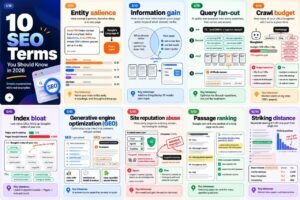
1. Entity salience
An “entity” is a clearly defined thing, such as a person, brand, place, or product. Entity salience is how clearly your page shows which entity or topic it is mainly about.
When a page jumps between many ideas, search engines struggle to tell what it covers. A page with a clear main subject is easier to understand and match with the right searches.
Example: A page titled “Best Sourdough Bread in Austin” that talks only about sourdough, the bakery, and its location is clearer than one that also covers coffee, catering, job openings, and wedding cakes.
What to do: Pick one main topic per page. Mention it in the title, the headings, and the opening paragraph, and support it with closely related terms.
2. Information gain
Information gain means adding something new that other pages on the topic don’t offer. If your article repeats what the top ten results already say, there’s little reason for anyone to choose it.
New value can be original data, a real example, an expert quote, a case study, or a fresh point of view.
Example: Dozens of articles on remote work repeat the same tips. One that includes results from the author’s own survey of 200 remote employees gives readers something they can’t find anywhere else.
What to do: Before publishing, ask, “What does this page add that others don’t?” If the answer is nothing, keep working.
3. Query fan-out
AI search tools often don’t answer a question with one search. They break it into several related questions, look up each one, and combine the results into a single complete answer. This is called query fan-out.
For example, someone asking about the best laptop for students might trigger searches on battery life, price, weight, and reviews, all at once.
Example: A laptop retailer publishes a student buying guide with separate sections on battery life, price, weight, and reviews. That one page can answer every sub-question an AI tool might ask.
What to do: Cover related questions in one well-organized page or a connected group of pages. The more of the follow-up questions you answer, the more chances you have to be included.
4. Crawl budget
Crawl budget is the amount of time and resources a search engine spends crawling your site. Large sites with thousands of pages feel this most, because not every page gets visited often.
If bots waste time on slow, duplicate, or low-value pages, your important pages may be crawled less often or discovered later.
Example: An online store with 50,000 URLs created by sorting and filter options (such as ?sort=price or ?color=blue) may find that bots spend time on those variations instead of its new product pages.
What to do: Keep your site fast, fix broken links, remove duplicate pages, and make sure your sitemap points to the pages that matter.
5. Index bloat
Index bloat happens when a search engine indexes too many pages that shouldn’t be there. Common culprits include filter pages, tag pages, old test pages, and near-duplicate content.
Too much low-quality content in the index can dilute your site’s overall quality and waste crawl budget.
Example: A blog has hundreds of empty tag pages and old test pages in Google’s index. Cleaning them up lets search engines focus on the pages that actually matter.
What to do: Review the pages indexed in Google Search Console. Remove, merge, or block pages with no real value, and use “noindex” tags where appropriate.
6. GEO (Generative Engine Optimization)
GEO is the practice of making your content easier for AI tools to use in their generated answers. Instead of only trying to rank in a list of links, you also want to be quoted, summarized, or cited by AI systems.
AI tools tend to favor content that is clear, well-structured, and trustworthy.
Example: A page answering “What is a 401(k)?” opens with a clear two-sentence definition, uses simple headings, and cites a trusted source. An AI tool can quote it far more easily than a page that buries the answer in long paragraphs.
What to do: Give direct answers near the top of sections. Use clear headings, short definitions, lists, and cited sources. Show who wrote the content and why they are qualified.
7. Site reputation abuse
This is a spam policy from Google. It targets the practice of publishing third-party content, such as coupons or unrelated reviews, on a trusted website mainly to borrow its ranking strength. The content often has little to do with what the main site is known for.
Sites that do this risk losing visibility.
Example: A respected news site hosts a section of unrelated coupon or payday-loan pages made by a third party, mainly to borrow the site’s ranking strength. This is the kind of case the policy targets.
What to do: Keep everything on your domain relevant and useful to your audience. If you work with partners or guest contributors, make sure their content follows your own editorial standards and adds real value.
8. Passage ranking
Google can identify and rank a specific section of a page, not just the page as a whole. This means a helpful paragraph buried in a long article can still show up for a specific search.
That works best when each section is clear and self-contained.
Example: A long home-budgeting guide includes a section titled “How to build an emergency fund.” That section alone can rank for a search like “how much emergency fund do I need.”
What to do: Use descriptive headings and make each section answer one question well. Avoid vague headings like “More thoughts.”
9. Striking distance keywords
These are keywords for which your page already ranks, usually around positions 11 to 20, which is the second page of results. They’re close to page one, so a small improvement can bring a big jump in clicks.
This is often the fastest win in SEO because you’re improving something that already has traction.
Example: Your article on email subject lines ranks 14th for “best email subject lines for sales.” Adding 10 fresh examples, a clearer heading, and a few internal links could help move it onto page one.
What to do: Use Google Search Console to find queries in that range. Then expand the content, improve headings, add internal links, and refresh outdated information.
10. SEO plus AI strategy
The smartest approach combines traditional SEO with AI-focused optimization. You still need technical health, good content, and trustworthy links. You also need content that AI systems can easily understand and cite.
These goals work together. Clear writing, strong structure, and real expertise help both people and machines.
Example: A travel company keeps its pages fast and its backlinks strong. It also adds a clear FAQ with direct answers and an expert author bio, so both Google and AI assistants have reasons to trust and quote it.
What to do: Build on your SEO foundation, then add AI-friendly habits like direct answers, structured sections, and original insights. Track both search traffic and mentions in AI tools.
Quick reference
- Entity salience: A clear main topic for each page
- Information gain: Something new that others haven’t covered
- Query fan-out: AI searching several related questions at once
- Crawl budget: The time Google spends crawling your site
- Index bloat: Too many low-value pages in the index
- GEO: Optimizing to appear in AI-generated answers
- Site reputation abuse: Using a trusted site to rank unrelated third-party content
- Passage ranking: Ranking specific sections of a page
- Striking distance keywords: Rankings around positions 11 to 20
- SEO plus AI strategy: Combining classic SEO with AI-focused optimization
Frequently asked questions
Is SEO still worth it now that AI answers questions directly?
Yes. AI tools draw on web content, so clear, trustworthy pages still matter. Good SEO also helps people find you when they want to click through and learn more.
What is the difference between SEO and GEO?
SEO aims to rank your pages in search results. GEO aims to get your content used or cited in AI-generated answers. The two overlap heavily, and good content helps with both.
Do I need to worry about crawl budget on a small site?
Usually not. Crawl budget matters most for very large sites with thousands of pages. Small sites should focus on quality content and a clean structure.
How do I find striking distance keywords?
Open Google Search Console, go to the Performance report, and look for queries where your average position is between 11 and 20. Start with the ones that already get many impressions.
How can I check for index bloat?
Use the Pages report in Google Search Console to see which URLs are indexed. Look for duplicates, thin pages, and old test content you can remove or block.
What is the fastest way to add information gain?
Include something original, such as your own data, a real customer story, an expert quote, or a step-by-step example from your experience.
What is query fan-out in simple words?
It’s when an AI tool breaks one question into several smaller searches, gathers the results, and combines them into one answer. Covering related questions on your page gives you more chances to be included.
Does passage ranking mean I should write shorter pages?
Not necessarily. It means each section should be clear and focused. A long page works well when every section answers one question completely.
Will AI-written content hurt my rankings?
Google says it focuses on content quality rather than how content is produced. Low-quality, unhelpful pages can still hurt you, so edit AI drafts carefully and add real expertise.
How long does it take to see results?
It varies. Quick fixes like updating a page near page two can show changes in a few weeks, while bigger strategy changes often take a few months.
Conclusion
Don’t optimize only to rank on Google. Create content that people and AI systems can understand, trust, and use. If you focus on clarity, originality, and real value, you’ll be in a strong position no matter how search keeps changing.
To get started, pick two or three terms from this list that fit your site best. A good first step is to review your striking distance keywords, clean up low-value pages, and add one original insight to your most important article. Small, steady improvements add up.
Search rules and features evolve quickly, so check Google’s official documentation for the latest guidance.