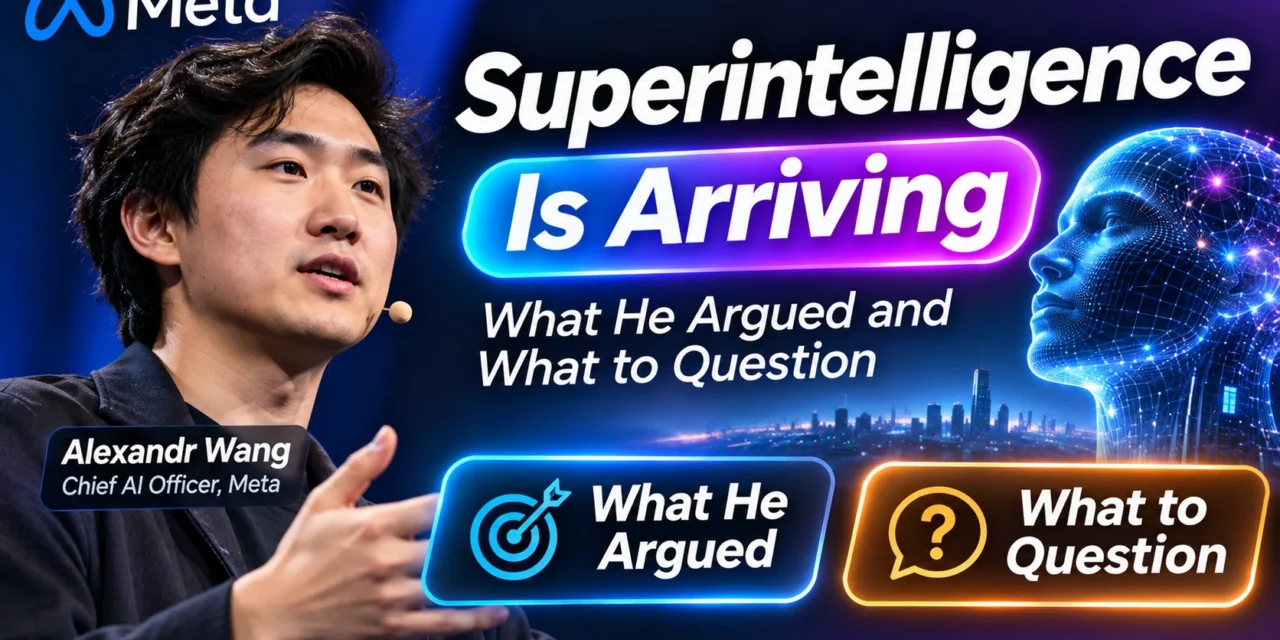
Meta AI chief Alexandr Wang has posted a long warning on X saying the world may already be entering the era of superintelligence, and that the next year will decide whether it helps humanity or slips out of human control. His argument rests on a reported proof of the Riemann Hypothesis, one of mathematics’ most famous unsolved problems.
This article covers his main claims, his call for a different path and why his predictions deserve careful reading. The details come from a Times of India Tech Desk report dated November 23, 2026, which includes Wang’s full post. They are one executive’s opinions and forecasts, not established facts, and I can’t independently confirm the math claim.
Quick summary
- Who said it: Alexandr Wang, described by Times of India as Meta’s AI head.
- Where: A long post on X.
- Core claim: Superintelligence is arriving, and recent math breakthroughs prove raw intelligence is no longer the main barrier.
- Trigger: The reported proof of the Riemann Hypothesis.
- His ask: Focus urgently on safety, alignment and security, and don’t accept a “handover” of society to AI.
Key points at a glance
| Area | Details |
|---|---|
| Report date | November 23, 2026 |
| Source type | Wang’s own X post, reported by Times of India |
| Evidence cited | Reported proof of the Riemann Hypothesis, plus AI models acing AIME math problems from December 2024 |
| Claimed remaining gaps | Domain know-how, infrastructure and experimentation, not intelligence |
| Biggest worry | Unconstrained recursive self-improvement |
| Verification | Not provided in the report |
1. The main claim
Wang says superintelligence is arriving and that how humanity acts over the coming year will have major consequences. He calls the reported proof of the Riemann Hypothesis a clear marker of a significant change.
He describes the problem as the pinnacle of intellectual achievement and says many physicists would call the atomic bomb a homework problem next to it. He credits the result to what he calls an “alien mind” that humans don’t understand.
2. His reasoning: the AIME comparison
Wang compares the moment to December 2024, when models began acing the AIME, a hard math competition for teenagers. His point is that the toughest AIME problems are harder than most day-to-day work in engineering, cybersecurity or business. So once models could solve them, raw intelligence stopped being the bottleneck.
Since then, he says, progress came from filling in other gaps. He points to coding being nearly solved, very strong cyber abilities and capable agents that work as general-purpose aides.
3. What he expects next
Wang argues the remaining barriers to AI surpassing humans everywhere are domain-specific know-how, infrastructure and experimentation. On that basis, he expects AI to become the largest contributor to progress in nearly every field, far ahead of top human experts.
That includes AI research itself, which he says is less demanding than the Riemann Hypothesis. In his view, models will be able to automate all of it and improve themselves in a clearly superhuman way, while also speeding up biological, weapons and economics research. He warns that fields could move faster than humans can follow or monitor.
4. His call for a different path
Wang says it’s hard to imagine humans keeping control over unconstrained recursive self-improvement, or over a system a thousand times smarter than people in every field. He believes the core technical problems of making models more capable are likely solved, so the urgent work is safety, alignment and security, along with deciding how progress should unfold.
He criticizes what he calls lazy thinking in the AI industry: the idea that superintelligence is inevitable and the only task is to do it safely. He says society shouldn’t accept being handed over to AI. It should aim for technology that gives all humans more agency, which he thinks will require the whole industry to depart from its default path.
What this says about the AI debate
- Industry insiders are sounding alarms. A senior leader at a major lab is openly worried about control.
- The definition of “intelligence” is contested. Wang treats math ability as the key measure, which not everyone accepts.
- The framing shapes policy. Calling superintelligence inevitable can push governments and companies toward certain choices.
- Safety and speed pull against each other. His own company is building advanced AI while its AI head asks for a different path.
Why this matters
- For policymakers: A prominent insider is urging attention to safety and oversight.
- For AI companies: Public pressure may grow to explain their plans for control and alignment.
- For workers and students: Predictions of AI outperforming experts across fields affect career thinking.
- For readers: A reminder that big forecasts from industry leaders come with their own stakes.
Things to keep in mind
- These are opinions and predictions. They aren’t settled facts.
- The Riemann Hypothesis claim is unverified here. The report calls it “reported,” and a proof of that scale would need extensive expert review.
- Math skill isn’t the same as real-world ability. Hard puzzles differ from messy practical work, which is where many experts see limits.
- Wang leads AI at a company building these systems. His view comes with business context.
- “Superintelligence” has no agreed definition, and forecasts often turn out wrong on timing.
Tips if you want to follow this debate
- Read Wang’s original post alongside responses from other researchers.
- Look for independent mathematicians’ verdicts on the Riemann Hypothesis claim.
- Compare his view with those of skeptics who see slower progress.
- Notice who benefits when a claim is made, and who doesn’t.
- Treat timelines as estimates, not schedules.
Frequently asked questions
What did Alexandr Wang say? That superintelligence is arriving, and that humanity’s actions over the next year will shape the future.
What evidence did he cite? A reported proof of the Riemann Hypothesis and models acing AIME problems from December 2024.
What does he think is left to solve? Domain know-how, infrastructure and experimentation, not intelligence.
What is he most worried about? Losing control through unconstrained recursive self-improvement, and a superintelligence far beyond humans in every field.
What does he want done? More work on safety, alignment and security, and a deliberate choice about how progress unfolds.
Is the Riemann Hypothesis proof confirmed? The report doesn’t confirm it, so check independent expert coverage.
Does he think superintelligence is inevitable? He criticizes that assumption, saying society shouldn’t accept a handover to AI.
Conclusion
Wang’s post is one of the starkest public warnings yet from a senior AI leader. It combines a bold claim about machine intelligence with a plea for safety and human agency. The claims are his own, and the key math result still needs independent confirmation. Read it as an influential opinion, and watch for expert reactions and any concrete steps from Meta and other labs.
Note: This article is based on a Times of India Tech Desk report dated November 23, 2026, which reproduces Alexandr Wang’s X post, rewritten in my own words.