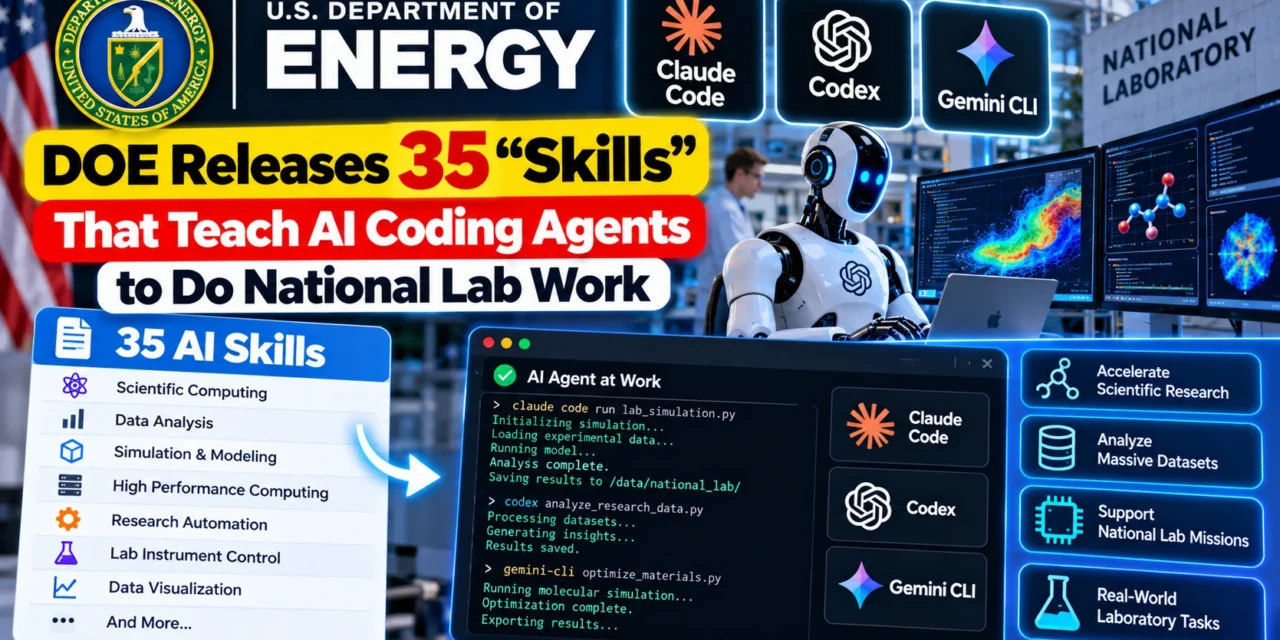
The US Department of Energy (DOE) has released a package of 35 “skills” that give AI coding tools access to national laboratory know-how. The skills are part of the Genesis Mission, a government effort to use AI to speed up scientific research.
This article explains what a skill is, what the package includes, who built it, which AI tools it works with, and how it fits into the wider Genesis Mission. The details come from an R&D World report dated October 29, 2026.
Quick summary
- What was released: 35 skills for AI coding agents.
- Who released it: The US Department of Energy, under its Genesis Mission.
- Works with: Claude Code, Codex, Cursor, OpenCode, Gemini CLI, and LangChain Deep Agents, according to the project’s documentation.
- Who wrote them: Researchers at seven national laboratories.
- Where it came from: The ModCon (Transformational AI Models and Data) program and the American Science Cloud.
What is a “skill”?
A skill is a folder of instructions that an AI agent loads when it needs to perform a certain task. Think of it as a how-to guide that the agent can read when needed.
- Each skill is built around a file called SKILL.md.
- That file’s metadata tells the agent when to use the skill.
- The folders typically contain Markdown files.
- Some skills also include scripts the agent can run.
The skills follow the Agent Skills format. DOE says the package complements existing skill libraries that focus on coding and software engineering.
What is in the package?
|
Detail |
Number |
|---|---|
|
Total skills |
35 |
|
Skills that include Python or shell scripts |
23 |
|
Text-only skills |
12 |
Examples of what the skills do
- Supercomputer work. Drafting job scripts for supercomputers such as Oak Ridge’s Frontier, along with guides for the Aurora and Perlmutter systems.
- Data tools. Generating a data card, which is a standard summary of what a dataset contains and how it was made.
- Literature search. A standalone skill for searching scientific papers.
- Multi-agent systems. A standalone skill for coordinating several agents.
- Science cloud services. Clients for American Science Cloud services such as Globus Compute.
- Other areas. Agent evaluation and monitoring, data governance, scientific workflows, and safety analysis workflows.
The text-only skills include the job-scheduling guides for Frontier, Aurora, and Perlmutter.
Who built them?
Researchers at seven national labs wrote the skills, according to attribution files in the project’s repository.
|
Contributor |
Work |
|---|---|
|
Matt Baughman, Princeton Plasma Physics Laboratory |
Five supercomputer and scheduler skills |
|
Ian Foster, Argonne |
The literature-search skill |
|
Teams led from Lawrence Berkeley and Pacific Northwest national laboratories |
Data and safety skills |
|
Nathan Hodas, Pacific Northwest National Laboratory |
Uploaded the first 291 files to GitHub on August 5 |
The Baseline AI R&D Capabilities (BASE) team within ModCon developed the package. Pacific Northwest National Laboratory and Lawrence Berkeley National Laboratory co-lead the team.
AI helped, with human review
The project’s contribution guide allows AI-assisted work with disclosure and requires a human reviewer on every pull request. Of its 69 commits, eight list Anthropic’s Claude or GitHub Copilot as a co-author.
Which AI tools can use them?
The documentation says the skills work with:
- Claude Code
- Codex
- Cursor
- OpenCode
- Gemini CLI
- LangChain Deep Agents
It adds a caveat: individual skills may still depend on client-specific features or external tools. Anthropic, OpenAI, and Google, the companies behind three of these agents, have all signed on as Genesis Mission partners.
What is the Genesis Mission?
The Genesis Mission is the Trump administration’s initiative to use AI to speed up scientific research. ModCon and the American Science Cloud build the shared AI tools and data for the national labs under it. DOE describes this release as the first building block of the mission’s shared research infrastructure, and one that works with commercial and open-source coding agents.
A note on the “SI” wording
The DOE release uses “Super Intelligence (SI)” throughout, following a September executive order that requires federal agencies to replace “artificial intelligence” with that term. This is a naming change. It does not describe a new kind of technology, and the tools in this package are the same kinds of AI coding agents available today.
How do the AI companies fit in?
- Partners. Anthropic, OpenAI, and Google were among 24 organizations that signed memorandums of understanding with DOE for the Genesis Mission.
- Pledges. On October 8, at a White House summit, 11 companies pledged a combined $2.4 billion in tools and compute credits for science, including $200 million from OpenAI and $150 million each from Google and Anthropic.
- Anthropic and DOE. In December 2025, Anthropic announced a multi-year partnership with DOE giving the national labs access to Claude and Anthropic-built tools, including Claude Skills for scientific workflows. A three-year commitment announced on October 8 makes Claude available to more than 15 agencies, including NASA, the National Institutes of Health, and the National Science Foundation, with credits for several hundred Genesis Mission projects.
Why this matters
- Expert knowledge becomes reusable. Lab know-how that once lived in people’s heads and scattered documents can now be loaded by an AI agent.
- Faster research. Agents that know how to use supercomputers and data tools may save researchers time.
- Works across tools. Support for several agents avoids tying researchers to one vendor.
- Open sharing. Publishing skills in a repository lets others review and reuse them.
- Human review is built in. Required reviewers on every pull request add a layer of oversight.
Things to keep in mind
- First step. DOE calls this the first building block, and more is expected.
- Compatibility caveats. Some skills may need specific tools or features.
- Skills do not replace expertise. They guide agents, but scientists still need to check the results.
- Real-world impact is unproven. The report does not include results showing how much faster research becomes.
- Funding pledges are pledges. The $2.4 billion figure is a commitment announced at a summit.
Frequently asked questions
What is a skill for an AI agent? A folder of instructions, usually in Markdown, that an agent loads when it performs a particular task.
How many skills did DOE release? 35, of which 23 include Python or shell scripts.
Which agents work with them? Claude Code, Codex, Cursor, OpenCode, Gemini CLI, and LangChain Deep Agents, according to the documentation.
Who wrote them? Researchers at seven national laboratories.
Was AI used to write them? Some work was AI-assisted, with disclosure and human review required. Eight of 69 commits list Claude or GitHub Copilot as a co-author.
What is the Genesis Mission? The administration’s initiative to use AI to speed up scientific research.
Conclusion
DOE’s 35 skills are a practical step toward putting national lab expertise in the hands of AI coding agents. By packaging instructions that work across several tools and requiring human review, the project aims to make AI more useful for real scientific work. How much it speeds up research will depend on how widely the skills are used and how well scientists verify what the agents produce.
Note: This article is based on an R&D World report by Julia Rock-Torcivia dated October 29, 2026, rewritten in my own words. Please check DOE’s repository and official announcements for details.