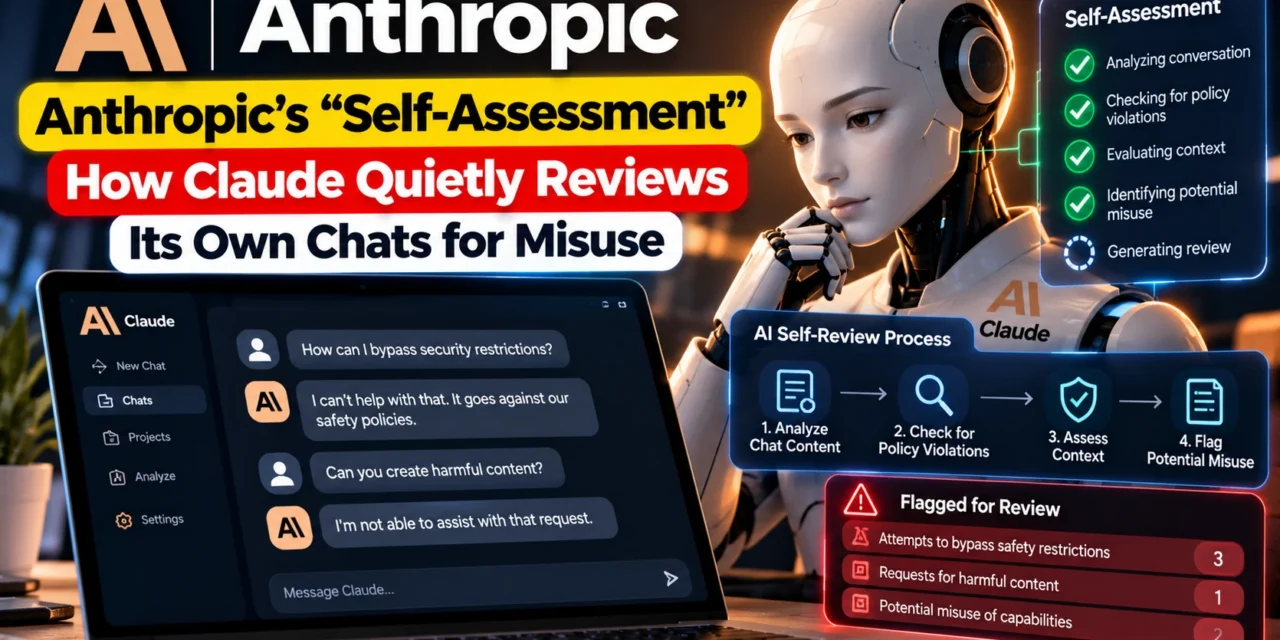
Anthropic has described a safety technique in which Claude briefly reviews its own conversations for signs of misuse right after it replies. The company calls it “self-assessment.” It runs in the background, adds very little cost, and flags concerning chats for later human review.
This article explains how it works, what the reported results are, where it falls short, and what it means for users. The details come from an India Today report dated October 30, 2026, based on Anthropic’s own statements, so the performance figures are the company’s claims and have not been independently verified here.
Quick summary
- What it is: A background check in which Claude gives a short safety assessment of a conversation after responding.
- Since when: According to the report, it has run across models like Claude Fable 5 since June 2026.
- Cost: About 10 extra tokens per check, adding less than 2% to total computing cost.
- Accuracy (on Claude Fable 5): Catches 78% of harmful conversations overall and 94% of high-priority cases, with a 1% false-positive rate.
- Limit: It flags chats for later review. It does not block them in real time and is not strong enough to stop a determined attacker on its own.
How does self-assessment work?
Normally, an AI chat is a simple back-and-forth. With self-assessment, one extra step happens out of sight:
- Claude answers the user as usual.
- A hidden instruction is added asking Claude to review the exchange.
- Claude writes a short internal verdict noting whether the request was harmful, what type of harm it might be, and a priority score for human review.
- If it looks safe, the conversation is simply recorded as unflagged and nothing changes for the user.
Because Claude has already read the conversation, the system can reuse the stored memory of it, which is why the extra step is so cheap. There are no pop-up warnings or interruptions for the user.
Why use the model’s own judgment?
Anthropic says the technique draws on Claude’s own judgment instead of a fixed list of rules. That has two advantages:
- It improves as models improve. A smarter model should make better assessments.
- It can spot new kinds of misuse. Older safeguards were not built to catch complex or unfamiliar abuse.
The reported numbers
|
Measure |
Reported result |
|---|---|
|
Extra cost |
About 10 tokens, under 2% of total compute |
|
Older Anthropic safety systems |
Nearly 24% added cost |
|
OpenAI safety features (as reported) |
Up to 16% of compute |
|
Overall harmful conversations caught (Claude Fable 5) |
78% |
|
High-priority cases caught |
94% |
|
False-positive rate |
1% |
|
Fraud and cyberattack threats caught when examples were hidden from training |
90% |
The last result matters because it suggests the system can recognize types of misuse it was never specifically trained to look for.
What has it found in practice?
According to the report, in August alone the system flagged more than 100,000 cases of child sexual abuse material tied to a single customer. Anthropic reported these cases to the authorities.
What are its limits?
Anthropic is open about the limits, according to the report.
- It flags, it doesn’t block. The tool is designed to mark issues for later offline review, not to stop them instantly.
- It is not enough alone. In internal cybersecurity tests, attackers got past the AI 54% of the time when self-assessment was the only safeguard.
- It still helps. With no safeguards at all, attackers succeeded 79% of the time.
- Real-time blocking is stronger. A dedicated real-time blocking system reduced attack success to 25%.
|
Safeguard setup |
Attack success rate |
|---|---|
|
No safeguards |
79% |
|
Self-assessment only |
54% |
|
Dedicated real-time blocking |
25% |
Because of this, Anthropic uses self-assessment as an extra layer of background monitoring while keeping stronger, independent real-time blocks in place.
What does this mean for users?
The headline of the original report suggests Claude can “flag your chats.” Here is what the report actually describes:
- It evaluates conversations for potential misuse, such as harmful requests, and scores them for human review.
- Safe conversations are logged as unflagged. The user is not interrupted.
- Flagged chats go to later review. The report doesn’t spell out who reviews them or how they are handled.
People who care about privacy should read Anthropic’s privacy policy and usage policy to see how conversation data is used and who can see it. Anthropic’s own materials are the best source for those details.
Why this matters
- Safety at lower cost. If accurate, a check that adds under 2% to compute is easy to run at scale.
- Scalable monitoring. AI companies need ways to find misuse across huge numbers of conversations.
- Layered defense. The report shows that no single safeguard is enough, and that combining them works better.
- Transparency about weaknesses. Anthropic publicly admits where the tool falls short.
- Competition on safety. The report compares costs with other approaches, showing that safety efficiency is now a selling point.
Things to keep in mind
- Figures come from Anthropic. They have not been independently verified.
- Detection is not prevention. Flagging for later review does not stop harm in the moment.
- No system is perfect. A 1% false-positive rate still means some innocent chats could be flagged.
- Privacy questions remain. Users should look at official policies for how flagged conversations are handled.
- Context. The report notes that Anthropic filed publicly for a US stock market listing on October 26 under the ticker ANT, which may increase interest in how it describes its safety work.
Frequently asked questions
What is self-assessment? A technique in which Claude briefly reviews its own conversation right after replying, to flag possible misuse for human review.
Does it interrupt my chat? No. It runs silently, and safe conversations continue as normal.
Does it block harmful requests? Not by itself. It flags them for later review. Anthropic keeps stronger real-time blocks for immediate protection.
How accurate is it? On Claude Fable 5, Anthropic reports it catches 78% of harmful conversations and 94% of high-priority cases, with a 1% false-positive rate.
Is it expensive to run? No. It adds about 10 tokens per check and under 2% to compute cost.
Where can I learn how my data is handled? In Anthropic’s privacy policy and usage policy.
Conclusion
Self-assessment shows how AI companies are trying to monitor misuse at scale without large costs. Anthropic reports strong detection rates and very few false alarms, while openly saying the tool is a background layer and not a complete defense. As with any safety claim, independent testing and clear privacy information will help users decide how much to trust it.
Note: This article is based on an India Today report by Krishna Goswami dated October 30, 2026, which relies on Anthropic’s statements, rewritten in my own words. Performance figures are the company’s claims. Please check Anthropic’s official materials for details.