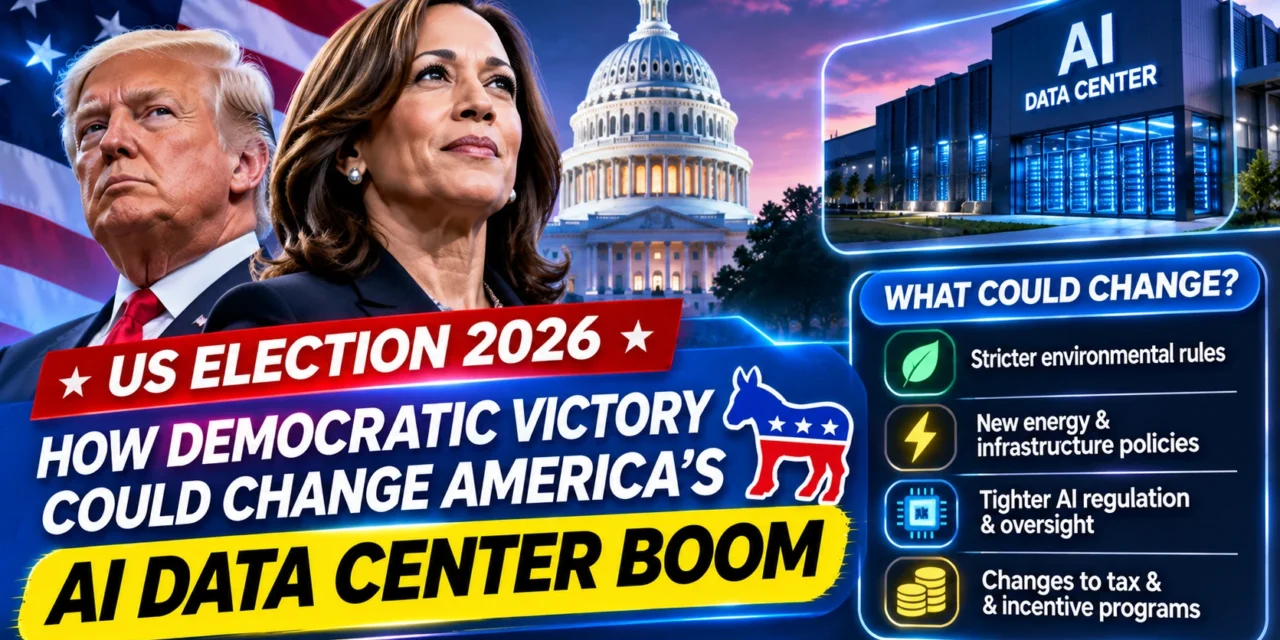
The United States is witnessing a major political shift following the 2026 midterm elections, and the impact could extend beyond Washington. One sector that may face significant changes is the rapidly growing artificial intelligence (AI) data center industry.
Developers planning large-scale AI data center projects in Texas are already dealing with challenges related to project approvals. Now, the election of Gina Hinojosa as Texas governor has created additional uncertainty for companies looking to expand their AI infrastructure in the state.
The development comes as Democrats secured control of both chambers of the US Congress, creating a new political environment for technology companies, investors, and infrastructure developers.
In this article, we explore why the US election results matter for AI data centers, what is happening in Texas, and how the political changes could influence America’s growing AI infrastructure industry.
What Happened in the 2026 US Elections?
The November 3, 2026, midterm elections resulted in a major victory for the Democratic Party. Democrats gained control of both the House of Representatives and the Senate, creating a significant setback for President Donald Trump and the Republican Party.
The election results also influenced financial markets, with Bloomberg reporting declines in stocks and the US dollar following the Democratic victory.
Beyond national politics, the results have raised questions about the future of major infrastructure projects, particularly those supporting artificial intelligence.
AI data centers require significant investment, land, electricity, water resources, and government approvals. Changes in political leadership can therefore create uncertainty for companies planning large-scale developments.
Why Texas Is Important for America’s AI Data Center Industry
Texas has become an important location for companies looking to develop large artificial intelligence infrastructure projects.
AI data centers require large facilities to operate powerful computing systems that support AI models, cloud platforms, and other digital services.
Developers are increasingly planning large campuses to meet the growing demand for computing capacity.
However, these projects also depend on several important factors:
-
Land availability: Large data center campuses require substantial areas for construction.
-
Electricity supply: AI infrastructure consumes significant amounts of power.
-
Government approvals: Developers need the necessary permissions before moving forward.
-
Infrastructure investment: Supporting facilities and resources are essential for operations.
-
Long-term planning: Companies need predictable conditions before committing billions to infrastructure.
Any delay or change in the approval process can affect project timelines and investment decisions.
Gina Hinojosa’s Election Creates New Uncertainty for AI Developers
One of the biggest developments following the US elections was Gina Hinojosa’s victory in the Texas governor’s race.
According to Bloomberg, she became the first Democratic governor of Texas in more than three decades.
Before this political change, AI data center developers were already dealing with a suspension of approvals under Republican Governor Greg Abbott.
Her election has created further uncertainty for companies planning major AI infrastructure projects across the state.
For developers, the main concern is how the new political leadership could influence future approvals and the broader environment for large-scale construction.
However, the supplied report does not specify any new restrictions or confirmed policy decisions by Hinojosa. The actual impact will depend on the policies introduced by her administration.
How Could Political Changes Affect AI Data Center Investments?
Building an AI data center is a major infrastructure investment. Companies need to plan projects well in advance, secure resources, and understand the regulatory environment before construction begins.
Political uncertainty can make this process more complicated.
Some possible areas of impact include:
1. Delays in Infrastructure Projects
If approval processes remain suspended or become more complicated, developers may face delays in moving their projects forward.
This could affect construction schedules and the availability of computing infrastructure.
2. Investment Decisions
Large technology companies and infrastructure investors need predictable conditions before committing substantial amounts of money.
Uncertainty around government approvals could encourage some developers to reconsider project timelines or locations.
3. Competition Between States
If Texas becomes more challenging for data center development, companies may explore opportunities in other states.
States that can provide suitable infrastructure, reliable electricity, and a clear approval process may become more attractive to investors.
4. Future Growth of AI Infrastructure
The expansion of artificial intelligence depends on access to powerful computing facilities.
Any slowdown in major data center projects could influence how quickly companies expand their AI infrastructure.
These are potential outcomes rather than confirmed consequences of the Texas election result.
What Does This Mean for the Future of the AI Industry?
The latest political developments highlight an important challenge for the artificial intelligence industry.
AI growth is not driven by software and advanced models alone. It also depends on physical infrastructure, including data centers, electricity networks, cooling systems, and large-scale construction projects.
As AI adoption increases, technology companies will need more computing capacity to support their products and services.
This makes government policies and infrastructure approvals increasingly important to the industry’s long-term growth.
The situation in Texas could become an important example of how political decisions influence the development of AI infrastructure in major technology markets.
Quick Overview: US Election Results and Their Impact on AI Data Centers
| Development | Key Details |
|---|---|
| US midterm elections | Democrats won control of both chambers of Congress |
| Texas governor election | Gina Hinojosa elected governor |
| Previous governor | Republican Greg Abbott |
| Data center approvals | Developers were already facing a suspension of approvals |
| Industry concern | Uncertainty around future project development |
| Potential impact | Investment decisions, construction timelines, and infrastructure expansion |
Frequently Asked Questions
1. Why could the 2026 US elections affect AI data centers?
Changes in political leadership can influence infrastructure approvals, investment conditions, and policies affecting large-scale data center projects.
2. Who is Gina Hinojosa?
Gina Hinojosa was elected as the new governor of Texas in the 2026 election, becoming the state’s first Democratic governor in more than three decades.
3. Why are companies building more AI data centers?
AI data centers provide the computing power required to train and operate artificial intelligence models, cloud services, and other advanced digital applications.
4. What challenges are AI data center developers facing in Texas?
According to the Bloomberg report, developers were already dealing with a suspension of project approvals under former Republican Governor Greg Abbott.
5. Could AI companies move their data center projects to other states?
It is a possibility if developers face prolonged delays or uncertainty. However, the supplied report does not confirm any company relocation decisions.
6. How important are data centers for artificial intelligence?
Data centers are essential because they provide the computing infrastructure needed to develop, train, and operate modern AI systems.
Conclusion
The 2026 US election results could introduce a new phase of uncertainty for America’s growing AI data center industry.
Texas has been an important location for large-scale infrastructure development, but the political transition following Gina Hinojosa’s election could influence how future projects move forward.
For technology companies and investors, the key factor will be whether the state can provide a predictable environment for infrastructure approvals and long-term investment.
As artificial intelligence continues to expand, the relationship between technology development, government policies, and physical infrastructure will become increasingly important.
Source: Bloomberg report by Lynn Doan, Brody Ford, and Brian Eckhouse, November 4, 2026.