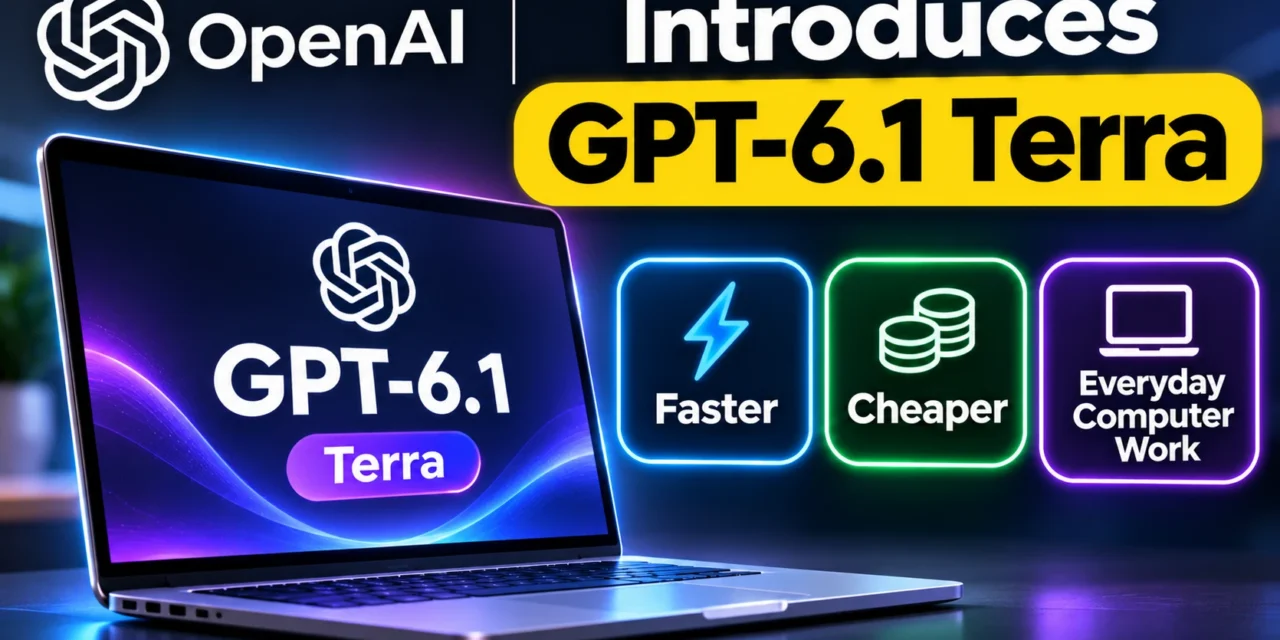
OpenAI has released GPT-6.1 Terra, a new model that aims to do more of the daily work people do on a computer, at a much lower price. It combines careful image understanding, precise computer control, and clearer writing, and it makes fewer factual mistakes than the model it replaces.
This article explains what Terra is, how it performed in OpenAI’s tests, what it costs, where you can use it, and what to keep in mind. All the numbers come from OpenAI’s own announcement, including comparisons with rival models such as Anthropic’s Claude Opus 5.5 and Sonnet 5.5, so treat them as the company’s claims until independent testing confirms them.
Quick summary
- What it is: GPT-6.1 Terra, a fast, efficient model in OpenAI’s GPT-6 family.
- Strengths: Visual reasoning, computer use, clearer writing, fewer factual errors, and better coding than GPT-5.6 Terra.
- Price: Standard API prices are 50% lower than GPT-5.6 Terra and GPT-6.1 Sol.
- Where: ChatGPT Work and Codex for Plus, Pro, Enterprise, and Edu users, and the API as gpt-6.1-terra.
- Limit: For the most complex coding tasks, OpenAI says GPT-6.1 Sol and GPT-6 Astra remain the better choice.
What is GPT-6.1 Terra?
Terra is built for the communication and computer-based tasks that fill a typical workday. OpenAI’s examples include:
- Drafting proposals
- Interpreting technical drawings
- Filling out forms
- Editing videos
- Reading incoming invoices and entering the details into accounting software
OpenAI describes it as advancing the cost-intelligence frontier, meaning a new balance of speed, capability, and price.
How did it perform?
Computer use
On Agents’ Last Exam, a benchmark of professional tasks such as turning architectural drawings into a 3D model, OpenAI reports:
- At medium reasoning effort, Terra scores 15 percentage points higher than GPT-5.6 Terra at about one-third the cost.
- Compared with GPT-6 Astra, it performs on par at only one-tenth the price per token.
- At max effort, it is over three times as token efficient as Claude Opus 5.5 and one-fourth its price per token, for roughly nine times lower cost per task.
- Speed: It completes tasks over three times faster than both GPT-6 Astra and GPT-6.1 Sol.
On OSWorld 2.1, which tests how well agents use desktop apps for multistep tasks, Terra at medium effort beats GPT-5.6 Terra’s best score at a fraction of the cost per task.
Visual reasoning
On MMMU-Pro, a visual reasoning benchmark, Terra beats GPT-5.6 Terra at every reasoning setting and nearly matches GPT-6 Astra and GPT-6.1 Sol at much lower cost.
Fewer factual errors
OpenAI says it invested heavily in reducing hallucinations this year. On its internal test of error-inducing prompts:
|
Reasoning effort |
GPT-5.6 Terra error rate |
GPT-6.1 Terra error rate |
|---|---|---|
|
Low |
53.6% |
16.7% |
|
Maximum |
About 22.3% (18 points higher) |
4.3% |
At maximum effort, Terra’s rate nearly matches GPT-6 Astra and GPT-6.1 Sol.
Coding
|
Benchmark |
What it tests |
Result |
|---|---|---|
|
Terminal-Bench 4.0 |
Solving problems from the command line |
GPT-6.1 Terra solves 50.3% of tasks at max effort, more than double GPT-5.6 Terra’s published 21.5% |
|
Terminal-Bench-Science 0.1 |
Using code for scientific research tasks |
At max reasoning, Terra beats GPT-6.1 Sol at lower cost and comes within five points of Claude Opus 5.5 at less than one-fifth the estimated cost |
OpenAI notes that for the most complex coding tasks, GPT-6.1 Sol and GPT-6 Astra are still better choices.
Pricing and availability
|
Item |
Price |
|---|---|
|
Input tokens |
$1 per million |
|
Cached input tokens |
$0.05 per million |
|
Output tokens |
$5 per million |
Where you can use it:
- ChatGPT Work and Codex: Available starting today to Plus, Pro, Enterprise, and Edu users.
- API: As gpt-6.1-terra.
In ChatGPT Work and Codex, OpenAI says your plan goes further with Terra. The same usage allowance covers more tasks than with GPT-5.6 Terra, and substantially more than with GPT-6.1 Sol or GPT-6 Astra.
Safety and alignment
OpenAI says it continued training, testing, and refining safeguards as it made the model more efficient. Key points:
- Cybersecurity: Terra meets the Critical threshold under OpenAI’s Preparedness Framework and keeps the protections developed for GPT-6 Astra.
- Staying in scope: According to OpenAI’s evaluations, Terra is more likely than GPT-5.6 Terra to stay within the task and honestly disclose limitations or blockers.
- Prompt injection: In OpenAI’s tests, it showed strong resistance to malicious instructions designed to pull it away from the user’s task.
More detail is in OpenAI’s system card.
What does this mean in practice?
For businesses: Lower costs make it more practical to automate high-volume tasks, like entering invoices into accounting systems or filling in forms.
For developers: A cheaper, faster model with better coding and computer-use skills can power agents at scale.
For everyday users: More work gets done within the same ChatGPT Work or Codex allowance.
Why this matters
- Cost is falling fast. A model that costs half as much as its predecessor, while scoring better, changes the economics of AI agents.
- Computer use is the new focus. Models are being tested on real desktop tasks, not just answering questions.
- Competition is intense. OpenAI directly compares Terra to Anthropic’s Claude models on both price and performance.
- Reliability is improving. A lower factual error rate makes AI more useful for real work.
Things to keep in mind
- Benchmarks come from OpenAI. Independent testing may show different results.
- Selected comparisons. The company chooses which tests and rivals to show.
- Terra is not the top coding model. OpenAI itself points to GPT-6.1 Sol and GPT-6 Astra for the hardest coding tasks.
- Cost depends on use. Real costs vary with reasoning effort, task type, and volume.
- Safety still matters. Any agent that controls a computer should be used with permissions and oversight.
Frequently asked questions
What is GPT-6.1 Terra? A fast, efficient OpenAI model for visual reasoning, computer use, writing, and coding.
How much does it cost? $1 per million input tokens, $0.05 per million cached input tokens, and $5 per million output tokens.
Who can use it? Plus, Pro, Enterprise, and Edu users in ChatGPT Work and Codex, and developers through the API.
Is it better than GPT-5.6 Terra? OpenAI says yes, with higher scores, fewer factual errors, and lower prices.
Is it OpenAI’s best model? No. GPT-6.1 Sol and GPT-6 Astra remain stronger for the most complex tasks.
How does it compare with Claude? OpenAI claims lower cost per task than Claude Opus 5.5 on some benchmarks. These are the company’s own results.
Conclusion
GPT-6.1 Terra is aimed at the everyday jobs that fill the workday: reading documents, filling forms, using software, and writing clearly. If OpenAI’s results hold up, it offers a strong mix of speed, accuracy, and price. As always, the best test is to try it on your own tasks and compare it with other options.
Note: This article is based on OpenAI’s announcement of GPT-6.1 Terra, rewritten in my own words. All figures and comparisons are OpenAI’s. Please check the official page and system card for details.