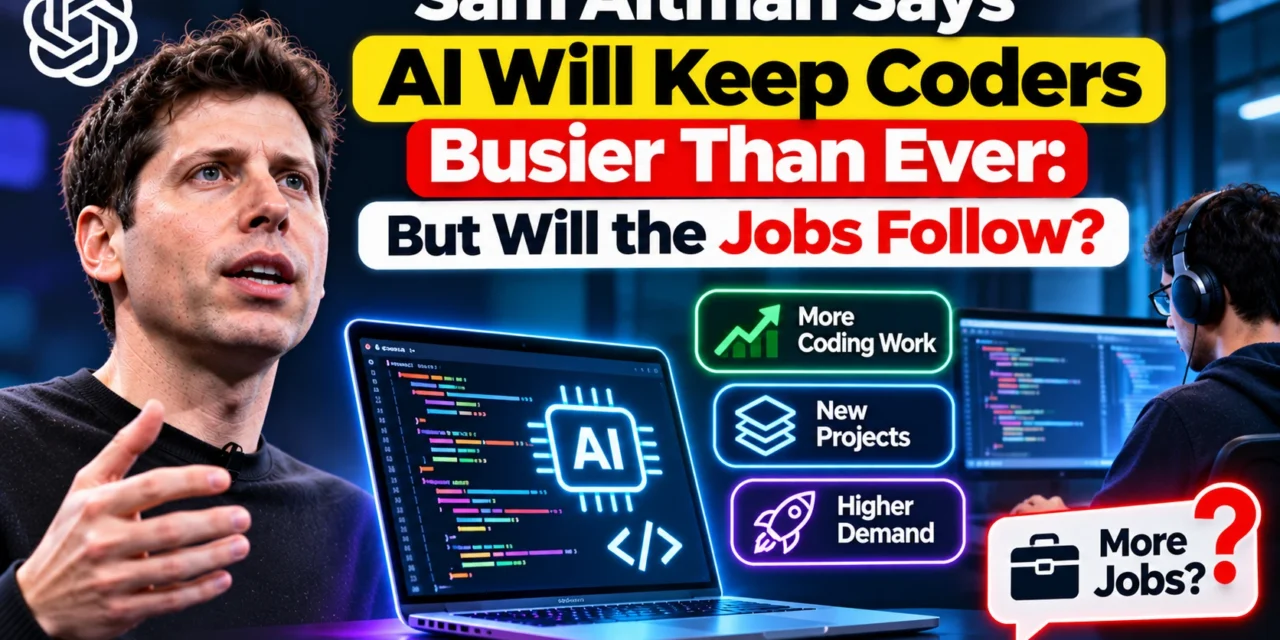
Will AI put programmers out of work? OpenAI CEO Sam Altman says no. In a recent podcast interview, he argued that coders will be busier, more influential, and better paid than ever. At the same time, big tech companies are cutting jobs, which makes his optimism a hard test.
This article explains what Altman said about coding and mathematics, the questions around OpenAI’s reported math progress, and why the layoff headlines complicate the picture. The details come from a Firstpost report dated October 22, 2026.
Quick summary
- Altman’s view: AI will change coding, not end it, because demand for software will keep growing.
- On math: He suggested AI may eventually handle some discoveries and proofs, leaving humans to interpret and apply them.
- The caveat: Big tech layoffs and doubts about AI claims make the outlook less certain.
- Where he said it: A 45-minute interview with podcaster Matthew Berman.
What did Altman say about coding?
Altman said fears that coding would become obsolete have not played out as many expected. Instead, AI has changed how software is built and increased how much work people can take on.
His main points:
- Coders are more impactful. He said coders have never been busier or had more impact, and he expects them to keep earning well.
- The world needs more software. The industry underestimated how much software would eventually be needed.
- AI opens new uses. As building software gets faster and easier, businesses may find new applications that didn’t exist before.
- The job changes, not vanishes. He doesn’t expect a world with no coding jobs. Programmers will increasingly use AI to do tasks that once took far more time and effort.
What did he say about mathematics?
Altman was less certain that mathematics would follow the same path. He suggested AI might eventually take on some mathematical discoveries and proofs that have traditionally needed human researchers.
In that case, mathematicians could focus more on:
- Interpreting AI-generated results
- Finding practical uses for them
- Explaining complex ideas so others can understand them
He also acknowledged it is unclear whether this shift would raise or lower overall demand for mathematicians. His broader point is that a profession can be transformed without the need for people disappearing.
The math controversy
The debate has more weight because of OpenAI’s reported progress on the Navier-Stokes problem.
What is the Navier-Stokes problem?
The Navier-Stokes equations describe how fluids such as air and water move. The big question is whether their solutions always stay smooth or can develop sudden singularities in a finite time. It is one of seven Millennium Prize Problems from the Clay Mathematics Institute, which offers a $1 million prize for a complete solution.
Why is it controversial?
According to the report:
- OpenAI’s reported result has drawn attention.
- Questions have been raised about how the company reached its findings.
- There are concerns about whether earlier work by mathematicians contributed to the result.
This follows another claim earlier this year, when OpenAI said one of its reasoning models independently produced a proof overturning a long-standing conjecture linked to Paul Erdős.
The report stresses that a promising result is not the same as a complete, independently verified solution. These cases raise bigger questions about what counts as an AI breakthrough, how independent the model’s work really is, and how researchers should check such claims.
The layoff problem
Altman’s optimism faces a more immediate challenge. Technology companies keep announcing big workforce cuts. According to the report, Meta, Oracle, Amazon, and Microsoft have all made headlines over job cuts in 2026.
The link between AI and layoffs is not simple:
- Other reasons exist. Companies may cut jobs for restructuring, cost reduction, or new priorities, not only because AI can replace people.
- Still, the timing worries people. AI capabilities are expanding while workforces shrink, raising fears about whether new opportunities will offset lost ones.
- Coding may be a special case. Cheaper, faster software can create more demand for software. In other industries, AI might finish tasks without requiring more human staff.
Altman’s argument vs the open questions
|
Altman’s argument |
Open questions |
|---|---|
|
Easier, cheaper software means more demand for software |
Will the same hold in other professions? |
|
Coders will have more impact and earn more |
Will the new opportunities be widely shared? |
|
AI may take on some math discovery, leaving humans to interpret it |
Will demand for mathematicians rise or fall? |
|
Technology transforms jobs without ending them |
Will new jobs appear as fast as others disappear? |
Why this matters
- It shapes how people plan careers. Whether to learn coding, math, or other skills depends on how AI changes demand.
- It affects companies. Leaders must decide whether to hire more, hire differently, or cut.
- It tests big AI claims. Math results show how hard it is to verify AI breakthroughs.
- It is not guaranteed. The central question is whether the economic gains from AI will be shared widely enough to benefit workers.
Practical takeaways for workers
- Learn to work with AI tools. Using them well may matter as much as the underlying skill.
- Build judgment. Explaining, checking, and applying results is hard for AI to replace.
- Stay curious across fields. New software uses may appear in areas you don’t expect.
- Keep your skills current. Roles are changing quickly.
- Don’t rely on one prediction. Experts disagree about how this will play out.
Things to keep in mind
- Altman leads an AI company. His outlook may reflect his position and interests.
- The math claims are unsettled. Independent checking is still needed.
- Layoffs have many causes. It’s hard to say how much AI is responsible.
- The future is uncertain. Both optimistic and cautious views are plausible.
Frequently asked questions
Does Altman think AI will replace coders? No. He argues that coding jobs will change and that demand for software will keep growing.
What about mathematicians? He suggested AI might handle some discoveries and proofs, with humans focusing on interpretation and application, but he is unsure what that means for overall demand.
What is the Navier-Stokes problem? A famous unsolved math problem about fluid motion, with a $1 million prize for a complete solution.
Has OpenAI solved it? The report says OpenAI’s reported result has drawn attention and questions. It has not been confirmed as a complete, independently validated solution.
Which companies have cut jobs in 2026? The report mentions Meta, Oracle, Amazon, and Microsoft.
Conclusion
Altman’s vision is that AI makes people more productive and creates more work, as it has in software. But coding may not be a model for every field, and layoffs and unresolved questions about AI breakthroughs keep the debate open. Whether the benefits reach workers widely is the real test, and the technology industry hasn’t answered it yet.
Note: This article is based on a Firstpost report by the FP Tech Desk dated October 22, 2026, rewritten in my own words. Please check the original interview for Altman’s exact remarks.