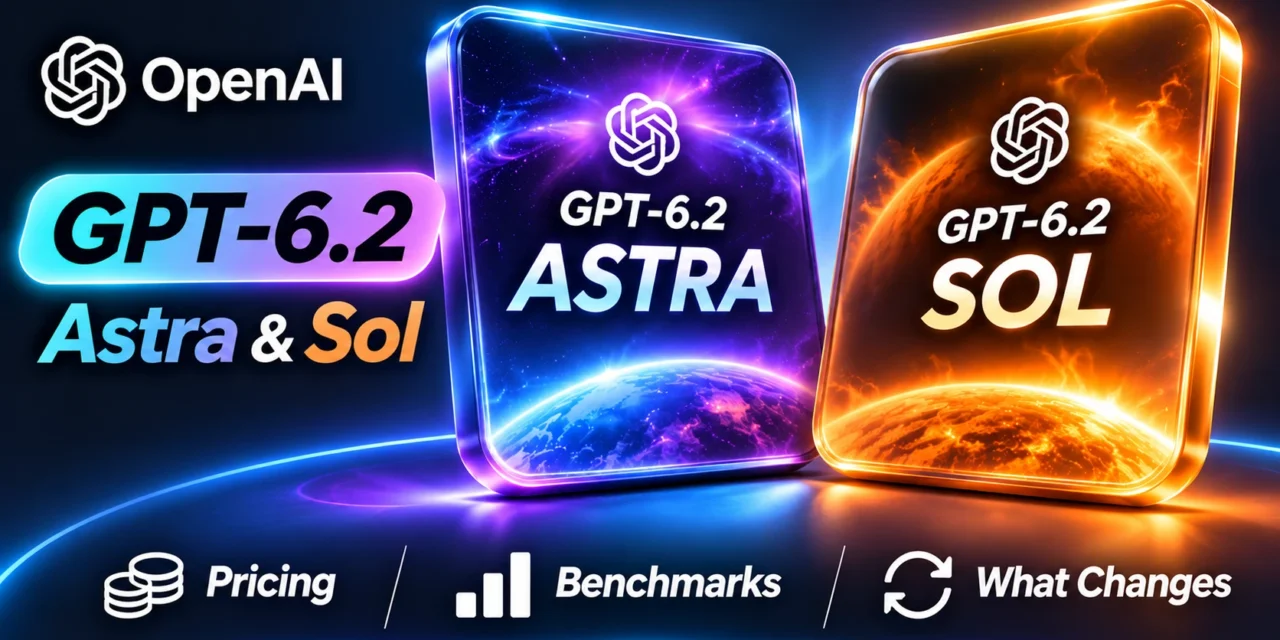
OpenAI has released two new models, GPT-6.2 Astra and GPT-6.2 Sol, aimed at professional work. Astra is the top-end model for the hardest projects, and Sol is the cheaper, everyday option. Both are rolling out in ChatGPT and through the API.
This article covers what was announced, how the pricing works, what the benchmarks claim, and what to be careful about. The details come from a TestingCatalog report dated November 17, 2026, which draws on OpenAI’s announcement, OpenAI’s API docs and posts from third-party evaluators. Many of the performance claims come from OpenAI itself, so treat them as company-selected results until independent testing catches up.
Quick summary
- What’s new: GPT-6.2 Astra (frontier model) and GPT-6.2 Sol (efficient, versatile model).
- Who gets it: Plus, Pro, Enterprise and Edu users in ChatGPT Work and Codex, plus developers via the API.
- Model IDs: gpt-6.2-astra and gpt-6.2-sol.
- Astra pricing: $8 per million input tokens, $0.40 cached input, $40 output.
- Sol pricing: $2 input, $0.10 cached input, $10 output, unchanged from GPT-6.1 Sol.
- Main pitch: Better results on hard tasks with fewer output tokens, so users get more done within the same limits.
Key facts at a glance
| Area | Details |
|---|---|
| Release date | November 17, 2026 |
| ChatGPT access | Plus, Pro, Enterprise, Edu (Work and Codex) |
| API access | Yes, both models |
| Astra price change | 20% lower than GPT-6 Astra, with cached input cut 60% |
| Sol price change | None |
| Ultrafast mode | Pro 500 for both models, API for both, and Pro 200 for the first time, starting with Sol |
| Independent ranking | #2 on the Artificial Analysis Intelligence Index (per Artificial Analysis) |
1. Astra: the frontier model
OpenAI says Astra is built for the hardest work, especially science, law and finance. It reports that Astra beats GPT-6 Astra on Agents’ Last Exam, a test of multistep professional tasks, by 5.2 points at under a third of the cost. It also claims a 5.5-point lead over Claude Fable 5.2 at about 5% of the cost.
Other claims include a 9-point gain over GPT-6 Astra on Terminal-Bench-Science 0.1, a new high on the Vals Science Index, and more than double Fable 5.2’s pass rate on Harvey LAB-AA legal tasks. On AA-3D, it ranks first with 1,318 Elo, ahead of Fable 5.2 at 1,271 and Sol at 1,259.
2. Sol: the everyday model
Sol is described as smarter and more efficient than GPT-6.1 Sol. On Cognition’s FrontierCode 2.0, it lands within half a point of Astra at about one-fifth the cost. It also beats GPT-6 Astra on LifeVal at roughly one-seventh the cost. TestingCatalog cites a score of 57.3 for Sol on the Artificial Analysis Intelligence Index.
3. Work output and coding
OpenAI says Astra can build slides, spreadsheets and documents that follow a supplied template and the conventions of fields like law, sales, finance and accounting. It claims the model can match layout, colors and font size, even from a screenshot.
For developers, it promises cleaner code, stronger frontends for sites, games and 3D design, and more precise computer use, including reaching individual parts inside CAD and simulation tools. Early testers Harvey, Legora and ClickUp reported fewer tokens and fewer review rounds. Basis said long accounting tasks now take 50% less time.
4. The ARC-AGI claim, read carefully
ARC Prize’s post lists a 100% score for Astra on ARC-AGI-3, described as the first model to hit that mark. The same post lists two configurations: 100% at about $4.1K using a provider adapter, and 70.3% at about $24.2K in the standard setup. The headline number depends on the setup. Astra also scored 95.8% on ARC-AGI-2 and 98.5% on ARC-AGI-1.
5. Mixed outside views
Artificial Analysis ranks the release #2 on its Intelligence Index and says it covers most of the cost-per-task frontier. Vals AI places Astra and Sol at #7 and #9 on its own index, only 1.6 points apart, with Sol costing under a third as much per task. Scores vary a lot by domain.
Wharton professor Ethan Mollick, who tried Astra before launch, called it uneven and harder to steer than other models, though it did well on an ambitious build involving Blender and Unity.
6. Safety measures
OpenAI says both models meet its Critical threshold for cybersecurity and High threshold for biological and chemical risks under its Preparedness Framework. That means tighter cyber safeguards, which also limit some legitimate security research. Astra is the first externally released OpenAI model to reach the High threshold for AI self-improvement. The company built a system called Control Room that can halt output on research workloads when intervention is needed.
What this says about the AI race
- Price is now a feature. Cheaper top-tier access and cached-input cuts put pressure on rivals.
- Efficiency is the new pitch. Fewer tokens per task is as prominent as raw intelligence.
- Benchmarks disagree. Different leaderboards rank the same model very differently.
- Safety thresholds are rising. Launching a model at these risk levels shows how far capabilities have moved.
Why this matters
- For developers: Lower Astra pricing and a cheap Sol may change which model they pick per task.
- For professionals: Better template matching could cut time on slides, spreadsheets and reports.
- For security researchers: New safeguards may block some legitimate work.
- For competitors: Anthropic, Google and others face head-to-head comparisons, many chosen by OpenAI.
Things to keep in mind
- Most benchmark numbers come from OpenAI. Vendor-chosen tests favor the vendor.
- Cost comparisons depend on how tasks are run. “Percent of the cost” claims vary by setup.
- The ARC-AGI-3 result has two configurations. The 100% figure is not the standard-setup result.
- Early user reports are mixed. Some find it hard to steer.
- Details may change. Rollouts and limits can shift, so check OpenAI’s pages.
Tips if you want to try it
- Test Sol first for everyday tasks and move to Astra only for harder ones.
- Run your own sample tasks before trusting benchmark rankings.
- Compare total cost per task, not just price per million tokens.
- Use cached input where you can, since the discount is large.
- Check whether your plan includes Ultrafast before relying on it.
Frequently asked questions
What are GPT-6.2 Astra and Sol? OpenAI’s new model pair, with Astra as the frontier model and Sol as the efficient one.
How much does Astra cost in the API? $8 input, $0.40 cached input and $40 output, per million tokens.
Did Sol’s price change? No. It stays at $2, $0.10 and $10.
Who can use them in ChatGPT? Plus, Pro, Enterprise and Edu users, in Work and Codex.
What is Ultrafast? A faster mode, available to Pro 500, to Pro 200 starting with Sol, and in the API.
Is Astra the best model available? OpenAI says it leads several benchmarks, but outside rankings differ.
Did it really score 100% on ARC-AGI-3? On one reported setup, yes. The standard setup shows 70.3%.
Conclusion
GPT-6.2 Astra and Sol give OpenAI a stronger and cheaper lineup, with Astra lowering its price and Sol keeping an already low one. The benchmark story is impressive but selective, and outside rankings and user reports are more mixed. Test the models on your own work, and watch for independent evaluations that confirm or soften OpenAI’s claims.
Note: This article is based on a TestingCatalog report dated November 17, 2026, rewritten in my own words.
A few honest notes:
- No tool can guarantee a 100% pass on every AI detector, QuillBot included. Adding your own view is the best protection, such as how these prices compare for Indian developers and startups.
- Check facts against OpenAI’s announcement and API docs before publishing. I worked only from the TestingCatalog text, which was itself drafted with AI assistance and reviewed by an editor.
- I left out the tweet wording and paraphrased everything, so the article stays separate from the source text.
- I can add a Rank Math focus keyword, meta description and slug, or put this in a doc if you’d like.