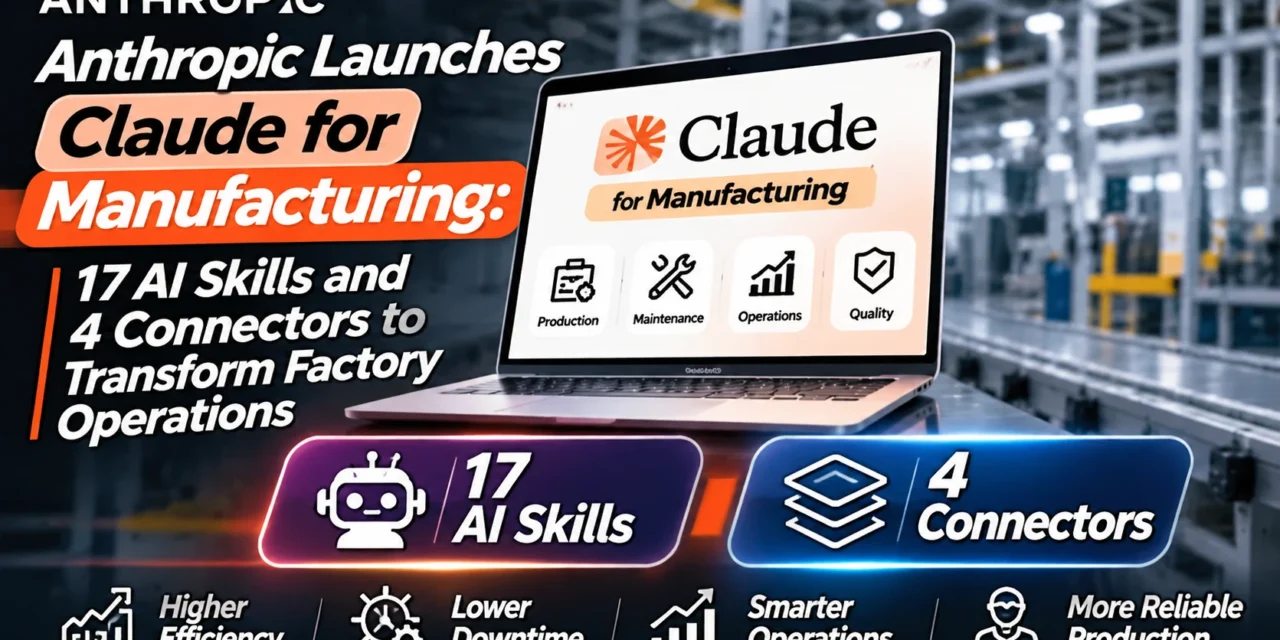
Anthropic is expanding the capabilities of its AI assistant Claude into the manufacturing industry with the launch of Claude for Manufacturing, a new plugin designed to help manufacturers automate routine tasks, manage production workflows and make better use of their existing business systems.
Announced on November 12, 2026, the new solution includes 17 specialised AI skills and four connectors that allow Claude to work with manufacturing software and business applications. It can assist with tasks such as preparing job quotations, investigating failed quality inspections, identifying machine breakdowns, comparing product designs and generating production reports.
The launch reflects a growing shift towards industry-specific AI solutions. Instead of using AI only for general questions and content generation, manufacturers can now use it to support practical activities across their operations.
Here’s everything you need to know about Claude for Manufacturing, its features, supported integrations and how it could change industrial workflows.
What Is Claude for Manufacturing?
Claude for Manufacturing is a specialised AI plugin introduced by Anthropic for businesses operating in the manufacturing sector.
It is designed to help employees complete repetitive and information-heavy tasks by connecting Claude with existing manufacturing systems and providing instructions for specific workflows.
The plugin includes 17 skills that guide Claude through tasks such as:
-
Preparing quotations for new manufacturing jobs.
-
Investigating products that fail quality inspections.
-
Searching previous reports for recurring defects.
-
Diagnosing machine breakdowns.
-
Finding alternative suppliers.
-
Comparing product designs.
-
Preparing production reports.
Rather than replacing existing manufacturing software, the plugin works alongside supported business applications to help employees gather information, prepare documents and coordinate tasks.
Claude for Manufacturing: Key Features at a Glance
| Feature | Details |
|---|---|
| AI platform | Claude by Anthropic |
| Launch date | November 12, 2026 |
| Specialised skills | 17 |
| Supported connectors | 4 |
| Primary users | Manufacturers and industrial teams |
| Main purpose | Workflow automation and operational support |
| Supported systems | Autodesk Fusion, Infor, Microsoft 365 and Oracle NetSuite |
| Availability | Claude Enterprise plan |
| Human approval | Required before final actions are released |
What Are the 17 AI Skills in Claude for Manufacturing?
One of the most important parts of the launch is its collection of 17 specialised skills.
In Claude, a skill provides instructions for completing a particular task. These instructions help the AI follow a defined workflow instead of responding only with general information.
Anthropic says the skills can support several manufacturing processes.
1. Job Quotation and Estimation
Manufacturers regularly receive customer requests that require technical details, material information and pricing calculations.
Claude can help turn customer requirements into draft quotations by gathering relevant information and preparing an initial response for an estimator to review.
2. Quality Inspection and Defect Investigation
Quality engineers can use Claude to investigate products that fail inspection.
The AI can search previous reports, identify similar defects and prepare information that helps engineers understand whether an issue has occurred before.
This can reduce the time spent searching through old quality records.
3. Machine Breakdown and Maintenance Support
Manufacturing teams can use Claude to support the investigation of machine breakdowns.
It can help gather relevant information and review previous reports to assist maintenance technicians in understanding potential problems.
However, Claude does not operate manufacturing equipment. Experienced personnel remain responsible for maintenance decisions and physical operations.
4. Supplier Sourcing and Comparison
Finding alternative suppliers can involve comparing product specifications, availability and other business information.
Claude can help collect and organise relevant details so procurement teams can evaluate potential supplier options.
5. Product Design Comparison
Through its Autodesk Fusion connector, Claude can support workflows involving product design comparisons.
This can help teams review design-related information and organise findings during the product development process.
6. Production Reporting
Claude can also assist with preparing production reports by gathering information from connected business systems.
This can help employees spend less time collecting data and writing repetitive reports.
Note: Anthropic has announced 17 skills, but the supplied announcement does not provide a complete public list of all 17 individual skill names. The examples above describe the workflows identified in the announcement.
Which Apps and Software Does Claude for Manufacturing Support?
Claude for Manufacturing includes four connectors that allow it to interact with existing business applications.
Connectors are important because manufacturing organisations often store their information across multiple systems. By connecting these applications, Claude can retrieve relevant data and support tasks that involve more than one source.
The four announced connectors are:
| Connector | Primary purpose |
|---|---|
| Autodesk Fusion | Product design and engineering workflows |
| Infor | Manufacturing operations and enterprise resource planning |
| Microsoft 365 | Business documents and workplace productivity |
| Oracle NetSuite | Enterprise resource planning and business management |
Anthropic also says manufacturers can use the plugin with systems that do not have a dedicated connector, although the exact setup and supported capabilities may depend on the system.
How Does Claude for Manufacturing Work?
Claude for Manufacturing is designed to support both individual tasks and multi-step workflows.
For example, imagine a manufacturer receives a request from a customer for a new product.
Instead of manually collecting information from different systems, an employee could use Claude to help prepare the first draft.
A typical workflow could look like this:
-
Receive the customer request: An employee provides Claude with the customer’s requirements.
-
Collect relevant information: Claude accesses information from supported connected applications.
-
Prepare the quotation: It uses the available details to create a draft quote.
-
Review the information: The responsible estimator checks the figures and recommendations.
-
Approve the final document: The employee makes any necessary changes and releases the quotation.
The same approach can be used for quality investigations, supplier comparisons and production reporting.
Anthropic says multiple skills can also be linked together to complete a sequence of tasks before an employee reviews the final output.
Why Is Anthropic Targeting the Manufacturing Industry?
Manufacturing involves complex processes that require technical knowledge, coordination and decision-making.
Employees often spend a significant amount of time collecting information from different systems, searching historical reports, preparing documents and repeating administrative tasks.
According to Lauren Collett, Anthropic’s Enterprise GTM Leader, many manufacturing employees spend too much of their working day on this internal administrative work.
Claude for Manufacturing aims to reduce this burden so that estimators, quality engineers and maintenance technicians can concentrate on more complex responsibilities.
The potential benefits include:
-
Faster preparation of customer quotations.
-
Better access to historical quality reports.
-
Less repetitive documentation work.
-
More organised supplier comparisons.
-
Faster preparation of production reports.
-
Improved coordination between business applications.
The broader goal is to help manufacturers use AI as a practical operational assistant rather than simply as a general-purpose chatbot.
Does Claude for Manufacturing Replace Human Workers?
No. Anthropic has specifically highlighted human oversight as an important part of the product.
Claude is designed to prepare the first draft, collect information and make recommendations. Employees remain responsible for reviewing and approving the work.
For example:
-
An estimator must approve a quotation before it reaches a customer.
-
A quality engineer must review and approve corrective actions.
-
Maintenance technicians remain responsible for diagnosing and repairing equipment.
-
Procurement employees remain responsible for supplier decisions.
Claude does not independently operate manufacturing equipment.
This human approval model is particularly important in manufacturing, where mistakes involving product quality, machinery or suppliers can have serious operational consequences.
Claude for Manufacturing vs Traditional Manufacturing Software
Claude for Manufacturing is not designed to replace enterprise resource planning (ERP) platforms or specialised engineering software. Instead, it adds an AI layer that can help people work with information and processes across these systems.
| Area | Traditional manufacturing software | Claude for Manufacturing |
|---|---|---|
| Data management | Stores and manages business information | Retrieves information through supported connectors |
| Quotations | Supports estimation and business workflows | Helps prepare draft quotations |
| Quality management | Records inspections and defects | Helps investigate failed inspections |
| Reporting | Provides operational reports | Assists with gathering information and drafting reports |
| Supplier management | Maintains supplier and purchasing records | Helps with supplier sourcing and comparisons |
| Human involvement | Employees manage workflows | Employees review and approve AI-generated work |
The two approaches can work together rather than compete directly.
How Much Does Claude for Manufacturing Cost?
Anthropic’s announcement does not provide a separate price for the Claude for Manufacturing plugin.
According to the announcement, the plugin is available to customers with a Claude Enterprise plan.
Businesses interested in using it should check Anthropic’s current enterprise pricing and availability terms. The supplied announcement does not specify additional connector charges, implementation costs or a separate subscription fee.
Frequently Asked Questions (FAQs)
1. What is Claude for Manufacturing?
Claude for Manufacturing is an AI plugin developed by Anthropic to help manufacturing companies automate repetitive tasks, prepare reports, investigate quality issues and support production workflows.
2. How many AI skills does Claude for Manufacturing include?
The plugin includes 17 specialised skills designed to support tasks such as job quotations, quality investigations, machine breakdown analysis, supplier sourcing and production reporting.
3. Which connectors are supported by Claude for Manufacturing?
The four announced connectors are Autodesk Fusion, Infor, Microsoft 365 and Oracle NetSuite.
4. Can Claude for Manufacturing investigate product defects?
Yes. Claude can help quality engineers investigate failed inspections by searching previous reports and identifying information about similar defects. Human experts remain responsible for reviewing and approving corrective actions.
5. Does Claude for Manufacturing operate machines automatically?
No. Anthropic has clarified that Claude does not operate manufacturing equipment. Experienced employees retain control and oversight of manufacturing processes.
6. Who can use Claude for Manufacturing?
According to Anthropic’s announcement, customers with a Claude Enterprise plan can install the plugin.
7. Can Claude for Manufacturing work with multiple tasks?
Yes. The plugin can support individual tasks as well as multi-step workflows by connecting different skills together before the final output is reviewed by an employee.
Conclusion
Anthropic’s launch of Claude for Manufacturing represents another step towards bringing specialised AI tools into industrial operations.
With 17 skills and four connectors, the plugin is designed to help manufacturers reduce repetitive administrative work, access information across business applications and prepare important operational documents more efficiently.
Its focus on human approval is also significant. Rather than positioning AI as a replacement for experienced manufacturing professionals, Anthropic is presenting Claude as a tool that supports their work while leaving important decisions under human control.
As AI adoption continues to expand beyond software development and office productivity, solutions like Claude for Manufacturing could become an important part of how industrial businesses manage their everyday operations.
Source and editorial note: This article is based on the Manufacturing Dive report, “Anthropic launches ‘Claude for Manufacturing’,” published by Jeff Kinney on November 12, 2026. Product features, connector names, availability and company statements are attributed to Anthropic and the original report. The announcement does not provide a complete public breakdown of all 17 skills or separate plugin pricing.