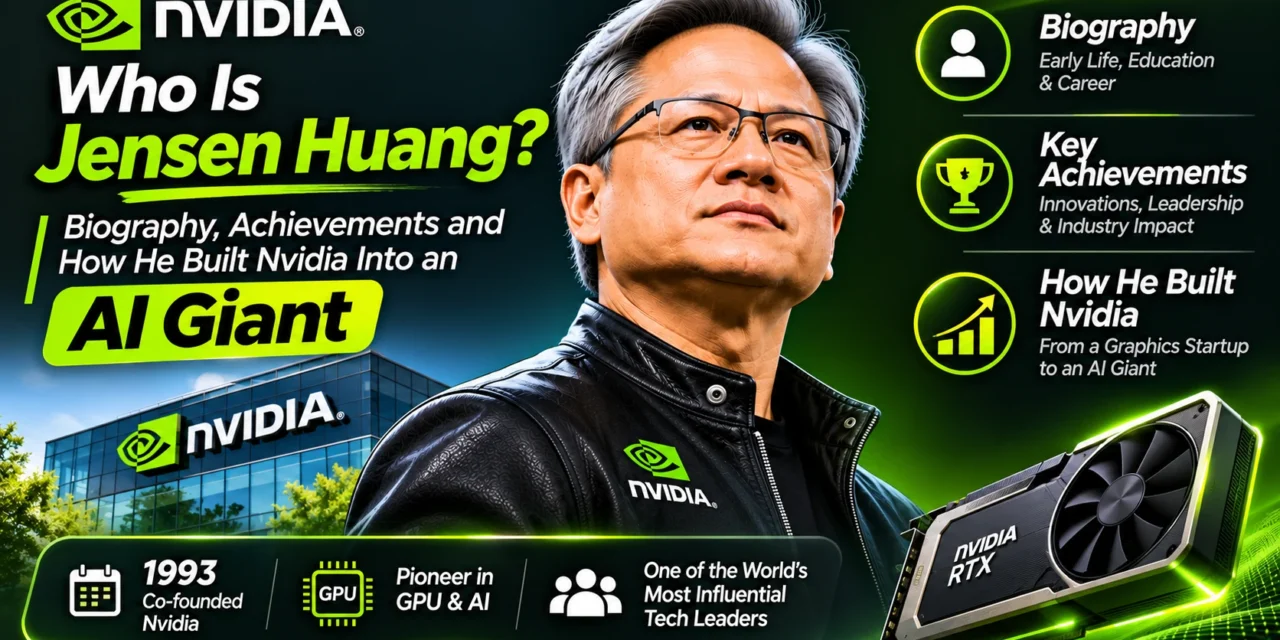
Jensen Huang is one of the most influential figures in the global technology industry. As the co-founder of Nvidia, he helped transform a small graphics-chip startup into one of the world’s most important companies in artificial intelligence, accelerated computing and semiconductor technology.
For more than three decades, Huang was the driving force behind Nvidia’s growth. His decisions helped take the company from developing graphics processors for video games to building the computing infrastructure used by AI companies, research institutions, cloud providers and technology giants worldwide.
However, his long association with Nvidia has now reached a major turning point. On November 12, 2026, reports confirmed that Huang had stepped down as Nvidia CEO following weeks of controversy and board scrutiny. The company appointed CFO Colette Kress as interim CEO while it considers a permanent successor.
His departure has raised an important question for the technology industry: how did one engineer build a company that became central to the global AI revolution?
Here is a closer look at Jensen Huang’s early life, education, career, major achievements and contributions to Nvidia and modern computing.
Who Is Jensen Huang?
Jensen Huang, whose full name is Jen-Hsun Huang, is a Taiwanese-born American technology entrepreneur and engineer. He co-founded Nvidia in 1993 alongside Chris Malachowsky and Curtis Priem.
He served as Nvidia’s president and CEO from its founding until his departure in November 2026.
Huang became widely recognised for his role in developing GPU technology and expanding its applications beyond computer graphics. Under his leadership, Nvidia entered several major technology markets, including gaming, scientific computing, data centres, artificial intelligence, robotics and autonomous vehicles.
His leadership was also known for being highly hands-on. Reuters reported that Huang directly oversaw around 60 senior executives and regularly worked with AI startups, investors and technology companies.
Jensen Huang: Quick Profile
| Detail | Information |
|---|---|
| Full name | Jen-Hsun Huang |
| Born | February 17, 1963 |
| Birthplace | Tainan, Taiwan |
| Nationality | American |
| Profession | Engineer and technology entrepreneur |
| Education | Oregon State University and Stanford University |
| Company | Nvidia |
| Co-founded Nvidia | 1993 |
| Former position | President and CEO of Nvidia |
| CEO tenure | 1993–November 2026 |
| Known for | GPU technology and AI computing |
Early Life and Education of Jensen Huang
Jensen Huang was born in Tainan, Taiwan, in 1963. During his childhood, his family moved between Taiwan, Thailand and the United States.
He moved to the United States at a young age and continued his education there. His early experiences helped shape his interest in technology, engineering and computers.
Huang attended Oregon State University, where he completed a bachelor’s degree in electrical engineering in 1984. He later earned a master’s degree in electrical engineering from Stanford University in 1992.
Before starting Nvidia, Huang worked at two semiconductor companies:
-
LSI Logic: He gained experience in semiconductor technology and engineering.
-
Advanced Micro Devices (AMD): He worked in the semiconductor industry and developed a deeper understanding of computer processors.
These experiences gave him the technical and industry knowledge that would later help him establish Nvidia.
How Did Jensen Huang Start Nvidia?
The story of Nvidia began in 1993 with an idea to improve computer graphics, particularly for video games and multimedia applications.
Huang, Chris Malachowsky and Curtis Priem came together in San Jose, California, to discuss the future of graphics computing. Their goal was to develop chips capable of delivering better graphics performance and more realistic visual experiences.
The company was founded on April 5, 1993.
Initially, Nvidia focused on graphics technology for the growing PC gaming market. However, Huang and his team eventually recognised that the same processing power used for graphics could also solve much more complex computing problems.
That decision became one of the most important turning points in Nvidia’s history.
Instead of limiting GPUs to gaming, the company worked towards making them useful for scientific research, parallel computing and artificial intelligence.
Major Achievements of Jensen Huang and Nvidia
Huang’s contribution to technology was not limited to building a successful semiconductor company. He helped guide Nvidia through several important technological shifts.
Here are some of the biggest milestones from his career.
1. Introducing the GPU in 1999
One of Nvidia’s biggest achievements came in 1999 with the introduction of the GeForce 256, which Nvidia described as the world’s first GPU.
Before this development, computer graphics processing was handled through different components and systems. The GPU brought important graphics-processing functions together, improving how computers rendered complex images.
This development helped Nvidia establish a strong position in the gaming and computer graphics industries.
It also created the foundation for the company’s future work in parallel computing.
2. Launching CUDA in 2006
The introduction of CUDA in 2006 was another major milestone.
CUDA, which stands for Compute Unified Device Architecture, allowed developers to use Nvidia GPUs for general-purpose computing instead of limiting them to graphics processing.
This opened new possibilities in:
-
Scientific research
-
Engineering simulations
-
Financial modelling
-
Data processing
-
Machine learning
-
Artificial intelligence
CUDA helped turn Nvidia’s GPUs into a computing platform. It also encouraged developers and researchers to build software around Nvidia hardware.
This software ecosystem later became one of the company’s strongest competitive advantages.
3. Supporting the Modern AI Revolution in 2012
A major breakthrough came in 2012 when the AlexNet neural network demonstrated the potential of deep learning using Nvidia GPUs.
The achievement showed that GPUs could significantly accelerate the training of neural networks.
It helped bring greater attention to GPU-powered AI research and encouraged Nvidia to invest more heavily in artificial intelligence computing.
This was a turning point because the company began moving beyond its traditional graphics business towards a much larger AI opportunity.
4. Introducing Real-Time Ray Tracing with RTX in 2018
In 2018, Nvidia introduced its RTX technology, bringing real-time ray tracing capabilities to its graphics products.
Ray tracing helps simulate how light behaves in the real world, allowing games and visual applications to produce more realistic lighting, shadows and reflections.
Nvidia also developed AI-powered graphics technologies to improve image quality and performance.
This strengthened its position in gaming, professional visualisation and computer graphics.
5. Developing Nvidia Omniverse
Nvidia Omniverse expanded the company’s work beyond traditional computing and graphics.
It provides a platform for developing and working with 3D simulations and digital twins.
Industries can use digital twins to create virtual representations of physical environments, products, machines and industrial processes.
Potential applications include:
-
Factory planning and simulation
-
Industrial automation
-
Robotics development
-
Product design
-
Virtual environments
-
Engineering and manufacturing
Omniverse reflects Nvidia’s broader ambition to connect digital computing with the physical world.
6. Building the Infrastructure Behind Generative AI
The growth of generative AI created a major opportunity for Nvidia.
AI models require enormous computing resources to train and operate. Nvidia’s GPUs, networking technology, software platforms and complete computing systems became important components of this infrastructure.
Companies developing large language models and other AI applications increasingly rely on high-performance computing systems.
Nvidia also expanded its business from selling individual chips to offering complete AI infrastructure, including GPUs, networking, software and server systems.
This helped position Nvidia as a central supplier in the global AI industry.
How Nvidia Expanded Under Jensen Huang’s Leadership
Nvidia’s transformation is one of the most important parts of Huang’s professional legacy.
The company started with a focus on PC graphics but gradually expanded into several major technology markets.
| Period | Major development | Industry impact |
|---|---|---|
| 1993 | Nvidia founded | Entered the graphics-chip market |
| 1999 | GeForce 256 GPU | Changed PC graphics and gaming |
| 2006 | CUDA introduced | Expanded GPUs into parallel computing |
| 2012 | AlexNet breakthrough | Accelerated GPU-powered deep learning |
| 2018 | RTX technology | Advanced real-time ray tracing |
| 2022 | Omniverse expansion | Developed digital twin and simulation capabilities |
| 2023–2026 | Generative AI infrastructure growth | Became a major supplier of AI computing systems |
The company’s expansion also changed its business model. Nvidia became more than a chip manufacturer, developing a broader platform combining hardware, software, networking and AI systems.
What Does Nvidia Actually Make?
Many people associate Nvidia mainly with graphics cards, but its business covers several different areas.
1. GPUs and Gaming
Nvidia’s GeForce graphics cards are widely used by gamers and PC enthusiasts. They also support content creation, video editing and other graphics-intensive applications.
2. AI Chips and Data Centres
Nvidia develops high-performance GPUs and computing systems used to train and run AI models.
Its data-centre business has become a major part of the company’s growth.
3. CUDA and AI Software
CUDA allows developers to use Nvidia GPUs for parallel computing. The company also offers software tools and platforms for AI development, deployment and research.
4. Robotics and Autonomous Vehicles
Nvidia develops technologies for robotics, autonomous driving and physical AI.
Its platforms help machines process information from cameras, sensors and other inputs to understand and interact with their surroundings.
5. Digital Twins and Industrial Simulation
Through Omniverse, Nvidia supports the creation of digital environments that companies can use to simulate factories, products and industrial processes.
Nvidia’s Business Growth: From Gaming to AI Infrastructure
Nvidia’s financial growth reflects the shift in demand for computing technology.
According to Nvidia’s 2026 company overview, the company reported record full-year revenue of $215.9 billion for fiscal year 2026.
Its business now reaches across gaming, AI infrastructure, healthcare, robotics, automotive technology and scientific computing.
Some figures highlighted in Nvidia’s 2026 company overview include:
| Company metric | Nvidia’s reported figure |
|---|---|
| Full-year FY2026 revenue | $215.9 billion |
| Employees | 42,000+ |
| Countries of operation | 38 |
| Granted and pending patent applications | 9,800+ |
| Developers in its programme | 7.5 million+ |
| Global startups in Nvidia Inception | 38,000 |
These figures demonstrate how far the company has expanded from its original focus on PC graphics.
Awards and Recognition Received by Jensen Huang
Huang has received recognition from technology, engineering and business organisations for his contribution to computing.
Some of his major honours include:
-
Robert N. Noyce Award: One of the semiconductor industry’s highest honours, awarded by the Semiconductor Industry Association.
-
IEEE Founder’s Medal: Recognition from the Institute of Electrical and Electronics Engineers.
-
Dr. Morris Chang Exemplary Leadership Award: Recognition for leadership and contributions to the semiconductor industry.
-
National Academy of Engineering: Huang was elected as a member of the academy.
-
TIME 100: He has been recognised among TIME magazine’s 100 most influential people.
-
Honorary doctorates: He has received honorary degrees from several universities, including Oregon State University and National Taiwan University.
In 2026, Huang was also appointed to the US President’s Council of Advisors on Science and Technology.
Why Did Jensen Huang Leave Nvidia in 2026?
After leading Nvidia for more than 33 years, Huang’s time as CEO came to an unexpected end on November 12, 2026.
His departure followed weeks of controversy involving reports about alleged extramarital relationships, including one with a businesswoman suspected by US officials of having links to Chinese intelligence.
Nvidia’s board had initiated an independent investigation into the matter. The controversy intensified after reports of another alleged relationship involving an Nvidia employee who reportedly reported directly to Huang.
According to Reuters and the Associated Press, Huang stepped down following the board’s decision.
Nvidia appointed Chief Financial Officer Colette Kress as interim CEO while the board considers internal and external candidates for the permanent position.
The company has also stated that it had no reason to believe its secrets or national security had been compromised.
The departure marks a major change for Nvidia because Huang was closely associated with its strategy, culture, technology direction and relationships across the AI industry.
What Jensen Huang’s Departure Means for Nvidia
Huang’s exit is significant because his influence extended beyond the role of a traditional CEO.
He was involved in technology decisions, startup investments, customer relationships and the company’s broader AI strategy.
His departure creates several challenges for Nvidia.
Leadership transition
Nvidia must identify a permanent CEO who understands both semiconductor technology and the fast-changing AI market.
Maintaining the AI strategy
The company will need to continue its investment in GPUs, AI systems, networking and software without disrupting its existing product roadmap.
Investor confidence
Investors will be watching how the leadership transition affects Nvidia’s business performance and long-term growth.
Replacing Huang’s industry relationships
Huang developed relationships with technology founders, major customers, investors and policymakers. Rebuilding these connections could be one of the most difficult tasks for the next CEO.
However, Nvidia’s technology, workforce and existing business operations remain important strengths that do not disappear with a leadership change.
Frequently Asked Questions (FAQs)
1. Who is Jensen Huang?
Jensen Huang is a Taiwanese-born American engineer and technology entrepreneur. He co-founded Nvidia in 1993 with Chris Malachowsky and Curtis Priem and led the company for more than three decades.
2. What is Jensen Huang famous for?
He is best known for co-founding Nvidia, helping popularise GPU computing and guiding the company’s expansion into artificial intelligence, accelerated computing and data-centre technology.
3. What was Jensen Huang’s biggest contribution to Nvidia?
One of his biggest contributions was helping transform GPUs from graphics-processing components into powerful tools for parallel computing and AI. His support for CUDA and long-term investment in AI infrastructure were particularly important.
4. What did Jensen Huang study?
Huang completed a bachelor’s degree in electrical engineering at Oregon State University in 1984 and a master’s degree in electrical engineering at Stanford University in 1992.
5. When did Jensen Huang start Nvidia?
Jensen Huang co-founded Nvidia on April 5, 1993, with Chris Malachowsky and Curtis Priem.
6. Why did Jensen Huang step down as Nvidia CEO?
Huang stepped down on November 12, 2026, following controversy involving reported personal relationships, national security concerns and an independent board investigation.
7. Who is the interim CEO of Nvidia after Jensen Huang?
Nvidia appointed Colette Kress, its chief financial officer, as interim CEO while the board considers candidates for a permanent replacement.
8. What is Jensen Huang’s contribution to artificial intelligence?
Huang helped position Nvidia GPUs as a major computing platform for AI research and development. CUDA, GPU-powered deep learning and Nvidia’s data-centre systems became important parts of the infrastructure used to train and run modern AI models.
Conclusion
Jensen Huang’s career represents one of the most significant technology journeys of the last three decades. From co-founding Nvidia in 1993 to helping build the computing infrastructure behind modern artificial intelligence, his contribution has influenced gaming, scientific research, data centres, robotics and several other industries.
His biggest achievement was arguably recognising that GPUs could become much more than graphics processors. By investing in parallel computing, CUDA and AI infrastructure long before generative AI became mainstream, he helped Nvidia prepare for a major shift in the technology industry.
His departure in November 2026 marks the end of an important chapter in Nvidia’s history. The company now faces the challenge of continuing its growth without the leader who shaped much of its identity.
Whatever happens next, Huang’s influence on GPU computing and the development of the modern AI industry will remain an important part of technology history.
Sources and editorial note: This article uses information from Nvidia’s official executive biography and corporate history, the Computer History Museum, Nvidia’s 2026 company overview, Reuters and the Associated Press. Leadership developments are based on reporting available as of November 13, 2026. Company statistics are attributed to Nvidia and refer to its stated fiscal-year reporting.