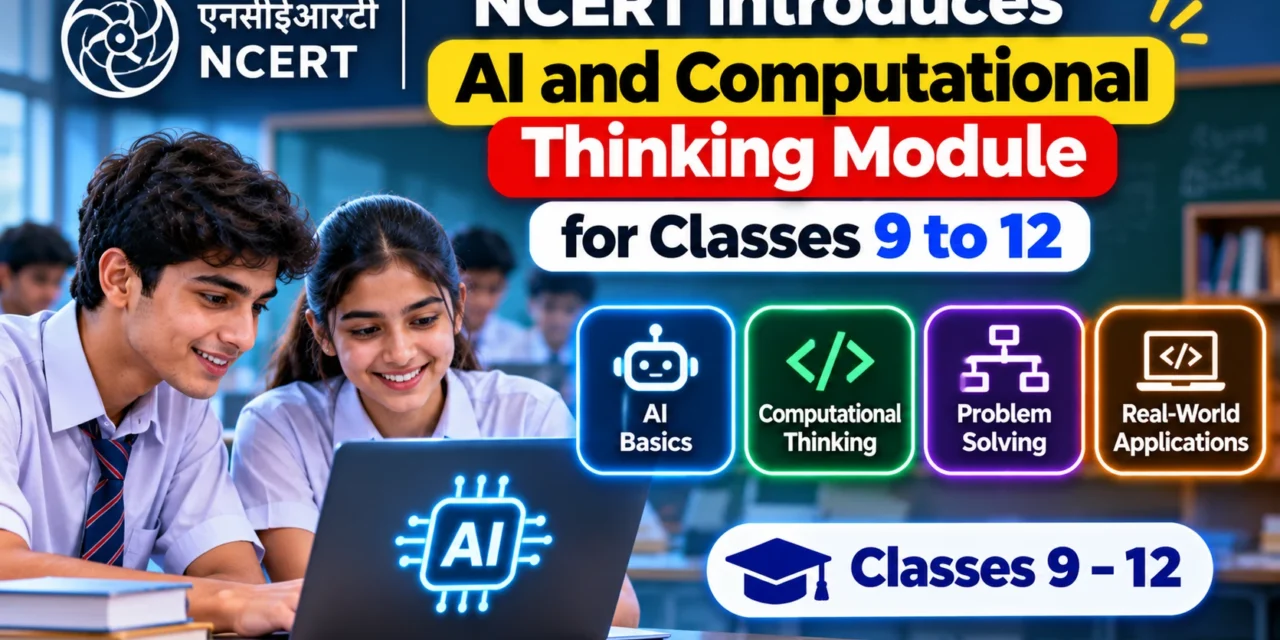
India’s school curriculum body has taken a step toward teaching students about artificial intelligence. The National Council of Educational Research and Training (NCERT) has developed an introductory module on Computational Thinking (CT) and Artificial Intelligence for Grades 9 to 12, in line with the National Education Policy (NEP) 2020.
This article explains what the module covers, how it is taught, why ethics is a major focus, and what it could mean for students and teachers. The details come from a New Indian Express report dated October 23, 2026, which cites an official release from NCERT. The module itself was not part of the report, so the article only covers what the release describes.
Quick summary
- Who made it: NCERT.
- For whom: Secondary stage students in Grades 9 to 12.
- Topic: Computational Thinking and Artificial Intelligence.
- Level: Designed for students with no prior knowledge of AI.
- Key focus: Ethical and safe use of AI.
- Policy link: Aligned with the vision of NEP 2020.
- Digital devices: Activities can be done with or without them.
What is computational thinking?
According to NCERT, computational thinking is a systematic way of solving problems. It is not only about computers. It helps learners break a problem into smaller steps and think about it in an organized way, which is also the foundation for understanding how AI works.
What does the module cover?
The module introduces:
- Computational thinking as a method for solving problems
- How AI works in simple terms
- Applications of AI in everyday life
- Possibilities and limitations of the technology
It is built for beginners, so students do not need any earlier AI knowledge.
Special focus on ethics and safety
The official release gives special emphasis to the ethical and safe use of AI. The topics named include:
|
Topic |
What it means for students |
|---|---|
|
Data privacy |
Understanding what personal information is shared with AI tools and why it matters |
|
Misinformation |
Recognizing false or misleading content, including AI-generated content |
|
Fairness |
Understanding that AI systems can be biased and treat people unequally |
|
Digital safety |
Staying safe when using online and AI tools |
|
Critical verification |
Checking AI-generated information before trusting it |
How will students learn?
The module uses an experiential, activity-based approach. According to NCERT, learning happens through:
- Discussions
- Practical exercises
- Experimentation
- Reflection
The module promotes critical thinking, creativity, problem-solving, and responsible use of new technologies. NCERT says it aims to help students become informed, confident, and responsible users of technology, while reinforcing that human judgment, creativity, and ethical responsibility remain central to learning.
Works with or without devices
Not every school has the same technology. NCERT says the activities can be carried out with or without digital devices. This is meant to ensure meaningful participation across schools in different settings, including those with limited resources.
Why this matters
- AI is part of daily life. Students already meet AI in apps, search, and social media. Understanding it helps them use it wisely.
- Critical thinking is essential. Learning to check AI-generated information is an important modern skill.
- It supports equal access. Activities that don’t require devices let more schools take part.
- It follows national policy. The module reflects NEP 2020’s focus on skills and future-ready education.
- It keeps people at the center. The module stresses that human judgment and ethics matter.
What could teachers and schools do?
- Start with discussion. Ask students where they already see AI in their lives.
- Use simple activities. Try problem-solving exercises that don’t need computers.
- Practice verification. Compare AI-generated answers with trusted sources.
- Talk about privacy. Explain what information should not be shared with online tools.
- Encourage reflection. Ask students to think about when AI helps and when it can mislead.
What can parents do?
- Ask what your child is learning about AI.
- Encourage questions about where information comes from.
- Discuss safe online habits and privacy.
- Model good use. Show how to verify information instead of accepting it right away.
Things to keep in mind
- Details are limited. The report doesn’t say how many hours the module takes or whether it is compulsory.
- Rollout is not described. The report doesn’t explain when schools will begin using it or how teachers will be trained.
- It’s an introductory module. It is meant as a starting point for beginners, not an advanced course.
- Check official sources. Schools should refer to NCERT’s own materials for the full content.
Frequently asked questions
Who is the module for? Students in Grades 9 to 12.
Do students need any AI background? No. It is designed for students with no prior knowledge of AI.
What does it emphasize? Ethical and safe use of AI, including data privacy, misinformation, fairness, digital safety, and checking AI-generated information.
Do students need computers? Not necessarily. The activities can be done with or without digital devices.
Is it linked to a national policy? Yes, it is aligned with the vision of the National Education Policy 2020.
Is it compulsory? The report doesn’t say.
Conclusion
NCERT’s new module is an early step toward preparing students for a world shaped by AI. By teaching how AI works along with privacy, fairness, and fact-checking, it aims to produce students who are curious, careful, and confident. How well it works will depend on how schools and teachers use it, but its focus on human judgment and ethics is a good starting point.
Note: This article is based on a New Indian Express report dated October 23, 2026, rewritten in my own words. Please check NCERT’s official release and materials for full details.
every aspect of this content in the module Design settings and even apply custom CSS to this text in the module Advanced settings.