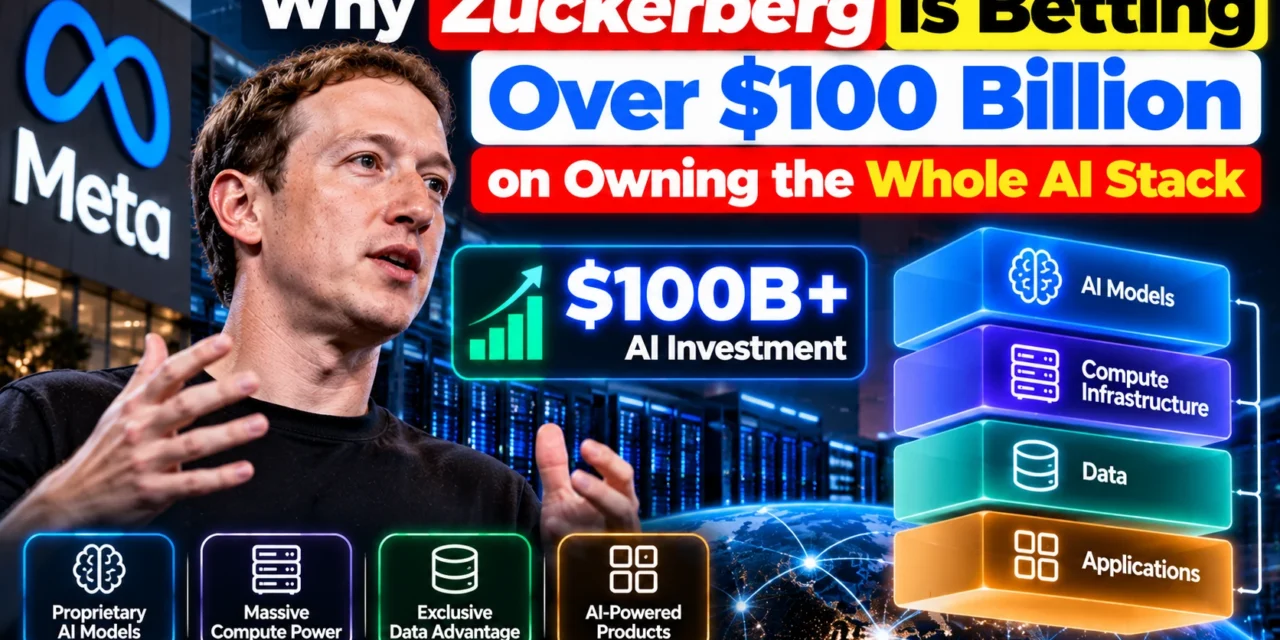
Mark Zuckerberg spent years building Facebook on rules set by Apple and Google. Now, with a commitment of as much as $200 billion to AI, he wants to own everything from the chips to the app. A Fortune report explains the thinking behind this bet, what it costs, and how it could even challenge Meta’s own advertising business.
This article summarizes the main points in simple terms. The details come from a Fortune article dated October 20, 2026, which draws on a Cheeky Pint podcast interview released on October 12.
Quick summary
- The bet: Zuckerberg says he approved AI spending of as much as $200 billion before there was proof it would work.
- The strategy: A “full-stack” approach: Meta builds its own data centers, chips, and low-level infrastructure.
- The history: Years of friction with Apple and Google over smartphone rules shaped his view.
- The product: Muse, Meta’s personal AI agent, powered by the new Muse Wonder model.
- The tension: AI agents that shop for people could undermine the advertising that makes up about 98% of Meta’s revenue.
The $200 billion decision
On the Cheeky Pint podcast, hosted by Stripe co-founder John Collison, Zuckerberg described the moment Meta decided on its AI build-out. He said he was about to commit something like $100 billion to $200 billion and asked Chief AI Officer Alexandr Wang whether he was sure it would work.
Wang said decisions of this size are made long before there is proof that the technology is working. He called it the opposite of the “lean startup” approach.
The episode was released on October 12, the same day Meta launched Muse Wonder, the first frontier-class model from the superintelligence lab Wang leads. Meta has said it expects as much as $145 billion in capital spending this year, much of it on AI infrastructure.
What does “full stack” mean?
Zuckerberg describes Meta as a full-stack tech company. In his words, it builds its own data centers, its own chips, and its own low-level infrastructure. He said owning the stack is less about wanting a platform for its own sake and more about being able to build the best things.
Why does Zuckerberg want to own everything?
The report points to his long history with Apple and Google, which control the dominant smartphone platforms.
|
Year |
What happened |
|---|---|
|
2008 |
Facebook’s iPhone app launches |
|
2009 |
Facebook’s Android app launches |
|
2013 |
Facebook pushes Android app updates outside Google Play, and Google bans the practice |
|
2019 |
Apple shuts down a Facebook “Research” app that paid users, including teens, up to $20 a month for broad access to their phone data |
|
2021 |
Apple lets iPhone users block app tracking, which Meta later said would cost it about $10 billion in 2022 alone |
In a 2024 post, Zuckerberg wrote that building Meta’s services within limits set by Apple was one of his formative experiences.
The cost of going it alone
Unlike Amazon, Microsoft, and Google, Meta does not run a cloud business that rents out its data centers, so it carries those costs itself.
- Building a one-gigawatt AI data center: $50 billion to $60 billion, according to Zuckerberg.
- Running it: Roughly $15 billion a year.
- Hyperion campus in Louisiana: Designed to grow to five gigawatts.
A possible change: In July, Bloomberg reported that Meta is building a cloud business to sell AI computing power, and Zuckerberg confirmed the plans on the earnings call. He framed this as a hedge. He said that for the plan not to work out, AI overall would have to fail, not just Meta.
The bet on agentic commerce
Meta wants Muse Wonder and the more powerful Muse Wonder Full to power Muse, its personal AI agent that can act for people.
Wang said the best personal agent should feel like a team of experts in your corner: legal, finance, and medical.
Fun examples from the podcast:
- Wang uses Muse to find increasingly obscure teas from obscure vendors.
- Zuckerberg set up an Instacart account just for Muse, which orders ingredients for weekend baking with his 3-year-old daughter. He went from using Instacart about twice a year to once or twice a week.
The advertising puzzle
This vision creates a challenge. Advertising made up about 98% of Meta’s revenue last quarter, and eMarketer projects its worldwide ad revenue will reach $243.46 billion this year, passing Google’s for the first time.
But if AI agents compare prices, check delivery dates, read reviews, and make purchase decisions, who are the ads for?
What Zuckerberg said:
- Few businesses have tried to block agents, and those that do are likely to lose out.
- More businesses are calling Meta to integrate deeply than the other way around.
- Agents could grow commerce overall by increasing the total market.
The report notes that Zuckerberg has not directly said whether agents will reduce the ad impressions that produce nearly all of Meta’s revenue today.
How could Meta make money?
|
Idea |
Details |
|---|---|
|
Subscriptions |
Muse is free, with paid plans at $20 and $100 a month for heavier users. Zuckerberg called subscriptions a big one. |
|
Commerce cut |
He floated taking a small share of what Muse saves or earns for people |
|
Business agents |
On the July earnings call, he described them as working like the ad system, with Meta paid when it delivers results |
|
Cloud computing |
Selling AI computing power to outside customers |
What does Wall Street think?
According to the report, investors are not pressing the advertising question for now. Bank of America analyst Justin Post wrote that Meta is back on offense with AI and named rising AI spending, not agents, as the top risk.
Why this matters
- Control. Owning chips, data centers, and software means Meta doesn’t depend on rivals’ rules.
- Scale. Spending on the level of $145 billion in a year is enormous.
- A possible clash. AI agents could change how advertising works, which is Meta’s core business.
- New revenue. Subscriptions, cloud services, and commerce fees could add other income sources.
Things to keep in mind
- Spending is a bet. Even Meta’s leaders say there was no proof it would work.
- Costs are huge and ongoing. Running data centers adds large yearly expenses.
- Many ideas are early. Commerce fees and business agents are plans, not proven revenue.
- This is not investment advice. The article summarizes reporting only.
Frequently asked questions
How much is Meta spending on AI? Meta has guided for as much as $145 billion in capital expenditures this year, and Zuckerberg described a commitment of up to $200 billion.
What is a full-stack approach? Building your own data centers, chips, and low-level infrastructure instead of relying on others.
What is Muse Wonder? The first frontier-class model from Meta’s superintelligence lab, launched October 12.
Is Muse free? Yes, with paid plans at $20 and $100 a month for heavier use.
Why could AI agents hurt Meta’s ad business? If agents make purchase decisions instead of people, fewer people may see or respond to ads.
Conclusion
Zuckerberg’s AI plan is a response to years of living under Apple’s and Google’s rules. By owning the stack, Meta hopes to build the best products on its own terms. But the plan comes with giant costs and a real puzzle: agents that shop for you might shrink the advertising business that pays for everything. How Meta solves that will shape its next chapter.
Note: This article is based on a Fortune report by Molly A. Wallace dated October 20, 2026, rewritten in my own words. It is not financial advice.