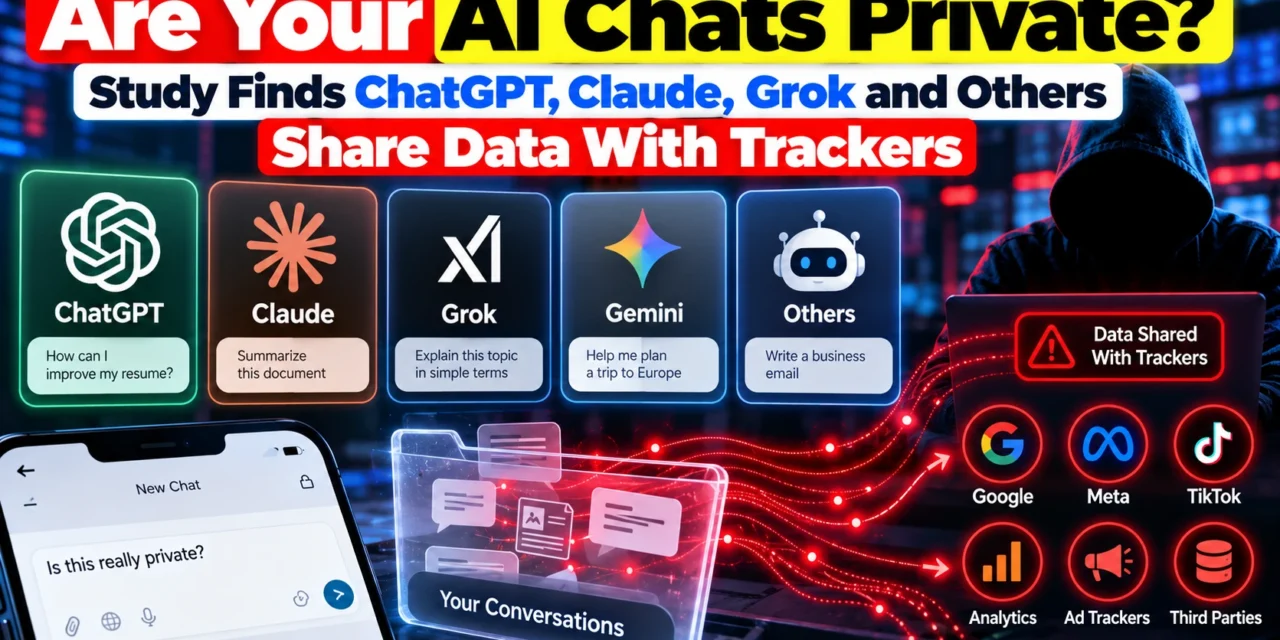
Talking to an AI assistant can feel like a private conversation. A new study suggests that, around the edges, it often isn’t. Researchers in Madrid found that popular AI assistants send chat links, titles, and sometimes even typed prompts to advertising and analytics companies.
This article explains what the study found, which services were involved, why rejecting cookies only helps partly, and the steps you can take to reduce tracking. The details come from a Notebookcheck report dated October 19, 2026. The researchers say they have no evidence that the companies receiving the data read the conversations.
Quick summary
- Who ran the study: Researchers at the IMDEA Networks Institute in Madrid.
- What they tested: Nine AI assistants in the browser and eight as Android apps, including ChatGPT, Claude, Gemini, Grok, and Perplexity.
- Main finding: Every service contacted at least one advertising or analytics company, and 44 companies received data in total.
- What leaked: Chat links, chat titles, and sometimes typed text.
- When: The tests ran in Spain in May 2026.
- Publication: The paper is accepted at the Privacy Enhancing Technologies Symposium and is due in July 2027.
What reached the trackers?
|
What was shared |
Which services (per the report) |
|---|---|
|
Links to conversations |
Five web versions, including ChatGPT, Claude, and Grok |
|
Chat titles |
Grok, Gemini, and Mistral’s Le Chat |
|
Screenshot and latest prompt (on shared pages) |
Grok, sent to Google, Meta, and TikTok |
|
Typed text (Android app) |
Perplexity, sent to a testing service called Wingify |
|
Advertising ID (Android) |
Perplexity, Grok, and Microsoft Copilot |
Overall, six of the nine web versions and three of the eight apps sent parts of conversations.
Why a link or title matters
- Links. Depending on the service, anyone with the link to a chat can open the whole conversation.
- Titles. The AI often creates a title from your first question. If you ask about your salary and a matching mortgage, the title will say exactly that.
- Identifiers. This data usually traveled with identifiers tied to your account, such as a hashed email address, which can help link a profile across services.
Aniketh Girish of the research team said most users have no way of knowing this is happening, since nothing in the interface shows it.
How far can a shared link travel?
The team planted test links to see who would open them.
- Grok: The links were opened 70 times from machines in 14 countries, in some cases days later.
- Claude, Copilot, DeepSeek, and Le Chat: Each fetched the link only once, right after it was submitted.
This shows how far a link can spread, though it doesn’t prove anyone read the chats. In July, Claude conversations appearing in Google search also showed that shared chats don’t always stay private.
Does rejecting cookies help?
Partly. The study found:
- It helps. About three quarters of identifiers only reached third parties after the user clicked “Accept all.”
- Example: On Claude, rejecting cookies stopped the Meta pixel and forwarding to about 11 services through Anthropic’s own servers.
- It isn’t enough. After clicking “Reject,” 80.8% of trackers stayed active, and four of the nine free services kept collecting data. Six of the nine still contacted Google Ads.
- Ad blockers have limits. Some data is forwarded from the company’s own servers, so a browser ad blocker never sees it.
- Paid plans. They did little about trackers themselves, but the strongest privacy controls were found in paid plans.
What about phone apps?
On Android, the advertising ID can link your activity across many apps. Perplexity, Grok, and Microsoft Copilot sent it to third parties.
Two services were different:
- DeepSeek: Did not share conversation content with outside trackers, but does use Chinese fingerprinting services.
- Meta AI: Did not share content with outside trackers, but sends the Android ID to Meta’s own servers.
How to reduce tracking: 5 steps
- Reject cookies. Click “Reject” instead of “Accept all.”
- Clean up shared chat links. See the list below.
- Delete your Android advertising ID. On Android 12 and later, go to Settings, then Privacy, then Ads, then “Delete advertising ID.” Apps will then see only a string of zeros.
- Avoid sharing sensitive chats. Don’t create public links for conversations about health, money, or private matters.
- Use stronger privacy settings. Check the controls offered by each service, including paid plans.
Where to find and delete shared links
|
Service |
Where to manage shared links |
|---|---|
|
ChatGPT |
Settings, Data controls, Shared links (delete one or all) |
|
Claude |
Settings, Privacy, “Shared chats,” or set a chat to Private in its Share menu |
|
Gemini |
gemini.google.com/sharing |
|
Grok |
grok.com/share-links |
|
Perplexity |
Set threads to Private in the sharing settings |
Important: Deleting a link only blocks new visits. Copies and screenshots others already made remain.
What are the companies doing?
According to the report, the study has so far moved providers very little.
- Regulators informed. The researchers sent their findings to European data protection authorities in April. Spain’s AEPD raised the issue at the European Data Protection Board in June.
- The legal concern. Under the GDPR, the team says privacy policies mention advertising partners but don’t clearly say conversation data goes along, and they see no legal basis for that sharing.
- Company responses. The authors say none of the providers has responded officially.
- Some changes. Perplexity removed the Meta pixel in April, probably because of a US class action. OpenAI has mentioned third-party trackers in its privacy policy since mid-August. Grok was still handing out publicly accessible links in September.
Why this matters
- Chats can be sensitive. People discuss health, money, work, and relationships with AI.
- Training opt-outs aren’t the whole picture. Opting out of AI training doesn’t control where your conversation links or titles end up.
- Ads are coming. The report notes that OpenAI is bringing ads to ChatGPT, which makes data sharing an even bigger issue.
- Transparency is limited. Users usually can’t see this sharing happen.
Things to keep in mind
- One study. Results come from tests in Spain in May 2026, and services may have changed since then.
- No proof of reading. The researchers have no evidence that recipients read the conversations.
- Company statements are missing. The report says the providers have not officially responded, so their side isn’t fully represented.
- Settings differ. Menu names and options may change over time.
Frequently asked questions
Which AI assistants were studied? Nine in the browser and eight as Android apps, including ChatGPT, Claude, Gemini, Grok, Perplexity, Mistral’s Le Chat, Microsoft Copilot, DeepSeek, and Meta AI.
Do trackers read my chats? The researchers say they have no evidence of that. They found that links, titles, and sometimes text were sent to third parties.
Does rejecting cookies fix it? It helps, but 80.8% of trackers stayed active after a click on “Reject.”
How do I delete shared chat links? Use the settings listed in the table above for your service.
Did DeepSeek and Meta AI share chat content? Not with outside trackers in the study, though each has other data practices noted in the report.
Should I stop using AI assistants? That’s your choice. A practical approach is to avoid sharing sensitive chats, delete old shared links, and review your privacy settings.
Conclusion
The study is a reminder that an AI chat is not always as private as it feels. Chat links, titles, and identifiers can travel to advertising companies, and rejecting cookies only solves part of the problem. The most useful steps are simple: reject cookies, clean up shared links, delete your Android advertising ID, and think twice before sharing sensitive conversations.
Note: This article is based on a Notebookcheck report dated October 19, 2026, rewritten in my own words. It summarizes research by the IMDEA Networks Institute. Please check each service’s current privacy settings and policies for updates.