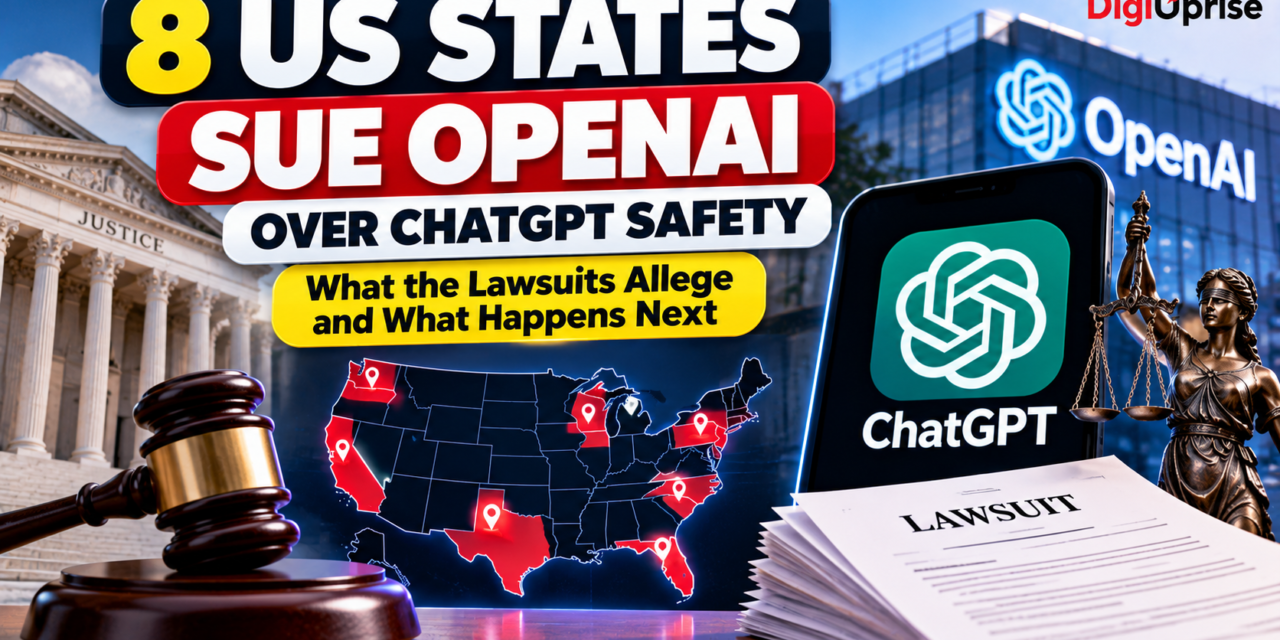
Eight US states have filed lawsuits against OpenAI, the company behind ChatGPT. They accuse it of putting profits ahead of safety and of misleading people about how safe its chatbot is, especially for children and other vulnerable users.
These are allegations, not proven facts, and OpenAI disputes the picture the states paint. This article explains what the lawsuits say, what the states want, how OpenAI has responded, and what could happen next.
Quick summary
- Who filed: Iowa, Kansas, Nebraska, West Virginia, Arkansas, Arizona, Idaho, and Montana.
- When: The complaints were filed separately on October 14, 2026.
- Who is accused: OpenAI.
- Main claim: OpenAI misled consumers about ChatGPT’s safety and exposed children and vulnerable users to possible harm.
- What the states want: Civil penalties, stronger safeguards, and court orders, including action on minors’ data.
- OpenAI’s response: It says no system is perfect and that it is improving protections.
What do the states allege?
According to reports, the lawsuits make several main points.
1. Misleading safety claims
The states say OpenAI presented ChatGPT as a safe tool that is suitable for young people, without clearly explaining the risks. They argue this breaks state consumer protection laws.
2. Risks to vulnerable users
The complaints raise concerns about how the chatbot interacts with people who may be vulnerable. The alleged risks include:
- Reinforcing a person’s false beliefs or delusions
- Giving dangerous medical advice
- Weakening critical thinking
- Encouraging unhealthy emotional relationships
3. Children’s data and access
The states accuse OpenAI of collecting personal information from minors without enough safeguards. They also say the company did not do enough to keep children from using ChatGPT.
4. Profits over mission
Arizona’s lawsuit, as reported by The Verge, argues that OpenAI has drifted away from its original public-interest mission. It claims that commercial goals have overshadowed important safety measures.
5. Other concerns
The states also point to reported cybersecurity incidents involving AI as part of their concerns about how the company manages risk. The lawsuits also refer to separate wrongful-death cases brought by families who say ChatGPT contributed to their loved ones’ deaths. Those claims are still being examined in court and do not, on their own, prove that OpenAI is responsible.
What are the states asking for?
According to Reuters, the states are seeking:
- Civil penalties against OpenAI
- Court orders that stop OpenAI from making misleading claims about ChatGPT’s safety
- Stronger safeguards for children and vulnerable users
- Deletion of personal information that some states say was collected unlawfully from minors
How has OpenAI responded?
According to The Verge, OpenAI spokesperson Drew Pusateri said the company has introduced age-specific protections and will keep improving its safeguards. He acknowledged that no system is perfect and said OpenAI will keep working with experts on measures such as:
- Parental controls
- Break reminders
- Age-appropriate model protections
OpenAI also said it wants to work with states to create realistic AI policies that can be applied across the whole industry.
Why this matters
- Children’s safety online. Many young people now use AI chatbots, and lawmakers are asking whether current protections are enough.
- Data privacy. The lawsuits focus on how minors’ personal data is collected and stored.
- Honest marketing. If a company calls a product safe, regulators want to know whether it can back up that claim.
- A wider trend. The cases add to growing government scrutiny of AI companies around safety, privacy, and the risks of conversational chatbots.
What happens next?
The lawsuits will now move through the legal process. Here is what to expect:
- OpenAI responds in court. The company will answer the complaints and may challenge parts of them.
- The states must prove their case. They will need to show that OpenAI’s practices violated consumer protection laws.
- The court decides on remedies. If the states succeed, a court could order penalties and new safeguards.
- Possible settlements. Cases like this can end with agreements rather than a full trial.
This process can take months or years, so the outcome is not clear yet.
What parents and users can do now
While the lawsuits play out, there are practical steps people can take:
- Use parental controls if your child uses an AI chatbot.
- Talk with children about what AI can and can’t do, and remind them it is not a doctor, therapist, or friend.
- Check medical or legal advice with a qualified professional.
- Limit personal information you share with any chatbot.
- Take breaks and stay aware of how much time you spend chatting with AI.
- Seek real support. If you or someone you know is struggling emotionally, reach out to a trusted person or a local helpline.
Frequently asked questions
Which states sued OpenAI? Iowa, Kansas, Nebraska, West Virginia, Arkansas, Arizona, Idaho, and Montana.
Has OpenAI been found guilty? No. The lawsuits only contain allegations, and a court has not made any decision.
What does OpenAI say? It says it has added age-specific protections, will keep improving them, and wants to work with states on workable AI policies.
Could ChatGPT change because of this? Possibly. If the states win or settle, OpenAI could be required to add safeguards or change how it markets and runs ChatGPT.
Is ChatGPT safe for children? That is the question at the heart of these cases. Parents should use available controls, supervise use, and follow guidance from OpenAI and child-safety experts.
Conclusion
These lawsuits mark a major moment for AI regulation in the United States. The states argue that OpenAI put growth ahead of safety, while OpenAI says it is working to improve protections. The courts will decide who is right. In the meantime, the cases are a reminder that powerful AI tools need clear rules, honest marketing, and strong protections, especially for children.
Note: This article is based on news reports published on October 15, 2026, including coverage citing Reuters and The Verge. The claims described are allegations and have not been proven in court.