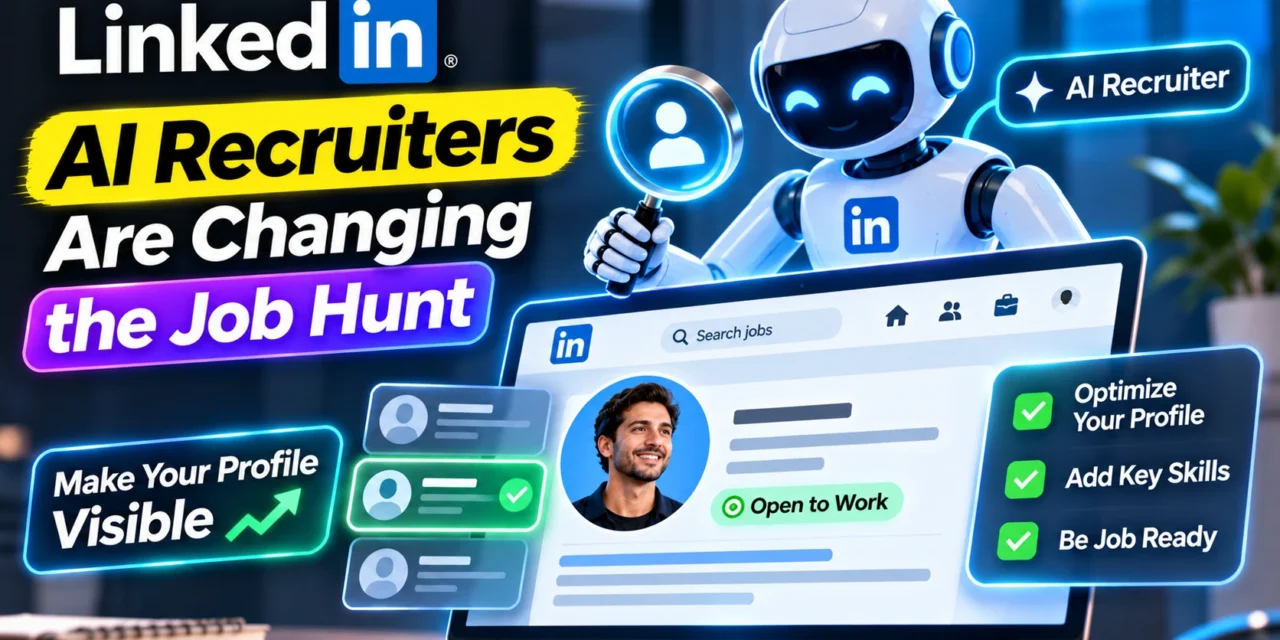
More job seekers are using AI to write résumés and apply for roles, and more employers are using AI to decide who deserves a closer look. LinkedIn’s latest recruiting agent, Hiring Assistant 2, is part of that shift. For candidates, having the right skills may no longer be enough. AI systems also need to be able to recognize them.
This article explains what LinkedIn’s new agent does, what the company says it can achieve, and the practical profile tips from two LinkedIn consultants. The details come from a CTech report dated November 1, 2026. Many figures are LinkedIn’s own, and the advice comes from MAIA Digital, a firm that sells LinkedIn services and is described as LinkedIn’s first official partner in Israel, so treat the recommendations as one commercial perspective.
Quick summary
- The tool: LinkedIn Hiring Assistant 2, or LIHA 2, announced in late September.
- Rollout: Scheduled to begin in November for customers already using the product.
- What it does: Finds potential candidates, assesses their fit for open roles, and recommends whom recruiters should contact.
- Who uses LinkedIn’s agent-based recruiting: More than 20,000 companies worldwide, including AMD, Cisco, and Palo Alto Networks, according to LinkedIn.
- What it means for you: A complete, active, keyword-rich profile gives AI more to work with.
What is LinkedIn Hiring Assistant 2?
It is a recruiting agent. A recruiter describes the role, and the agent searches for suitable people, evaluates how well they fit, and suggests whom to contact. It also learns from recruiters’ feedback and the organization’s preferences, then applies that knowledge to later searches.
Other recruiting steps AI can handle
- First-round screening. Recruiters can screen candidates with questions answered in writing or on video. The system can ask follow-up questions based on the responses. LinkedIn says the median time to finish an initial screening is six minutes.
- Trust checks. In a US survey in August, 64% of recruiting professionals said it had become harder to know whom to trust and what is authentic when evaluating candidates. The new agent therefore uses identity-verification data, screening answers, and information from companies’ recruiting systems to help assess candidates.
What does LinkedIn say the results are?
|
Claim |
Figure |
|---|---|
|
Fewer profiles reviewed by recruiters using Hiring Assistant |
83% fewer |
|
Faster identification of interview-ready candidates |
33% faster |
|
Likelihood a candidate found by the agent gets contacted |
Four times higher than with traditional sourcing |
|
Median time for initial screening |
About six minutes |
|
Companies using agent-based recruiting |
More than 20,000 |
These figures come from LinkedIn and have not been independently verified here.
How does the AI judge candidates?
According to Shay Thieberg, co-founder and chief marketing officer of MAIA Digital, the system no longer relies only on matching keywords. He says it also scans posts and comments, drawing on LinkedIn activity to identify years of experience, responsibilities, achievements, figures, and how many people someone managed. He stresses that it can use only information that candidates have put in their profiles and activity on the platform.
He compares LinkedIn to a dating app: one side lists criteria, the other lists relevant information, and the platform matches them.
Practical tips to improve your profile
The advice below comes from Thieberg and MAIA Digital’s CEO, Eli Igra Serfaty.
1. Start with your headline
Include keywords for both your role and your industry, not just where you work. “Marketing Manager” alone can apply to many fields, so name your area of expertise and the keywords relevant to the jobs you want.
2. Fill in every section
LinkedIn has no space limit, unlike a static résumé. Add detailed information about your experience, skills, and achievements. Recruiters may not read everything, but AI systems can scan it all.
3. Update your Skills section
Thieberg says most people have not updated their Skills section to include AI skills. If a recruiter’s job description lists criteria that your profile lacks, you may be less likely to be matched.
4. Join conversations through comments
Comments expose you to more people, including potential hiring managers, and can feel easier than posting. Recruiters’ systems can now scan your activity, so comments can become part of how you are assessed.
5. Connect outside platforms
Use the Connected Apps feature to show real work, not only descriptions of skills.
|
Platform |
Useful for |
|---|---|
|
GitHub |
Software projects |
|
Behance |
Design portfolios |
|
Replit |
Software development |
|
ElevenLabs |
AI-generated audio |
LinkedIn says profiles with a connected app receive up to 2.9 times as many recruiter messages. That figure does not prove that connecting an app alone causes the increase.
6. Build a relevant network
Focus on people in your industry, professionals with relevant expertise, and potential recruiters, instead of connecting with anyone and everyone.
7. Publish content if you have a nontraditional path
For older workers, career changers, and people whose experience comes from military service, relying on a profile alone may not be enough. Posting and joining discussions can help explain why you fit. LinkedIn has about 1.4 billion users, and the consultants say no more than 3% publish content.
Other features mentioned
- Internal mobility. Employees can apply for open positions within their own organization, sometimes before they are advertised externally.
- LinkedIn Business Card. A digital business card that can be saved in a digital wallet and shared by tapping phones. It is expected to become available in Israel.
- Learning from the organization. The agent can learn from changes in job requirements, which may signal where a company wants to go, such as hiring more technology-skilled workers.
What about AI-generated content?
LinkedIn says it is trying to reduce what it calls “AI slop,” meaning generic AI-written content that adds little original knowledge. In September, it reported that it had reduced views of this kind of content by 40%. According to Thieberg, LinkedIn says it can identify 94% of AI-driven activity on the platform and distinguishes between AI-generated content, automated comments, automated connection requests, and generic material.
LinkedIn is not against AI-generated content itself. It wants users to add their own perspective. As Thieberg puts it, there should be some human element to get past generic content.
Why this matters
- AI is deciding who gets noticed. Visibility in recruiters’ systems may affect who gets interviews.
- Profiles are living documents. Regular updates may matter more than a one-time résumé.
- Activity counts. Posts and comments may be part of how AI evaluates you.
- Authenticity is under pressure. Recruiters struggle to know whom to trust, which pushes platforms toward verification.
Things to keep in mind
- Company claims. Most performance numbers come from LinkedIn.
- Commercial interest. The advice comes from a firm that sells LinkedIn consulting.
- No guarantees. A strong profile may improve visibility but cannot promise interviews.
- Privacy. Think about what you share publicly, since activity may be scanned.
- Keep it truthful. Accuracy and honesty matter, especially with verification checks.
- Rollout is gradual. LIHA 2 begins rolling out in November to existing customers.
A simple checklist
- Rewrite your headline with role and industry keywords.
- Complete the About, Experience, and Skills sections.
- Add current skills, including any AI skills you truly have.
- Connect a portfolio or work platform.
- Comment thoughtfully on posts in your field.
- Share a post about a real project or lesson.
- Grow a focused network.
- Review your profile every few months.
Frequently asked questions
What is LIHA 2? LinkedIn Hiring Assistant 2, a recruiting agent that finds, assesses, and recommends candidates.
When does it launch? It begins rolling out in November to customers already using the product.
Does it only look at keywords? According to the consultants, it also scans posts, comments, and activity, but only information candidates have shared on the platform.
Does connecting GitHub or Behance help? LinkedIn says profiles with a connected app get up to 2.9 times as many recruiter messages, though that does not prove cause and effect.
Is AI-written content banned? No. LinkedIn wants original perspective and is trying to reduce generic AI content.
Conclusion
As recruiters hand more of the searching and screening to AI, job seekers need profiles that systems can read and trust. The advice is simple: be specific, be complete, show real work, and take part in your professional community. Do it honestly, because your own perspective is what stands out.
Note: This article is based on a CTech report by Maya Nahum Shahal dated November 1, 2026, rewritten in my own words. Many figures come from LinkedIn, and the advice comes from MAIA Digital, a LinkedIn consulting firm.