A new name and a new voice model arrived in the same week. SpaceXSI, the company behind Grok and formerly known as xAI, has launched Grok Voice 3.0, a speech-to-speech AI model built to handle customer support calls. According to independent testing, it now sits at the top of a major speech benchmark, ahead of models from OpenAI and Google.
This article covers what happened, what the numbers show, where the model is already in use, and what to keep in mind.
Quick summary
- What it is: Grok Voice 3.0, a speech-to-speech AI model for voice agents.
- Who made it: SpaceXSI, previously xAI and SpaceXAI.
- Main claim: It leads the Artificial Analysis Speech-to-Speech Index with a score of 86.9.
- Speed: Replies arrive in under one second, according to the company.
- Cost: It is cheaper to run per task than the comparable models tested.
- In use: Tesla vehicles and Starlink call centers.
Why is it called SpaceXSI?
The naming can be confusing, so here is a short timeline.
- xAI was the AI company founded by Elon Musk.
- After SpaceX acquired it in early 2026, it was rebranded as SpaceXAI.
- In October 2026, following Musk’s posts that suggested dropping “AI” in favor of “SI,” the company’s official X account was renamed SpaceX Super Intelligence, with the handle @SpaceXSI.
The company has not said whether other websites, product names, or legal entity names will follow. For now, Grok and Grok Bot branding appear unchanged. The rename is a branding choice, and it does not change what the technology can do.
What is Grok Voice 3.0?
Grok Voice 3.0 is a speech-to-speech model. It listens to a person speaking and replies by voice, aiming for a natural, back-and-forth conversation. It is designed mainly for customer support, where fast and accurate answers matter.
The company says it sets a record for resolving support calls, responds in under one second, and costs less than other advanced models.
How does it perform?
The results come from Artificial Analysis, an independent testing group, and were published on October 13, 2026.
Speech-to-Speech Index
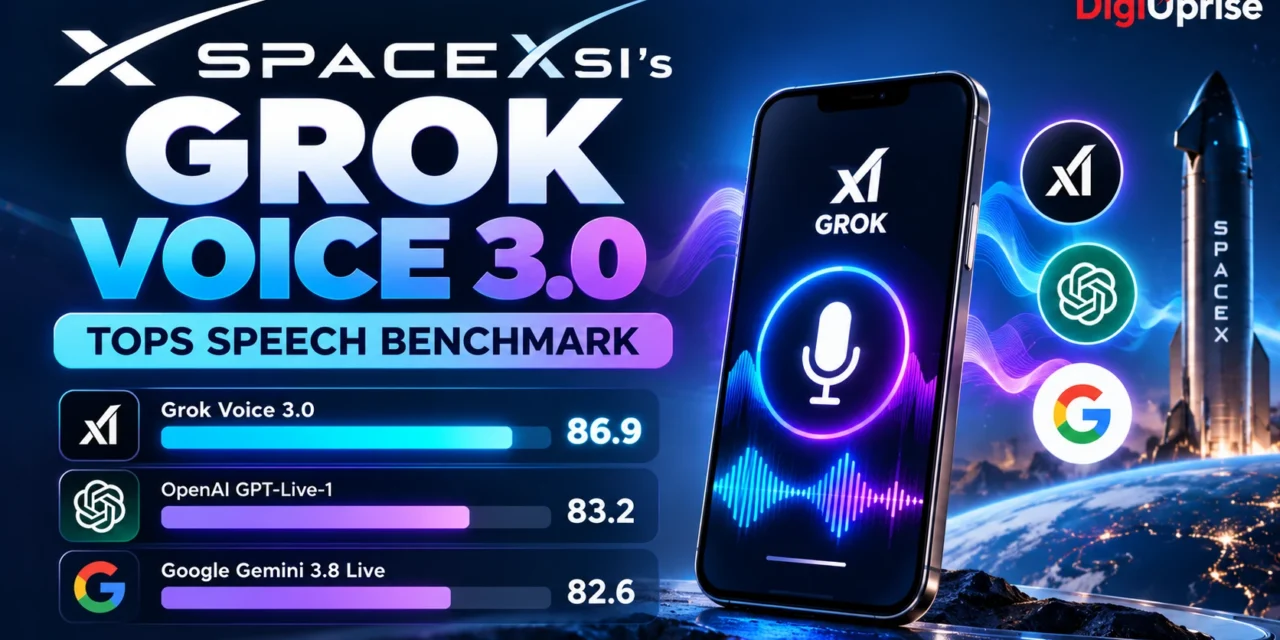
Grok Voice 3.0 scored 86.9, ranking first. The index combines speech reasoning, a call-handling test called τ-Voice, human preference, and task success from blind head-to-head calls.
|
Model |
Speech-to-Speech Index score |
|---|---|
|
Grok Voice 3.0 (SpaceXSI) |
86.9 |
|
GPT-Live-1 (OpenAI) |
83.2 |
|
Gemini 3.8 Live (Google) |
82.6 |
Natural conversation
On Full Duplex Bench, which tests how smoothly a model handles pauses, turn-taking, and interruptions, Grok Voice 3.0 scored 97%.
Enterprise accuracy
On EVA-Bench, ServiceNow’s benchmark for enterprise voice agents, it earned the highest accuracy score, 74%.
Is it cheaper to run?
Yes, according to the testing cited. In Artificial Analysis’s Big Bench Audio run, Grok Voice 3.0 cost less per completed task than both GPT-Live-1 (Astra, Medium) and GPT-Realtime-2.1. Companies that handle thousands of calls a day often care about this number as much as quality.
For developers, the company lists the Voice Agent API price at $0.08 per minute, the same as the previous version.
Where is it already used?
Tesla vehicles
The model handles millions of conversations every day in Tesla cars. Drivers can use hands-free voice for simple requests, such as checking a calendar or answering an email, and use Grok Bot for bigger tasks, such as ordering a coffee or booking dinner.
Starlink call centers
Starlink uses Grok Voice to answer about 20,000 customer calls a day in several languages. Roughly 70% are resolved without a human stepping in.
Why this matters
- Voice AI is a real battleground. OpenAI, Google, and SpaceXSI are all competing to build the best voice agents.
- Customer service is changing. Faster, smarter agents could handle more routine calls.
- Costs matter. Lower cost per task makes voice agents easier for businesses to adopt.
- It’s already live. Real-world use at Tesla and Starlink shows the model working at scale, not just in a lab.
What to keep in mind
- Company claims. The headline claims come from SpaceXSI’s announcement. The benchmark scores are from independent sources, but the company chose which results to highlight.
- Benchmarks aren’t everything. Your own accents, call quality, and use case may give different results.
- Rankings can change quickly. Rivals regularly release new versions.
- Test before you commit. Try several models on your own calls before switching.
Frequently asked questions
What is SpaceXSI? It is the new public name for the AI business formerly called xAI and then SpaceXAI. It makes Grok, Grok Bot, and Grok Voice.
Did Grok Voice 3.0 really beat OpenAI and Google? On the Artificial Analysis Speech-to-Speech Index, yes. It scored 86.9 against 83.2 for GPT-Live-1 and 82.6 for Gemini 3.8 Live. Results on other tests can differ.
Is it free? There is a way to try it, but the Voice Agent API for developers is priced at $0.08 per minute.
Where can I experience it? In Tesla vehicles through voice features, in Grok Bot’s voice mode, and in apps built on the Voice Agent API.
Conclusion
Grok Voice 3.0 gives SpaceXSI a strong start under its new name. It leads an independent speech ranking, responds quickly, costs less per task, and is already handling real calls at scale. As with any new AI release, the smartest approach is to test it yourself and compare it with the alternatives before you decide.
Note: This article is based on a news report dated October 15, 2026, the company’s announcement, and other published coverage. Please confirm current details on the company’s official website.